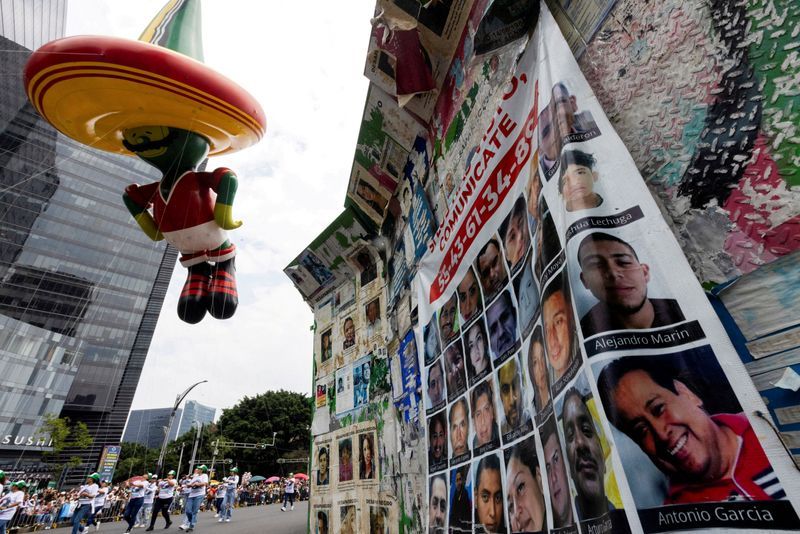
Along Mexico City's iconic Paseo de Reforma, massive screens broadcasting the World Cup co-host nation's knockout-stage encounter with England stand alongside haunting reminders of a national tragedy unfolding in the shadows of global football fever. Interspersed between celebratory tournament signage are posters bearing the faces of Mexico's more than 135,000 missing people—a staggering figure whose exponential growth traces directly to the 2006 launch of then-President Felipe Calderon's military offensive against drug trafficking organisations. The juxtaposition encapsulates the fractured experience of Mexican patriotism in 2026, where sporting triumph collides with unresolved humanitarian catastrophe in the public consciousness.
The Mexican national team's remarkable run to the Round of 16 without surrendering a goal has generated the type of collective national sentiment that typically transcends ordinary political and social divisions. Yet this tournament arrives at a moment when the country confronts multiple overlapping crises that refuse to recede even when most attention turns toward stadium seats and television screens. Carlos Mendoza, a podcaster and journalist closely observing these dynamics, articulated the psychological mechanism at work: the neurochemical satisfaction of victory permits citizens to temporarily suppress contemplation of systemic dysfunction, from allegations of Morena party collusion with criminal syndicates to deteriorating living standards. However, Mendoza cautioned that postponement is not resolution—when the tournament concludes, the accumulated weight of unaddressed problems will remain waiting.
Economic pressures underscore why many Mexicans experience this World Cup with divided hearts. Although inflation decelerated in early June, the core rate continues hovering above the Bank of Mexico's three percent target, creating genuine financial strain for ordinary households. Tournament organisers exacerbated this burden by pricing match tickets at levels accessible only to affluent spectators, effectively excluding working-class fans from attending their national team's matches. This democratisation barrier represents a profound shift from previous World Cups, when ticket scarcity alone posed the obstacle. Mendoza identified this pricing mechanism as perhaps the tournament's most egregious injustice, transforming attendance from a matter of persistence and fortune into a matter of disposable wealth.
The celebration following Mexico's first knockout-stage victory in four decades—a triumph over Ecuador—turned tragic when four people died during festivities along Reforma, tempering national joy with sudden loss and grief. Simultaneously, anti-World Cup graffiti adorns walls throughout Mexico City and surrounding the Azteca Stadium, visual testimony to protesters who questioned the tournament's appropriateness given the nation's acute suffering. Members of the CNTE teachers' union established semi-permanent protest encampments blocking central streets, demanding government fulfilment of pledges to repeal the 2007 law fundamentally restructuring public-sector pensions and social security, alongside salary restoration demands.
This convergence of celebration and resistance creates unusual psychological terrain for Mexican patriots attempting to honour their national team without appearing complicit in government failings or indifferent to humanitarian catastrophe. The challenge transcends simple compartmentalisation; it requires acknowledging that individual citizens possess sufficient complexity to simultaneously experience genuine enthusiasm for football excellence while harbouring legitimate anger at governance failures, FIFA decisions, and municipal mismanagement. Local politician Rodrigo Cordera articulated this nuance on social media, emphasising that human experience encompasses multiple, sometimes contradictory, emotional registers—one can invest intensely in ninety minutes of athletic competition while maintaining critical consciousness regarding institutional dysfunction.
President Claudia Sheinbaum's administration enters this period with relatively solid domestic support, with an El Financiero poll registering 69 percent approval ratings following a modest recovery from March's decline. The government formally designates the location and recovery of missing persons as a paramount national priority, though sceptical observers question whether World Cup euphoria provides political cover for delaying substantive progress on these and other urgent matters. The government's positioning attempts to claim credit for both sporting infrastructure and humanitarian commitment, though residents increasingly recognise these narratives as somewhat divergent in practice.
For ordinary Mexicans navigating this turbulent moment, the World Cup functions neither as escape nor distraction in the conventional sense, but rather as a temporal reorganisation of national priorities. Alejandra Gonzalez, a Mexico City resident, described the tournament as placing accumulated troubles into a lower cognitive priority tier rather than resolving them. She acknowledged the potential for sustained sporting success to catalyse positive collective sentiment, yet insisted that patriotic enthusiasm must coexist with systematic critical analysis identifying persistent governmental, industrial, and citizen-level inequities. This simultaneous embrace and interrogation reflects how sophisticated segments of Mexican society approach the simultaneous imperatives of celebrating national achievement and demanding accountability.
The economic vulnerability underlying this moment deserves particular attention from regional observers, as Mexico's experience mirrors pressures affecting populations throughout Latin America and Southeast Asia. Host nations increasingly discover that World Cup expenditures concentrate wealth among elites while pricing ordinary citizens out of the patriotic experience, inverting the tournament's democratic aspirations. Currency pressures, remittance fluctuations, and global commodity exposure similarly affect Malaysia and neighbouring economies, making Mexican struggles with inflation and inequality instructive for regional policymakers assessing the true costs of hosting mega-events.
Looking forward, Mexico's continuation in the tournament introduces variables that will test the fragile balance between celebration and criticism. Victory brings intensified euphoria that further crowds out space for institutional accountability, while early elimination would risk redirecting popular frustration toward the government through the deflated national mood. Either trajectory presents hazards for the Sheinbaum administration's political standing and for citizens seeking substantive policy responses to missing persons, economic hardship, and state capacity challenges. The World Cup ultimately functions as a pressure-release valve that temporarily masks rather than addresses Mexico's profound structural challenges, leaving citizens to contemplate whether patriotic joy and democratic vigilance can genuinely coexist or whether one perpetually sacrifices the other.

