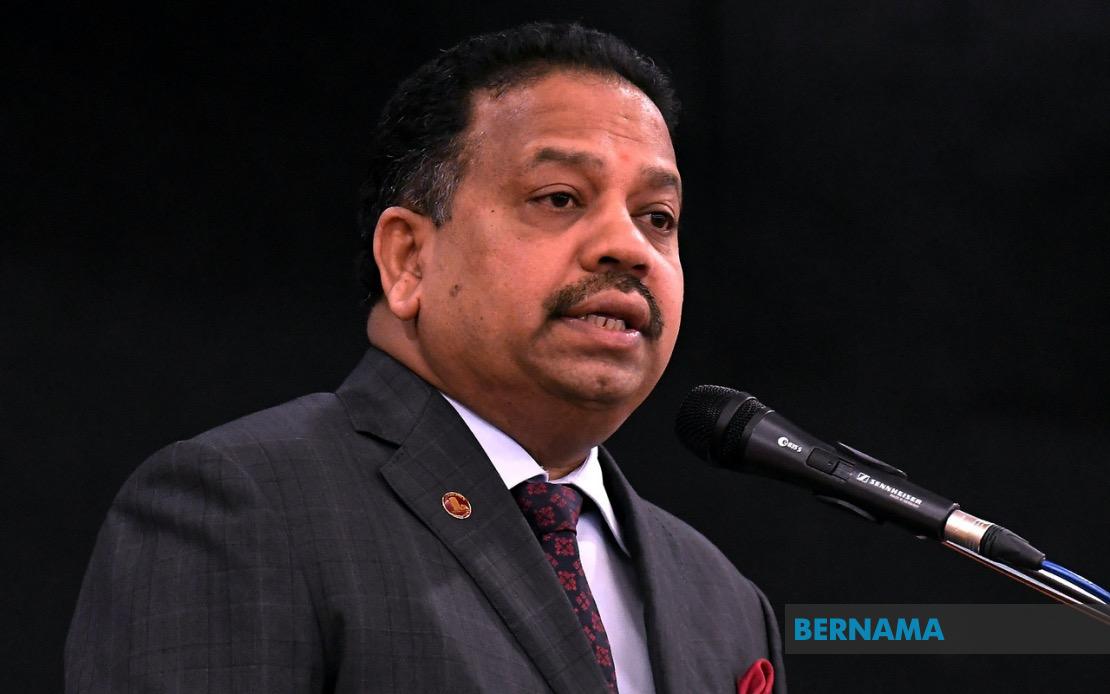
The Malaysian Indian Congress (MIC) enters the Johor state election tomorrow riding on optimism about Indian voter support for Barisan Nasional candidates, with the coalition's Hindu-majority component party banking on its established relationship with both federal and state administrations to secure community backing. At a press conference in Kulai on Wednesday, MIC president Tan Sri S.A. Vigneswaran projected confidence that the Indian electorate would continue its traditional alignment with Barisan, particularly in constituencies where MIC is fielding candidates, reasoning that voters value representation capable of working constructively with government to address pressing concerns affecting their community.
Vigneswaran anchored his optimism to what he characterised as a productive working relationship between MIC and the ruling structures at both levels of government. He emphasised that the party's primary focus throughout the campaign has centred on demonstrating tangible solutions to community problems rather than engaging in the acrimonious personal attacks that often characterise electoral contests. This measured approach, he suggested, reflects MIC's maturity as a political force and its commitment to substantive governance rather than score-settling. The strategy represents a deliberate positioning of MIC as a constructive partner within the Barisan framework, one capable of channelling community grievances into government action.
The 16th Johor state election features four MIC candidates competing across different constituencies, each representing the party's geographic footprint within the state's electoral landscape. K. Raven Kumar contests the Kemelah state assembly seat, V. Rugendran stands in Kahang, P. Pannir Selvam represents MIC's interests in Perling, and R. Kumaran is fielded in Bukit Batu. These four candidates embody MIC's attempt to maintain meaningful presence in the state legislature despite broader demographic and political shifts within the Indian community that have periodically challenged the party's traditional support base.
Indian voters in Malaysia represent a significant if not dominant bloc within particular constituencies, particularly in states like Johor where plantations, urban commercial districts, and established residential areas have historically concentrated Indian populations. Their electoral behaviour has traditionally leaned towards Barisan Nasional due to longstanding patronage networks, community organisation through party-affiliated associations, and the perception that coalition governments better deliver on resource allocation for minority communities. However, this support has not been automatic in recent election cycles, with segments of the Indian electorate gravitating towards opposition parties or abstaining entirely, citing perceived neglect of community welfare and the rise of religious nationalism within government circles.
Vigneswaran's emphasis on collaborative governance and problem-solving reflects an attempt to counter this erosion of traditional support by positioning MIC as an essential intermediary between Indian community interests and state power. The party's claim to have maintained constructive relationships with both federal and state governments—particularly relevant given that Johor remains a Barisan-controlled state—offers a tangible argument for community retention of its electoral backing. From this perspective, voting for MIC candidates becomes framed not as a nostalgic return to old political habits but as a pragmatic choice to maintain access to decision-makers and resource allocation mechanisms.
Separately, Vigneswaran addressed a controversy that had threatened to overshadow the party's campaign messaging. A Tamil-language news portal had reported that MIC received government funds totalling RM221 million, a figure that, if presented as direct party subsidies, would have appeared to validate opposition claims that MIC functions as a government-funded appendage rather than an autonomous political organisation. Such framing would have undercut Vigneswaran's claims to community independence and strengthened arguments that MIC lacks genuine political agency within the coalition.
The MIC president rebutted the allegation by clarifying that the sum in question represents annual government grants to AIMST University, a private higher education institution legally established as a foundation-owned entity rather than party property. This distinction matters because it shifts the financial relationship from direct party subsidy to support for an educational provider that MIC may have historical connections to but does not directly control. Vigneswaran specified that since Prime Minister Anwar Ibrahim took office in 2023, annual allocations to the university have reached RM25 million, including the current financial year, figures substantially below the RM221 million the portal had cited.
The grants, according to Vigneswaran, serve explicitly defined operational and maintenance purposes including dormitory upgrades, installation of renewable energy systems, and cost reduction measures designed to lower student fees and reduce the financial burden on enrollees. These utilitarian framings contrast with the more politically charged characterisation implied by the portal's reporting, which had suggested improper financial arrangements between government and party. By emphasising transparent auditing of fund usage and concrete benefits to the university's student population, Vigneswaran attempted to normalise the grant as routine government support for higher education rather than as a subsidy to MIC itself.
The distinction carries political weight in Malaysia's increasingly competitive electoral environment. Opposition parties have regularly attacked Barisan-affiliated organisations as parasitic on state resources, a charge that resonates particularly among younger voters and urban populations sceptical of traditional power structures. By establishing that government money flows to an autonomous educational institution rather than to party coffers, Vigneswaran sought to defuse the allegation and prevent its circulation as campaign ammunition in the final hours before voting. The fact that MIC's legal team has been instructed to send formal demand letters to the portal, calling for retraction and correction, signals the party's intention to pursue this matter beyond the election cycle itself.
The university at the centre of the controversy occupies a particular place within Malaysia's higher education landscape. As a non-profit institution offering undergraduate and postgraduate programmes, AIMST serves a multiethnic student body but retains historical associations with the Indian community and MIC's wider institutional ecosystem. Government grants to such institutions reflect broader policy commitments to supporting private higher education as a complement to the public university system, though the politicised nature of Malaysia's funding landscape means that any financial allocation can be read through a partisan lens.
The Johor state election unfolds against a backdrop of shifting Malaysian politics following the 2023 federal polls, which saw the formation of the Anwar Ibrahim-led coalition government and a substantial reconfiguration of electoral patterns. The Indian community's voting behaviour has attracted particular analyst attention as a potential swing constituency capable of influencing state-level outcomes in strategically important regions. MIC's confidence heading into the poll rests partly on calculations about how much of the traditionally Barisan-aligned Indian electorate remains committed to existing patterns versus how much has migrated towards opposition alternatives or disengagement.
For Malaysian observers and regional analysts, the Johor election results will offer important signals about whether traditional coalition support structures among minority communities remain robust or whether longer-term erosion of these voting blocs continues. MIC's performance in its four contested seats will particularly indicate whether the party retains sufficient grassroots mobilisation capacity to translate its claims of constructive governance into electoral returns. The party's strategic emphasis on solutions-oriented messaging and its aggressive response to the funding allegations suggest a recognition that traditional appeals to minority community interests require reinforcement through both tangible governance performance and effective counter-messaging to political attacks.

