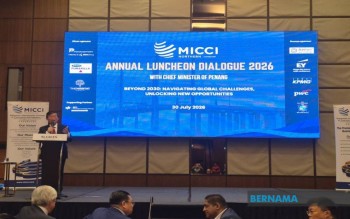
The Malaysian International Chamber of Commerce and Industry (MICCI) has sounded an urgent call for its members to prioritise substantial investment in workforce development and innovation, recognising that technological disruption presents both existential risks and significant opportunities for businesses across the region. Speaking at the MICCI Northern Branch Annual Luncheon Dialogue 2026 in George Town, Datuk Brian Tan Guan Hooi, chairman of the Northern Branch, argued that companies which fail to adapt their talent strategies and embrace innovation will struggle to maintain their competitive position in an increasingly globalised economy shaped by artificial intelligence, automation and digitalisation.
The transformation underway is not simply about replacing workers with machines, according to Tan's analysis. Rather, technological advancement is fundamentally restructuring industries and employment markets in ways that simultaneously eliminate certain traditional roles while creating new sectors and higher-value positions. This paradox means that Malaysian businesses face a critical juncture: they can either proactively reshape their workforce capabilities to capture emerging opportunities, or risk watching market share shift to more agile competitors. The challenge is particularly acute for companies that have built their competitive advantages on traditional manufacturing or service models that are now vulnerable to automation.
Central to MICCI's message is the recognition that qualifications alone are insufficient in this new operating environment. Tan emphasised that companies must cultivate a range of capabilities in their workforce that extends far beyond formal educational credentials. Technical proficiency remains essential, but equally important are qualities such as creative problem-solving, effective communication, and a demonstrated capacity for continuous learning and adaptation. This multi-dimensional approach to talent development reflects a broader understanding that the jobs of tomorrow will require workers who can navigate ambiguity, collaborate across disciplines, and rapidly acquire new competencies as industries evolve.
A crucial aspect of Tan's argument concerns the alignment between education and training systems and actual industry needs. Malaysia's vocational and tertiary education institutions have historically operated with some distance from the private sector, resulting in periodic mismatches between graduate skills and employer requirements. Tan called for closer integration between these systems, arguing that educational providers must maintain real-time awareness of technological developments and workforce trends within their partner industries. This alignment is particularly critical for young Malaysians entering the labour market, who will increasingly encounter roles that did not exist when their education began.
The dialogue took place against the backdrop of broader regional economic challenges and the rapid pace of technological change across Southeast Asia. Penang Chief Minister Chow Kon Yeow attended as guest of honour, reflecting the state government's interest in these issues. The province has positioned itself as a technology and manufacturing hub, making workforce development and innovation critical to maintaining its competitive advantage within Malaysia and the region. The presence of senior political leadership underscored that business competitiveness is not merely a corporate concern but a matter of state strategic interest.
Tan also articulated a broader vision for business sustainability that emphasises long-term capability building over short-term financial optimisation. This perspective challenges the quarterly earnings focus that dominates much contemporary corporate strategy, particularly among publicly listed companies. By advocating for sustained investment in people and innovation even when such expenditure pressures near-term profitability, MICCI is essentially arguing for a more developmental approach to corporate strategy—one that prioritises resilience and adaptability over maximum current returns.
Particularly significant was MICCI's emphasis on public-private sector collaboration as essential infrastructure for business success. Tan argued that neither government nor the private sector can independently create the conditions necessary for sustained competitive advantage. Government must establish the policy environment, invest in public infrastructure, and support education systems, while businesses contribute capital, expertise, employment, and innovation. This ecosystem perspective is relevant across Southeast Asia, where many nations are struggling to balance the need for regulatory oversight with the imperative to attract and retain productive investment.
Tan specifically called for deeper engagement between industry and government to ensure that policies, infrastructure investments, and support systems remain responsive to evolving business needs. This reflects frustrations that often exist within the Malaysian business community regarding the pace and appropriateness of policy changes in response to technological disruption. Regular structured dialogue can help identify emerging challenges before they become crises and allow government to anticipate infrastructure requirements. For Malaysian policymakers, this represents a call to establish more robust mechanisms for incorporating business perspectives into strategic planning.
The chamber itself, which traces its origins to 1837 and is marking its 189th anniversary this year, positioned itself as a critical bridge between these sectors. MICCI's longevity suggests institutional memory and established relationships that enable it to facilitate productive dialogue. The organisation's role as an intermediary—sharing industry insights with government and helping translate policy into practical business strategies—becomes increasingly valuable during periods of rapid change when misalignment between sectors can impose significant economic costs.
For Malaysian businesses specifically, MICCI's message carries practical implications. Companies operating in traditional sectors must begin now to identify how their competitive advantages might be threatened by automation and digitalisation, and to develop strategies for repositioning their workforce and business models. This is not optional competitive positioning but essential survival planning. Small and medium enterprises, which form the backbone of Malaysia's economy, face particular challenges in allocating resources to innovation and talent development while managing current operational demands.
The call also resonates with Malaysia's broader development aspirations. The country aims to transition toward higher-value economic activities and reduce dependence on low-skill, labour-intensive manufacturing. This transition cannot succeed without a workforce equipped with the capabilities that MICCI has outlined. Education policy, therefore, becomes intimately connected to economic transformation and competitiveness.
Looking forward, the success of MICCI's advocacy will depend partly on whether its members actually increase talent and innovation investment, and partly on whether government responds with supportive policies and infrastructure development. The dialogue between these sectors, and the willingness of each to adapt and invest, will largely determine whether Malaysia and the region can successfully navigate technological transformation while creating broadly shared prosperity.

