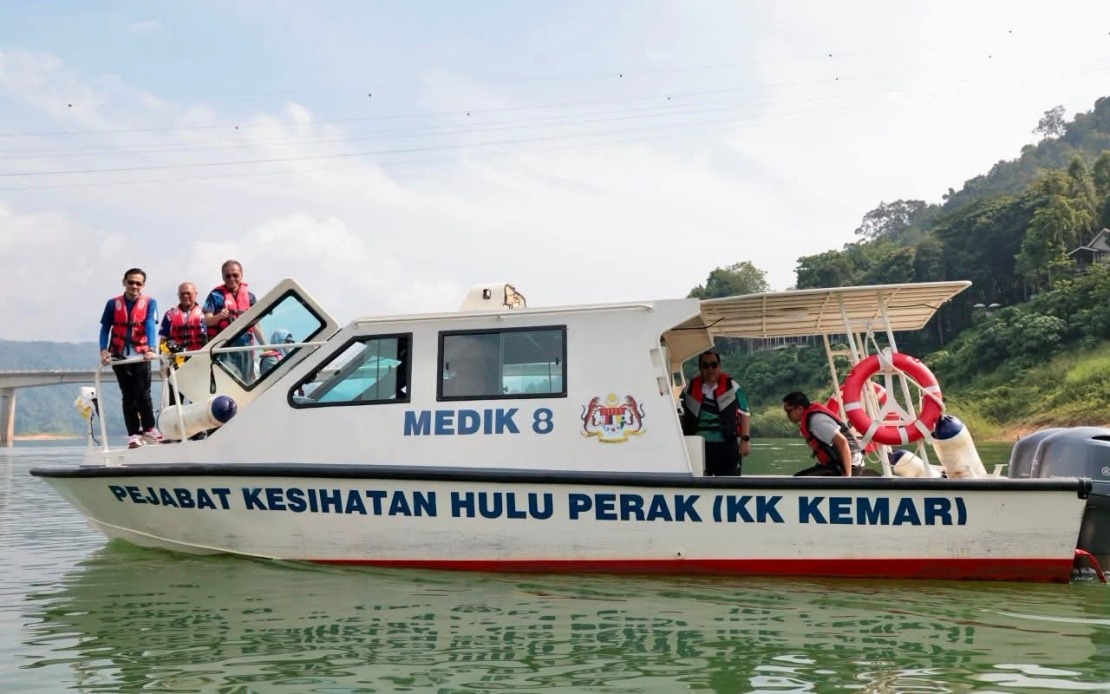
The Ministry of Health has taken significant steps to expand medical services in Malaysia's most remote indigenous communities by deploying a new dedicated medical vessel to Hulu Perak. The RM350,000 Medic Boat 8, a 12-passenger multipurpose vessel, now joins the ministry's existing fleet of six watercraft to serve the Kemar Resettlement Scheme near Gerik, where accessibility has traditionally hinged entirely on waterway transportation.
Health Minister Datuk Seri Dr Dzulkefly Ahmad formally launched the service at Belum Rainforest Resort jetty during an official visit to the district, highlighting the strategic importance of this infrastructure investment for the region's most vulnerable population. The initiative directly addresses a critical gap in healthcare delivery, as the Kemar Resettlement Scheme is home to more than 4,500 Orang Asli residents whose geographic isolation has historically prolonged emergency response times and complicated routine medical access. The minister emphasised that without dedicated waterborne ambulance services, medical emergencies in these communities face severe logistical constraints that can prove life-threatening.
The deployment of additional medical boats reflects a broader commitment within Malaysia's government framework to ensure equitable healthcare distribution across all regions, regardless of terrain or development status. Dr Dzulkefly Ahmad articulated this philosophy through reference to Malaysia MADANI, the government's overarching governance agenda, which positions healthcare accessibility as a non-negotiable right rather than a privilege determined by geography. His statement that challenging terrain and remote location should never become barriers to quality medical care represents an explicit policy commitment to address the long-standing healthcare disparities that have characterised indigenous settlements throughout peninsular Malaysia.
The practical implications of this development extend beyond simple transportation. Medical boats serve as mobile clinics capable of delivering emergency interventions, conducting health screenings, and transporting critically ill patients to regional hospitals in Kuala Lumpur or Ipoh. The addition of a 12-passenger capacity vessel significantly increases the ministry's ability to conduct multi-purpose health campaigns, including vaccination drives, maternal health monitoring, and chronic disease management programmes that rural Orang Asli communities have traditionally accessed inconsistently.
For the Hulu Perak region specifically, this investment addresses documented gaps in emergency response capability. River travel in Perak's interior can take hours depending on water levels and weather conditions, meaning that conditions requiring immediate intervention—such as severe injuries, acute respiratory distress, or obstetric emergencies—previously faced substantial delays. The dedicated medical boat model reduces this lag by positioning healthcare personnel and equipment strategically along primary waterway routes, enabling faster initial assessment and stabilisation before patients reach tertiary facilities.
The ministry's recognition of personnel resilience forms an equally important dimension of this initiative. Healthcare workers, including doctors, nurses, and specialised boat operators, have consistently volunteered to operate in conditions characterised by unpredictable river currents, seasonal flooding, and extreme weather exposure. The minister specifically acknowledged this commitment, noting that sophisticated government assets only achieve meaningful impact when staffed by personnel willing to work under challenging field conditions. This staffing reality underscores the human dimension of healthcare access—equipment alone cannot substitute for the dedication of medical professionals accepting posting to remote locations.
The boat services model also carries broader significance for Southeast Asian healthcare policy. Malaysia's approach demonstrates that waterway-dependent communities require waterway-dependent solutions rather than attempts to impose land-based healthcare models. This principle has applicability across the region, where numerous indigenous and minority populations inhabit river valleys and coastal zones where conventional road networks prove impractical or environmentally damaging. Thailand's remote northern communities, Indonesia's archipelago populations, and the Philippines' island-based indigenous groups face similar access challenges that could potentially benefit from comparable investment models.
Financially, the RM350,000 investment per vessel represents a significant commitment, yet must be evaluated against the costs of untreated illness, preventable mortality, and the social burden of health-related emergencies in isolated populations. For comparison, emergency medical evacuations from remote locations can require helicopter deployment costing RM5,000 to RM10,000 per operation. A dedicated boat service spreading costs across routine operations, health campaigns, and emergency response delivers superior cost-effectiveness over time while building sustainable local healthcare capacity.
The expansion from six to seven operational medical boats signals that the Ministry of Health intends to systematise access improvements rather than treat them as ad-hoc responses to periodic crises. Future policy decisions regarding additional boat deployments to Sabah, Sarawak, or other peninsular locations with significant indigenous populations could establish a networked approach to waterborne healthcare delivery across Malaysia. This systematic approach contrasts with previous sporadic interventions and suggests institutionalised commitment to addressing geographic healthcare equity.
For Orang Asli communities themselves, the Medic Boat 8 represents tangible government recognition of their health needs and the legitimacy of their geographic reality. Rather than expecting indigenous residents to relocate or travel excessive distances to access healthcare, the ministry brings services to communities. This approach respects cultural attachment to traditional territories while delivering on government's constitutional obligation to provide health services to all citizens regardless of residence.
Looking forward, the sustainability of these services depends on securing consistent operational funding, maintaining vessel infrastructure, and sustaining recruitment of healthcare professionals willing to serve remote postings. The ministry's continued investment signals confidence in these dimensions, though ongoing monitoring of service quality, response times, and health outcomes among Hulu Perak's Orang Asli population will be essential to validate whether the expansion achieves its intended impact of reducing emergency response times and improving overall health status in these communities.

