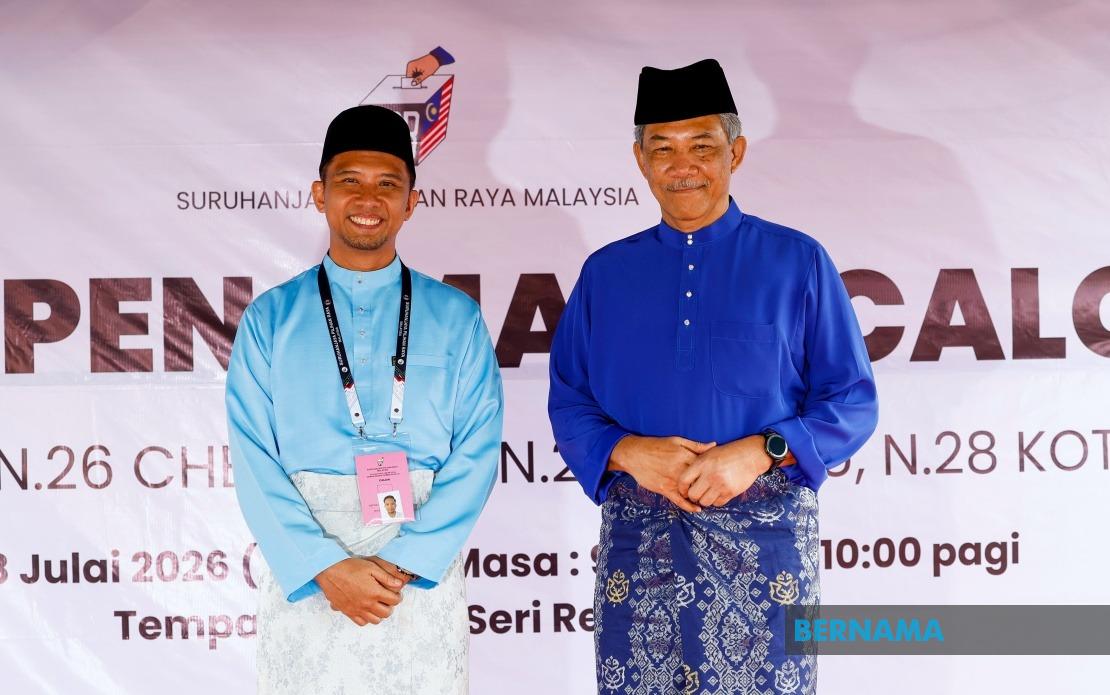
The Rantau state constituency in Negeri Sembilan will be the setting for a significant political showdown in the state's 16th election, pitting Barisan Nasional heavyweight Datuk Seri Mohamad Hasan directly against Pakatan Harapan's candidate Dr Azizul Hakim Mahdi. The nomination process concluded at Dewan Sri Rembau in Rembau today, with returning officer Mohd Zamri Mohd Esa confirming that only these two contenders met the requirements to contest, establishing what both camps will view as a pivotal encounter for control of this traditionally significant constituency.
Monamad, who doubles as UMNO's deputy president and Negeri Sembilan's Barisan Nasional chairman, brings two decades of incumbency to the race, having retained the Rantau seat continuously since 2004. His political longevity in the area underscores the entrenched support he enjoys among the local electorate, a foundation that has repeatedly proved resilient against opposition challenges. In the previous 2023 state election, he overwhelmed his PH opponent Rozmal Malakan by a commanding margin of 10,280 votes, securing 16,957 votes compared to Malakan's 6,677, demonstrating the substantial electoral advantage he carries into this contest.
Yet the composition of his challenger this time signals a strategic pivot by Pakatan Harapan. Dr Azizul Hakim, at 35 years old, represents a generational and professional departure from previous opposition nominees. His credentials in the medical field—a decade of clinical practice combined with ownership of three private clinics operating across Senawang, Puncak Alam, and Melaka—position him as a candidate rooted in the locality's welfare concerns. This approach appears designed to appeal to voters by emphasizing healthcare accessibility and community-oriented governance, positioning him as a professional servant rather than a career politician seeking advancement.
Monamad's immediate campaign strategy, articulated during his remarks to journalists following the nomination closure, centres on systematic grassroots mobilization and clarity regarding Barisan Nasional's electoral programme. He emphasized that the coalition's machinery must function with coordination and discipline throughout the campaign phase, suggesting confidence in the organizational superiority that incumbent status and established party structures typically confer. His comments reflect the conventional playbook of an advantaged incumbent: focus on party message discipline while leveraging superior resources and organizational depth.
Beyond Rantau, the broader electoral landscape across Negeri Sembilan reveals fragmentation that could complicate any single bloc's path to majority control. The Paroi constituency will witness a three-way contest involving PH's Ahmad Shahir Mohd Shah, a senior aide to the state's chief minister, against Perikatan Nasional's Kamarol Ridzuan Mohd Zin and Bersatu's Mohd Nazree Mohd Yunus. This splintering of the opposition vote—with both Perikatan and Bersatu fielding candidates—potentially benefits any incumbent or dominant local player who can consolidate their core support.
Chembong presents a starker contest, featuring incumbent Barisan Nasional's Datuk Zaifulbahri Idris confronting Pakatan Harapan's Danish Nazran Murad in what amounts to a direct duel. Conversely, the Kota seat again illustrates the three-cornered dynamics, with Barisan Nasional's Suhaimi Aini defending against both PH's Muhammad Allif Ibrahim and Bersatu's Akmal Noradzmi Abdul Rahim. These varied contest structures across the 36-seat assembly mean that seat-by-seat arithmetic will heavily depend on vote consolidation, local sentiment, and the relative organizational capabilities of the three competing blocs at ground level.
The electoral foundation is substantial: Negeri Sembilan's Election Commission has registered 889,490 eligible voters, comprising 867,151 ordinary voters, 16,884 military personnel and spouses, and 5,455 police officers who will participate in early voting. The sheer voter population means that turnout patterns and demographic shifts in urban versus rural areas could prove decisive. Early voting is scheduled for July 28, with the main polling day set for August 1, following the dissolution of the state legislative assembly on June 5.
For Malaysian political observers, the Negeri Sembilan contest carries significance as a bellwether for current dynamics within Barisan Nasional, Pakatan Harapan, and the fragmented reformist vote split between multiple parties. The state, which has historically been a coalition stronghold, now faces competition from a Perikatan Nasional increasingly active at the state level, complementing Bersatu's continuing defection of support from Barisan Nasional. How these blocs fare here—and whether Bersatu's scattered candidacies primarily damage Barisan Nasional's expected hold or weaken opposition consolidation—will offer insights into the broader trajectory of Malaysian electoral politics.
Moreover, Mohamad Hasan's performance in Rantau carries personal and factional implications beyond the state. As Foreign Minister and UMNO's second-ranking official, his electoral dominance signals confidence in Barisan Nasional's leadership credentials and his own political standing within the party. Conversely, any significant weakening of his majority, or an upset loss, would reverberate through national political circles and potentially embolden rival factions within UMNO and the coalition.
The campaign period now officially underway will test whether Dr Azizul Hakim's professional credentials and youth can resonate against Mohamad Hasan's accumulated institutional advantage and political machinery. It will simultaneously reveal whether voters in Negeri Sembilan remain anchored to established political alignments or whether emerging frustrations with governance, healthcare access, or other community concerns might shift electoral preferences. The contest represents not merely a seat struggle but a window into the evolving preferences of Malaysian voters confronted with increasingly fragmented political choices.

