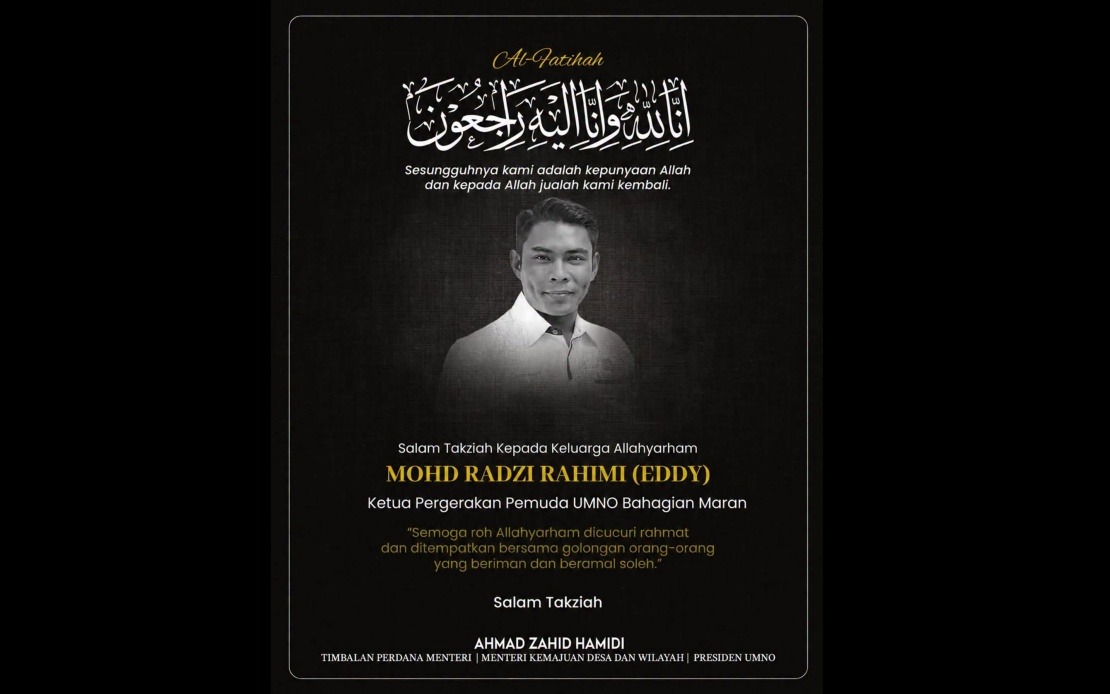
UMNO president Datuk Seri Dr Ahmad Zahid Hamidi has expressed profound sorrow following a tragic accident in Bentong that claimed the lives of Maran UMNO Youth chief Mohd Radzi Rahimi, his wife, and his brother-in-law, marking a significant blow to the party's organisational fabric and leadership pipeline.
The 40-year-old youth leader and his family were killed when a falling tree crushed their vehicle, an incident that also claimed the life of a five-year-old boy travelling with them. The accident underscores the unpredictable dangers on Malaysian roads and the sudden manner in which tragedies can reshape community structures and political organisations.
In a heartfelt statement posted on social media, Ahmad Zahid conveyed his sympathies to Mohd Radzi's entire family, acknowledging the profound grief that accompanies such a sudden loss. The UMNO president characterised the tragedy as extending beyond personal bereavement to represent a substantial loss within the broader UMNO family, particularly affecting the party's youth wing operations in Pahang and the specific organisational structure of Maran UMNO.
Youth wings of political parties in Malaysia serve critical functions in party mobilisation, grassroots engagement, and the cultivation of emerging political talent. The loss of a sitting UMNO Youth chief thus represents not merely a personal tragedy but potentially a gap in the party's capacity to organise and energise younger voters during crucial political periods.
Mohd Radzi's role positioned him at an important intersection within UMNO's hierarchical structure. As a youth leader in Maran, a constituency with historical significance to UMNO, his responsibilities would have encompassed membership recruitment, event organisation, political education, and serving as a conduit between younger party members and senior leadership. Such positions require individuals who combine enthusiasm with organisational skills and understanding of local political dynamics.
The broader context of this tragedy reflects ongoing challenges for Malaysian political parties in balancing rapid modernisation with maintaining strong grassroots networks. Youth leaders like Mohd Radzi bridge generational gaps within party structures, helping to adapt traditional party messaging to appeal to younger voters who engage with politics through different channels and with different expectations than their predecessors.
Pahang UMNO, as the state-level party organisation, will likely need to consider succession planning and the redistribution of responsibilities that Mohd Radzi held. Such transitions during periods of grief can prove administratively complex, as party structures must function effectively while members process loss and maintain morale. The political calendar may not accommodate extended periods of organisational adjustment, making swift but thoughtful succession processes essential.
The accident also affected a five-year-old child who did not survive the incident, while another young boy, believed to be the child's twin, sustained injuries and received treatment at Bentong Hospital. The involvement of young children in the tragedy amplifies its emotional dimensions and serves as a sobering reminder of road safety concerns that persistently affect Malaysian families across all socioeconomic and professional strata.
Ahmad Zahid's public expression of condolence serves multiple functions within UMNO's organisational culture. It communicates party solidarity during crisis, demonstrates that senior leadership acknowledges and values the contributions of party workers at all levels, and provides public reassurance that the party continues to function as a cohesive unit despite unexpected losses. Such statements also set the emotional tone for how party members should respond to collective grief.
The circumstances of the accident, involving a falling tree in what appears to have been weather-related or environmental conditions, raise questions about road maintenance, tree management along Malaysian highways, and broader public safety infrastructure that falls outside political party control but affects all citizens. These infrastructural questions often gain renewed attention following such tragedies, though momentum for substantive change can dissipate if not sustained through dedicated follow-up efforts.
For the families directly affected, the coming weeks will involve navigating grief while likely managing attention from media and party structures simultaneously. The intersection of personal tragedy with public significance creates particular pressures for grieving families of political figures, as their private loss becomes part of party narrative and organisational reflection.
Mohd Radzi's passing, while tragic on the personal level, also prompts consideration of succession planning and leadership resilience within political parties more broadly. Organisations that depend heavily on specific individuals may face unexpected vulnerabilities when those figures are suddenly removed through circumstances beyond anyone's control. Building organisational depth and redundancy remains an ongoing challenge for political structures seeking to ensure continuity during periods of loss.

