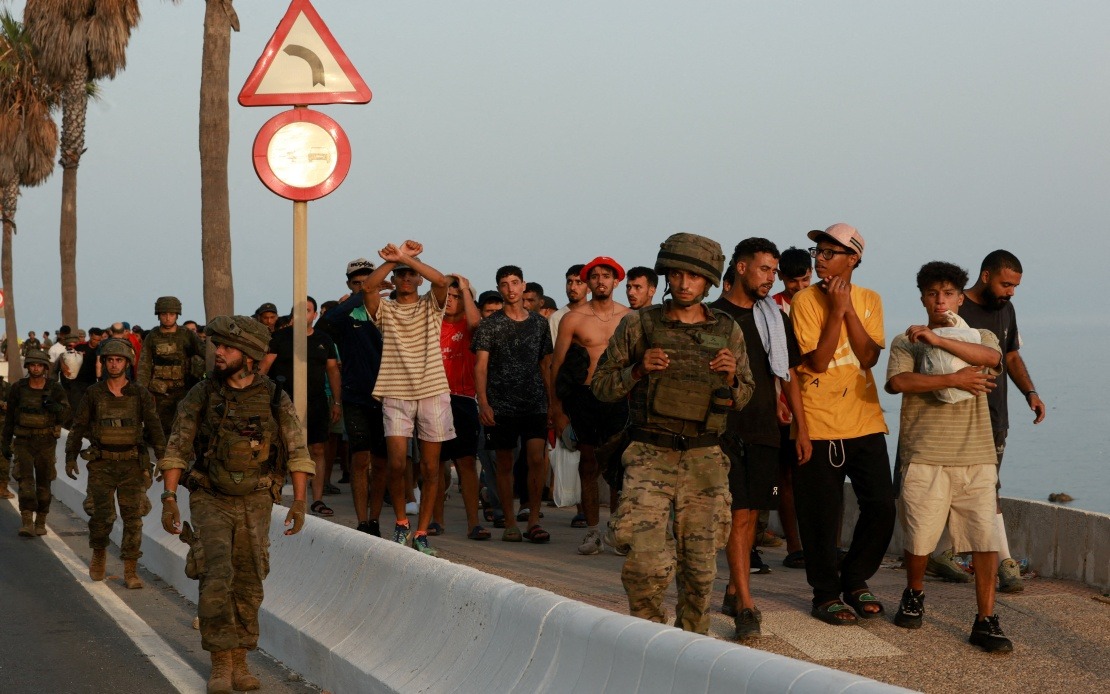
Morocco's government has pointed to deliberate misinformation circulating on social media platforms and organised human trafficking networks as the primary drivers behind a dramatic influx of migrants who breached the border into Ceuta, the Spanish enclave on North Africa's coast. The Interior Ministry characterised the crisis as a confluence of digital deception and criminal smuggling operations that capitalised on legal confusion to persuade thousands to attempt a perilous crossing they otherwise might not have considered.
The scale of the movement was extraordinary by any standard. Within a compressed timeframe of merely a few days, tens of thousands of people surged towards Ceuta's borders in what officials described as an orchestrated wave. Spanish authorities estimated the total at between 50,000 and 60,000 migrants, though Moroccan figures placed the number closer to 40,000 arrivals in Ceuta itself, with an additional 1,135 individuals attempting to breach Melilla, another Spanish possession on the Moroccan coast. The speed and volume of the crossing strained both nations' border management capacity and raised immediate humanitarian concerns.
A critical factor amplifying the crisis was widespread misinterpretation of a Spanish court decision, which human traffickers and opportunistic online commentators weaponised to convince migrants they could enter Europe without facing automatic deportation. This legal distortion spread rapidly across social media ecosystems where fact-checking is minimal and sensational claims circulate unchecked. Traffickers leveraged this confusion to maximise their client base, knowing that false hope—however temporary—would motivate desperate people to pay for passage and attempt the crossing. The combination of bogus legal claims and trafficking networks created a powerful, mutually reinforcing narrative that overwhelmed border defences.
The human cost proved devastating. Morocco acknowledged 11 deaths among those attempting the crossing, though Spanish authorities documented a significantly higher toll of at least 72 fatalities. This discrepancy in reported numbers underscores the chaos and difficulty in accounting for all individuals during such a rapid mass movement. The Moroccan Interior Ministry committed to ongoing coordination with Spanish counterparts to verify additional death reports, establish identities, and determine nationalities of the deceased—a logistical and bureaucratic challenge compounded by the circumstances of their deaths and the transnational nature of the migrant population.
Ceuta itself, home to only 85,000 residents, faced an unprecedented pressure test as it suddenly absorbed populations equivalent to half its existing population within days. The enclave's infrastructure, shelters, healthcare facilities, and administrative systems were designed for nothing approaching this volume. Spanish authorities scrambled to process, shelter, and potentially deport the arrivals, while humanitarian organisations raised alarms about conditions in overcrowded facilities. For a territory of Ceuta's size, this represented not merely a border incident but a fundamental disruption to daily life and governance.
The Moroccan government's attribution of responsibility to misinformation and trafficking represents a particular framing worth examining. By emphasising external factors—false social media narratives and criminal smugglers—rather than internal conditions driving migration, Morocco positioned itself as a victim of information warfare and organised crime rather than as a nation whose citizens and sub-Saharan migrants transiting through were fleeing desperate circumstances. This narrative reflects broader geopolitical dynamics between Morocco and Spain, countries whose relationship encompasses cooperation on security matters, territorial disputes, and migration management challenges.
The incident illuminates the vulnerability of migration systems to manipulation through digital channels. Traffickers operate with sophisticated understanding of how to exploit social media algorithms and human psychology. A false claim, once amplified through networks of shares and reposts, can acquire sufficient credibility to motivate thousands of high-risk decisions. The speed of digital propagation vastly outpaces official corrections, meaning authorities struggle to counter misinformation once it gains traction. This asymmetry creates opportunities for those profiting from human movement.
For Malaysia and other Southeast Asian nations managing their own migration pressures, the Ceuta episode offers cautionary lessons. Digital misinformation about border policies, visa regulations, and employment opportunities already circulates widely through Malaysian social media, messaging apps, and online forums frequented by migrant communities. Traffickers operating across the region similarly exploit confusion about legal pathways and destination countries' regulations. The Ceuta case demonstrates how concentrated misinformation campaigns, whether deliberate or organic, can overwhelm border infrastructure and endanger thousands of lives.
The coordination challenges revealed in this crisis—establishing death tolls, identifying victims, determining nationalities—directly parallel issues Malaysia faces in managing irregular migration from Myanmar, Bangladesh, and other source countries. Both contexts involve transnational populations without clear documentation, rapid movements across borders, and coordination difficulties between nations with differing priorities and capacities. Morocco and Spain's experience suggests that investment in real-time information systems, crisis communication protocols, and bilateral agreements becomes essential when facing sudden mass movements.
Looking forward, the Ceuta situation underscores the critical importance of both nations addressing the root conditions driving migration while simultaneously building resilience against misinformation and trafficking networks. For Moroccan officials, this means tackling economic inequality and limited opportunity that makes migration appear attractive despite its dangers. For Spain, it requires managing public perceptions and legal clarity around migration policies. Both must combat the criminal networks profiting from desperation while recognising that no border enforcement, however robust, can function effectively when combined with systematic deception and economic desperation.

