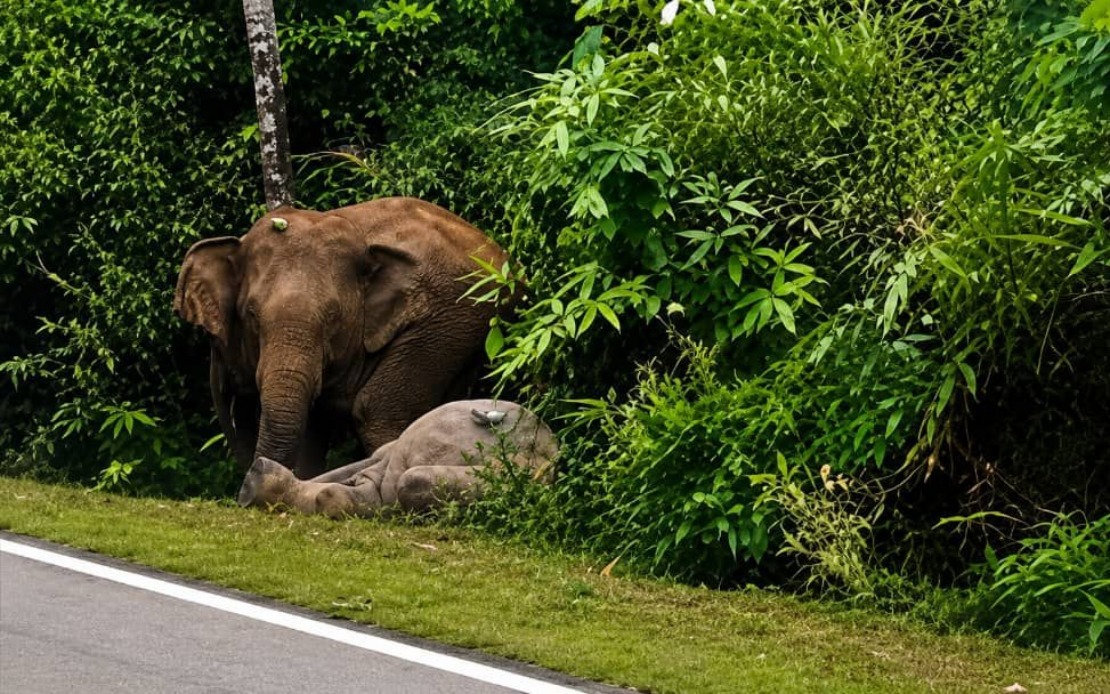
A heartbreaking scene unfolded along Jalan Felda Nitar in Mersing, Johor, when a young female elephant was fatally struck by a vehicle early this morning, prompting her mother to remain at the site in what wildlife officials describe as a display of maternal distress. The incident occurred at approximately 2.28 am when a Perodua Bezza collided with the five-year-old calf, triggering a cascade of events that would captivate public attention through the day and reignite concerns about escalating human-elephant encounters in the state.
The tragic sequence unfolded with the mother elephant standing vigil over her dead offspring for seven consecutive hours, an emotionally charged response that was captured on video and rapidly circulated across social media platforms. The footage resonated deeply with Malaysian observers, as the raw grief displayed by the adult elephant underscored the profound bonds within elephant family structures and the devastating consequences of road incidents in wildlife corridors.
Wildlife authorities in Johor received notification of the incident at approximately 8.30 am, several hours after the collision had occurred. The Department of Wildlife and National Parks, known locally as Perhilitan, mobilised four personnel to the scene to undertake preliminary assessments and manage the developing situation. Upon arrival, officers confirmed that the deceased animal was a female elephant calf measuring approximately 150 centimetres in body length, identifiable by specific physical characteristics including its lack of tusks and distinctive footprint dimensions—11 inches across the front foot and 14 centimetres at the rear.
The elephant herd involved in the incident belongs to the Jamaluang-Mersing ID group, a population that has been documented and monitored by conservation authorities as part of broader efforts to understand and mitigate human-elephant conflict in the region. The identification of the herd represents an important data point for wildlife managers attempting to track movement patterns and develop strategies to protect both elephant populations and human communities in areas where their habitats overlap.
The incident also claimed a human victim. The 31-year-old male driver sustained significant leg injuries when his vehicle, after impact with the elephant calf, careened off the roadway and plunged into a five-metre-deep ravine. Fire and Rescue Department personnel extracted the trapped occupant and provided emergency medical response, highlighting how these collisions pose genuine danger to human occupants as well.
Perhilitan's Elephant Capture Unit, operating from the Johor Elephant Sanctuary, arrived at the scene to assist in encouraging the grieving mother elephant back toward the forest. The operation required considerable patience and expertise, as forcibly separating a mother from her deceased offspring risked provoking defensive behaviour. Once the mother had been guided away, wildlife officials proceeded to bury the calf's remains in proximity to the accident site, a practical measure that also removed a potential attractant for scavengers and reduced the likelihood of additional disturbance.
Following the immediate intervention, Perhilitan committed to conducting intensive patrols throughout the subsequent night and following day to monitor the mother elephant's wellbeing and discourage her from returning to the collision location. Such follow-up surveillance reflects growing recognition that traumatised animals may repeatedly attempt to return to sites of loss, thereby exposing themselves to continued danger from vehicle traffic.
The authorities emphasised that warning signage indicating elephant crossing zones had been previously installed in the area, yet this failed to prevent the collision. This gap between infrastructure and outcomes points to broader challenges in road safety management: signage alone may prove insufficient without corresponding reductions in vehicle speed, enhanced visibility measures during dark hours, or fundamental alterations to traffic patterns through known elephant corridors.
The Mersing incident inevitably invokes comparison with the Gerik tragedy that unfolded on Mother's Day of the previous year in Perak. In that earlier incident, a young elephant became trapped beneath a container lorry following a collision, while observers witnessed the mother elephant apparently attempting to push the vehicle away, presumably seeking to free her trapped offspring. That emotionally charged scene generated unprecedented viral attention and catalysed national discourse about the inadequacy of current protections against human-elephant conflict.
These recurring tragedies underscore a persistent vulnerability in Malaysia's approach to wildlife protection along major transportation corridors. Elephant populations in Peninsular Malaysia remain endangered, with fewer than 2,000 individuals estimated to survive in fragmented habitats. Each loss of a young animal diminishes reproductive capacity and represents a measurable setback for population recovery efforts. Beyond population dynamics, these incidents symbolise the human cost of environmental fragmentation—the creation of conflict zones where animal behaviour and human infrastructure collide with lethal consequences.
The role of darkness in facilitating this collision merits particular attention. The early morning hour combined with reportedly poor lighting conditions along the route created circumstances where vehicle operators possessed insufficient visibility to detect and avoid the animals. Addressing this dimension would require examining current lighting standards in elephant corridor areas and determining whether enhanced illumination or speed restrictions during high-risk hours could reduce incident frequency.
For Malaysian conservationists and policymakers, these incidents represent mounting evidence that incremental responses no longer suffice. The installation of warning signs, while necessary, has proven inadequate. Comprehensive solutions might encompass wildlife overpasses or underpasses in high-conflict zones, stricter speed enforcement in identified elephant corridors, driver education campaigns emphasising caution in such areas, and potentially more extensive habitat connectivity that reduces the necessity for elephants to traverse major roads during feeding or movement cycles.
The broader Southeast Asian context adds urgency to these concerns. As development accelerates across the region, elephant populations throughout the sub-continent face similar pressures from road infrastructure fragmenting their ranges. Malaysia's response to this challenge will likely influence conservation approaches adopted by neighbouring countries confronting identical problems. The grieving mother elephant in Mersing, refusing to abandon her dead calf, serves as a sobering reminder that wildlife protection remains an incomplete and fragile endeavour.

