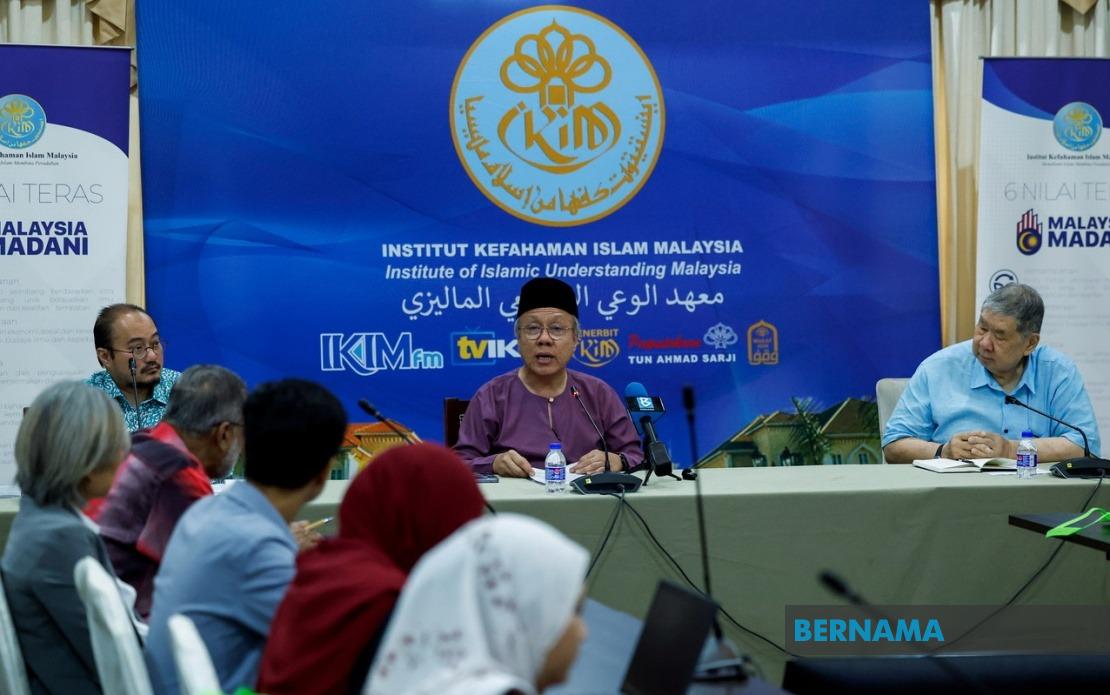
Three prominent Malaysian institutions convened in Kuala Lumpur on Wednesday to address media understanding of the Tabung Haji Royal Commission of Inquiry, signalling a coordinated effort to reshape public discourse around one of the country's most sensitive financial and religious institutions. The Malaysian Press Institute, working alongside the Institute of Islamic Understanding Malaysia and Lembaga Tabung Haji itself, organised the closed-door session at IKIM's headquarters to equip roughly two dozen journalists with authoritative briefings on the investigation and its implications.
Tabung Haji Group Managing Director and Chief Executive Officer Mustakim Mohamad took centre stage during the nearly two-hour session, delivering a comprehensive presentation before fielding direct questions from assembled media representatives. His participation underscored the institution's commitment to transparency and its determination to guide media coverage towards substantive issues of governance rather than allowing speculation to dominate headlines. The forum represented a rare opportunity for journalists to hear firsthand from leadership about the measures being implemented to address concerns and restore the confidence of the millions of Malaysians who contribute to the fund annually.
MPI President Datuk Yong Soo Heong framed the exercise as essential bridge-building between institutional accountability and public understanding. He articulated the media's role as conduit for accurate information, emphasising that journalists equipped with comprehensive details could better translate complex financial and institutional matters into accessible reporting. Yong noted that the collaboration between MPI and IKIM reflected a shared commitment to ensuring depositors and the broader Malaysian public received consistent, factual narratives about Tabung Haji's trajectory and operational resilience in the face of investigative scrutiny.
The institutional partnership itself carries symbolic weight in Malaysia's governance landscape. By bringing together a media organisation, an Islamic understanding body, and Tabung Haji's leadership, the three entities signalled that the RCI matter transcended narrow sectoral interest. IKIM's involvement particularly underscores an interpretation of the investigation as fundamentally about institutional stewardship of one of Islam's Five Pillars, rather than a crisis that should fracture along religious or ethnic lines. This framing responds to a broader concern in Malaysian discourse about how contentious issues can become prisms for communal polarisation if left to fragmentary reporting or social media speculation.
Associate Professor Datuk Dr Mohamed Azam Mohamed Adil, IKIM's Director-General, delivered perhaps the session's most pivotal message: that the Tabung Haji RCI represents an accountability and governance issue, not a religious or racial controversy. By explicitly rejecting interpretations that might weaponise the investigation along communal lines, Mohamed Azam positioned Tabung Haji's crisis as one rooted in institutional integrity and management transparency. This distinction carries practical implications for how Malaysian journalists should frame stories—emphasising questions of financial stewardship, investment decisions, and regulatory compliance rather than identity politics or sectarian anxieties.
The framing of Tabung Haji as a trust issue rather than a crisis of faith reflects a nuanced understanding of how institutional credibility functions in Malaysia. Millions of Malaysian pilgrims entrust their hajj savings to the fund, making it a unique hybrid of religious obligation and financial service. When governance failures occur, they threaten not merely depositors' financial interests but also their spiritual journey and the integrity of one of Islam's fundamental practices. Mohamed Azam's insistence that journalists communicate this perspective of restoration rather than collapse becomes a strategic attempt to preserve public confidence while accountability processes unfold.
Yong suggested that similar programmes could be organised across Malaysia's states through dialogue sessions and town halls, indicating this was not a one-off exercise but potentially the opening salvo in a sustained media engagement strategy. Such regional expansion would allow Tabung Haji's leadership and Islamic institutional figures to reach journalists in Penang, Johor, Sabah and Sarawak, where perceptions may be shaped by different local concerns and media ecosystems. Extending the programme beyond the capital reflects recognition that Malaysia's informed public includes constituencies far beyond Kuala Lumpur's press gallery.
The timing of this initiative reflects broader pressures facing Malaysian institutions navigating investigations and public scrutiny. Media literacy programmes and journalist briefings have become standard institutional responses when organisations face credibility crises or complex investigations. By proactively engaging media practitioners rather than adopting defensive postures, Tabung Haji and its partners attempt to shape the informational environment around the RCI. This approach assumes that journalists armed with comprehensive institutional perspectives will produce more contextualised, sophisticated reporting than those forced to rely on court documents, anonymous sources, or incomplete public information.
For Malaysian readers and the Southeast Asian media ecosystem, this initiative carries implications about how large financial and religious institutions manage reputational challenges. Tabung Haji manages billions of ringgit in hajj deposits and represents a crucial interface between Islamic practice and Malaysia's financial system. The confidence it commands among depositors—whether they save gradually over years or entrust lump sums—directly affects the hajj experience of ordinary Malaysians seeking to fulfil their religious duties. When institutional credibility wavers, it ripples through millions of families simultaneously.
The RCI investigation itself emerged from accumulated concerns about Tabung Haji's investment decisions, governance structures, and financial performance. Rather than treating the investigation as evidence of institutional collapse, the three-way collaboration frames it as precisely the accountability mechanism that should reinforce faith in Malaysia's governance frameworks. By helping journalists understand that scrutiny and investigation represent institutional health rather than institutional death, the literacy programme attempts to reshape how investigative findings are absorbed and interpreted by the public.
For Malaysian journalists specifically, the briefing session offered unmediated access to institutional leadership and a chance to clarify technical details about Tabung Haji's operations and the RCI process. Quality journalism on complex financial institutions requires journalists who understand investment structures, regulatory obligations, and the distinction between management failures and systemic collapse. The MPI-IKIM-TH initiative operates on the premise that better-informed journalists produce better-informed public discourse, ultimately serving the millions of Malaysians whose hajj dreams and financial security depend on Tabung Haji's stability and integrity.

