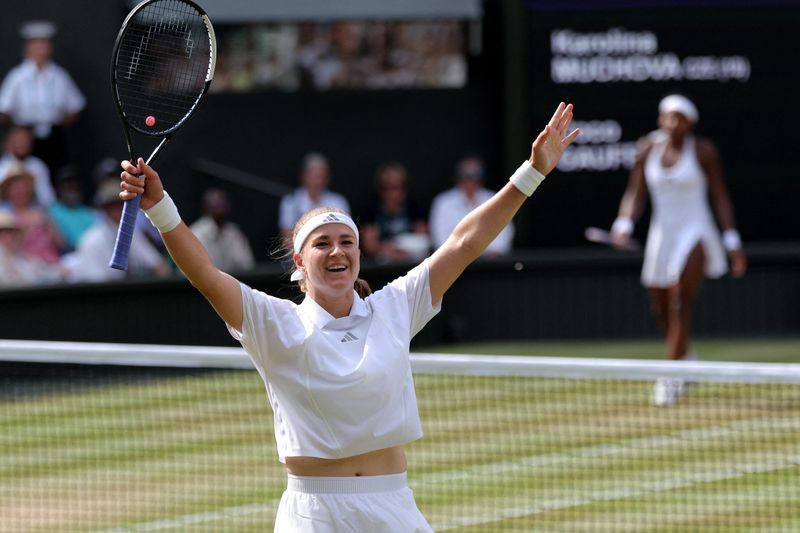
Karolina Muchova reached her first Wimbledon final on Saturday after an extraordinary comeback victory against seventh-seeded American Coco Gauff, triumphing 6-2 1-6 7-6 (12-10) in a match that showcased dramatic swings in fortune and unwavering mental resilience from both competitors. The Czech player's progression to the championship match, contested after a nervy two hours and 35 minutes on Centre Court, sets up the tantalizing prospect of an all-Czech final should her compatriot Linda Noskova overcome Ukrainian Marta Kostyuk in the second semifinal scheduled for Thursday.
The significance of Muchova's advancement extends beyond her personal achievement. Should a Czech champion be crowned this weekend, it would represent a remarkable concentration of dominance at tennis's oldest Grand Slam, with the nation claiming three titles in four years. The Czech tennis federation would join an elite group of countries with such deep benches of talent and success, following Marketa Vondrousova's victory in 2023 and Barbora Krejcikova's triumph in 2024. This pattern reflects the exceptional development of women's tennis in central Europe and demonstrates how individual success can cascade through an entire sporting ecosystem.
What makes Muchova's victory particularly noteworthy is the peculiar challenge she faces whenever competing at the All England Club. The tenth seed has a documented grass allergy that requires intensive pharmaceutical and medical management—she must consume multiple medications, use sprays, and rely on eyedrops simply to function on the sport's most prestigious lawn. This hidden battle adds another layer to her achievement, suggesting that her performance was not merely about tactical brilliance but also about managing physical discomfort that most spectators would never perceive.
Muchova's dominance in the opening set demonstrated why she remains one of grass court's great technicians. She secured breaks of serve in the third and fifth games, with Gauff's capitulation in the latter coming from an unforced error of the highest order—a wildly misdirected forehand that flew far beyond the baseline. An ace clocked at 111 mph provided the exclamation point to claim the set 6-2, suggesting a player entirely in command and ready to seal a straightforward victory.
Yet Gauff has built her reputation on refusing to surrender even when tournament circumstances appear bleak. The American had already navigated four consecutive three-set encounters to reach the semifinals, and her temperament once again refused to buckle under pressure. After struggling through the opening set, Gauff began converting opportunities in the second frame with clinical precision. She needed nine attempts to manufacture a break point, but when the opportunity finally arrived, she seized it to establish a 3-1 advantage. Another break for 5-1 prompted visible celebration from her mother in the player's box, and Gauff leveled the match by taking the set 6-1.
The deciding set transformed into the kind of tennis that reminds observers why Wimbledon remains the sport's most treasured championship—a contest between two elite athletes producing shots of exquisite quality and courage. Both players unleashed devastating forehands and constructed points with architectural precision, moving each other across the grass and striking the ball with ferocious intent. The quality of tennis transcended mere competition; it became a form of athletic artistry that left spectators breathless during the furnace-like heat of a London summer afternoon.
The climactic moments revealed the tournament's cruel mathematics. Gauff fashioned two break opportunities to seize a 5-4 lead, positioning herself within touching distance of the final. However, Muchova's experience and composure proved decisive. The Czech player escaped the trap set by her opponent and seized control of the pivotal tiebreak with a mixture of power and precision. She produced the kind of shot that deserves immortality in highlight reels—an audacious diving volley that won the point outright—before following with a perfectly weighted lob that again left Gauff helpless.
When Muchova earned her first match point, the opportunity slipped away when Gauff managed to recover her aggressive instincts. However, the American's reserves finally depleted on the second occasion, and she deposited a forehand into the net to end her Wimbledon journey. Muchova's arms rose in triumph as she recognized the magnitude of reaching a Grand Slam final for the first time in her career—a moment that vindicated her courage in battling through both the physical limitations imposed by her allergy and the relentless quality of her opponent's tennis.
For Malaysian and Southeast Asian tennis enthusiasts, Muchova's triumph underscores how perseverance across multiple surface types and the ability to maintain mental fortitude during adversity separates champions from the rest of the field. The regional tennis community watches global events not merely for entertainment but for lessons in character development and tactical sophistication that can elevate standards across Asia. Muchova's journey to the final, achieved despite managing a medical condition that would discourage many competitors, offers inspiration about transcending physical obstacles through determination and strategic ingenuity.
The Wimbledon women's final will now feature Muchova, a player who has proven herself capable of manufacturing victory from the most unfavorable circumstances. Whether she faces Noskova or an alternative opponent, she arrives at Saturday's championship match as a competitor who has already demonstrated the mental strength and technical mastery required to claim tennis's most revered individual prize.

