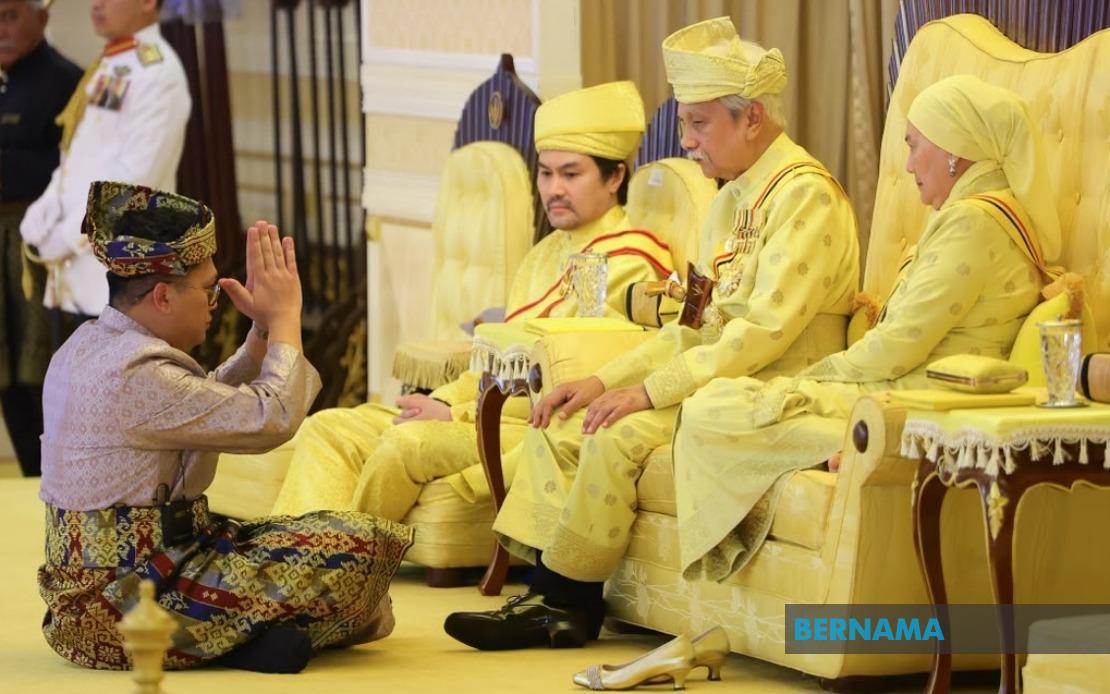
Muhammad Faris Johari has been formally installed as the 11th Undang of Luak Sungei Ujong following a traditional ceremony conducted by Tuanku Muhriz Tuanku Munawir, the Yang Dipertuan Besar of Negeri Sembilan, at Istana Besar Seri Menanti in Kuala Pilah. The 28-year-old now holds the title Datuk Klana Petra, marking a significant moment in the state's longstanding system of customary leadership that traces its roots to the Minangkabau settlement patterns of Negeri Sembilan.
The installation ceremony adhered to time-honoured protocols within the Undang system, beginning with formal consent from the Orang Empat Istana—the senior palace officials—before proceeding with the proceedings. Muhammad Faris then delivered his pledge of loyalty directly to Tuanku Muhriz, reaffirming the constitutional relationship between the chieftains and the ruler that has characterised Negeri Sembilan's governance structure for generations. This ceremonial exchange represents more than symbolic gesture; it encodes the reciprocal duties binding the Undang class to their sovereign authority.
In his remarks during the installation, Tuanku Muhriz emphasised the enduring importance of maintaining the institutional framework that underpins Negeri Sembilan's dual system of governance. The ruler stressed that pledges made during such ceremonies must be honoured with sincerity and personal integrity, qualities he identified as essential to effective leadership in a traditional context. His address underscored the expectations placed upon appointed Undang to demonstrate accountability not merely to administrative structures but to the customary values that their office represents.
Tuanku Muhriz drew particular attention to the relationship between the ruling class and the Palace, instructing the Orang Kaya—the broader chieftaincy—to preserve deference and close consultation with royal authority. This guidance reflects ongoing tensions within Malaysian governance between centralised state power and decentralised customary institutions. By reiterating such expectations, the ruler signalled commitment to maintaining hierarchical order while acknowledging that effective governance requires voluntary compliance rooted in respect rather than coercion alone.
The ceremony also served as an occasion for Tuanku Muhriz to reaffirm the relationship between constitutional monarchy, customary traditions, and collective welfare in Negeri Sembilan. The ruler characterised this tripartite relationship as essential to the state's identity and sustainability. His remarks suggested that preserving Adat Perpatih—the matrilineal customary law practised throughout the state—depends upon conscious effort by both leadership and the general population to transmit these values across generations rather than allowing them to fade amid modernisation pressures.
Several senior royal figures attended the installation, including Tunku Ampuan Besar Tuanku Aishah Rohani Tengku Besar Mahmud and Tunku Besar Seri Menanti Tunku Ali Redhauddin Tuanku Muhriz, alongside Tunku Panglima Besar Tunku Zain Al-'Abidin. The presence of Menteri Besar Datuk Seri Aminuddin Harun and senior government officials reflected the hybrid character of Negeri Sembilan's institutions, where state administration and customary chieftaincy operate in parallel yet interconnected spheres. This layered attendance pattern demonstrated how modern bureaucratic governance coexists with hereditary customary authority in the state.
Muhammad Faris brings a contemporary educational profile to the traditionally rooted office of Undang. Born on 27 October 1997, he completed undergraduate studies in accountancy at Universiti Teknologi MARA before obtaining professional certification through the Association of Chartered Certified Accountants programme in 2022. His professional qualifications represent the increasing education levels among those assuming traditional leadership roles in Malaysia, suggesting potential for modernised approaches to managing customary institutions while preserving their cultural significance. He is married to Sharifah Amirah Syed Ismail Ash-Shahab.
The installation of Muhammad Faris follows a broader pattern of succession within Negeri Sembilan's Undang system, which comprises multiple territorial divisions or Luak. Each Luak maintains its own Undang, creating a distributed leadership structure that distinguishes Negeri Sembilan among Malaysian states. This arrangement reflects the state's historical settlement by Minangkabau migrants who brought with them sophisticated political institutions based on territorial and kinship organisation, which the state has preserved through constitutional provisions.
A second installation ceremony was scheduled for later the same day to formalise the appointment of the 22nd Undang of Luak Rembau, indicating that the state was conducting significant transitions within its customary leadership simultaneously. This clustering of installations suggests possible generational change within Negeri Sembilan's elite circles and raises questions about continuity in how these offices will be managed in coming years.
For Malaysian observers, the installation of Muhammad Faris exemplifies how federal Malaysia accommodates multiple legal and governance traditions within a single nation-state. Negeri Sembilan's retention of customary chieftaincy alongside modern state administration offers a model, however imperfect, of institutional pluralism. The formal involvement of both royal and executive branches signals commitment to maintaining this balance, though ongoing pressures from centralisation, economic modernisation, and demographic change will likely test the resilience of such arrangements in years ahead.

