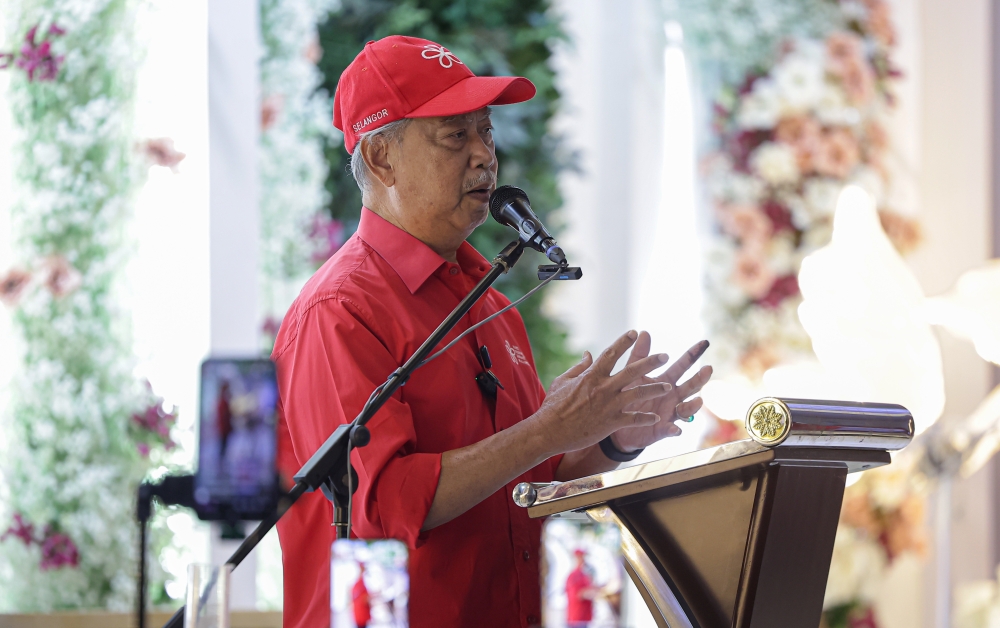
Tan Sri Muhyiddin Yassin has staked a fresh claim to political legitimacy by declaring that Parti Pribumi Bersatu Malaysia functions as Parliament's only genuine Opposition bloc, a pronouncement that underscores deepening fissures within Malaysia's increasingly fluid governing arrangements. The assertion comes at a moment when Malaysia's legislative landscape remains in considerable flux, with multiple coalitions jostling for influence and strategic positioning as the nation approaches potential electoral realignment.
The Bersatu president's contention rests on the distinction that his party maintains principled distance from the federal government without the entangling commitments that other legislative groupings carry. This positioning attempt seeks to differentiate Bersatu from parties aligned with Pakatan Harapan and Barisan Nasional coalitions, which together form the current parliamentary majority supporting the government. By claiming singular Opposition credentials, Muhyiddin appears to be constructing a narrative whereby Bersatu occupies unique parliamentary space—neither embedded within the ruling configuration nor formally affiliated with other opposition formations.
The political context underlying this claim reflects Malaysia's chronic instability in coalition management and legislative arithmetic. Since the 2022 general election, successive prime ministers have navigated a parliament where no single coalition commands overwhelming majority, necessitating ad hoc arrangements and compromises that have frequently shifted. This fragmentation has created openings for smaller parties to amplify their significance through strategic positioning, a dynamic Bersatu clearly aims to exploit.
Muhyiddin's framing deserves scrutiny given Bersatu's own complex recent history within coalitions. The party previously participated in the Perikatan Nasional framework alongside PAS, an arrangement that profoundly shaped Malaysian politics before fragmenting. That history complicates any claim to untainted Opposition status, as Bersatu's former coalition partners retain considerable parliamentary influence. The assertion of singular Opposition legitimacy thus represents a rhetorical repositioning rather than a fundamentally altered parliamentary status.
From a Malaysian governance perspective, the proliferation of competing Opposition claims highlights substantive institutional weaknesses. A functioning democratic system typically features clearly delineated government and Opposition benches, enabling coherent policy debate and governmental accountability. Malaysia's current configuration instead produces multiple fragmented Opposition voices, each claiming authenticity but collectively lacking unified direction. This diffusion dilutes parliamentary scrutiny and complicates the electorate's ability to present clear electoral choices.
The implications for regional Southeast Asian politics merit attention as well. Malaysia's political volatility has historical precedent, but the current phase's defining characteristic involves smaller parties leveraging structural parliamentary weakness to magnify influence disproportionate to electoral support. Bersatu's repositioning attempt exemplifies this dynamic—a party that secured roughly 2.5 million votes in 2022 now claims singular Opposition standing in a 222-seat parliament. Such mathematical disconnects between electoral legitimacy and claimed parliamentary roles raise questions about democratic representation quality.
For Malaysian voters seeking coherent policy alternatives, Muhyiddin's claim presents a credibility challenge. The Opposition's traditional role involves presenting comprehensive alternative governance visions alongside robust critique of incumbent policies. A fragmented Opposition landscape where multiple voices claim authenticity inevitably weakens such articulation, leaving voters with partial, contradictory, or unclear policy proposals. Bersatu's separate Opposition claim potentially further subdivides already fragmented Opposition capacity rather than strengthening it.
The timing of this assertion carries significance within immediate political developments. As the nation's legislative calendar advances and various coalition members reassess strategic alignments ahead of potentially triggered elections, declarations of parliamentary positioning carry tactical weight. Muhyiddin's statement appears designed to secure Bersatu's negotiating leverage—establishing claimed independence simultaneously creates options for future coalition discussions with potentially multiple partners. Such maneuvering reflects rational political calculation but simultaneously undermines coherent governance arrangements.
International observers and Malaysia's development partners increasingly monitor such political turbulence with concern, recognizing that chronic governmental instability correlates with policy discontinuity and implementation weakness. When parliament fragments into multiple competing Opposition voices rather than featuring consolidated alternatives, executive-legislative relations become more difficult to manage systematically. This affects everything from long-term economic planning to regulatory consistency to foreign policy coherence.
Bersatu's particular claim to Opposition authenticity rests substantially on perceived separation from Pakatan Harapan, which governs alongside Barisan Nasional components. This distinction, however, proves increasingly notional given the overlapping parliamentary coalitions and shared governance participation. Bersatu members have served in cabinet positions during various government configurations, complicating claims to principled Opposition distance. The party's ability to credibly maintain that distinction over time remains uncertain.
Looking forward, Malaysian political observers should anticipate that such positioning statements will multiply as parliamentary arithmetic continues shifting. Each smaller party has incentive to claim distinctive parliamentary standing and maximum negotiating flexibility. Whether such fragmentation ultimately strengthens or weakens parliamentary democracy depends significantly on whether dominant coalitions eventually consolidate, providing electoral clarity, or whether the current diffusion persists indefinitely, further straining institutional legitimacy and citizen confidence in democratic processes.

