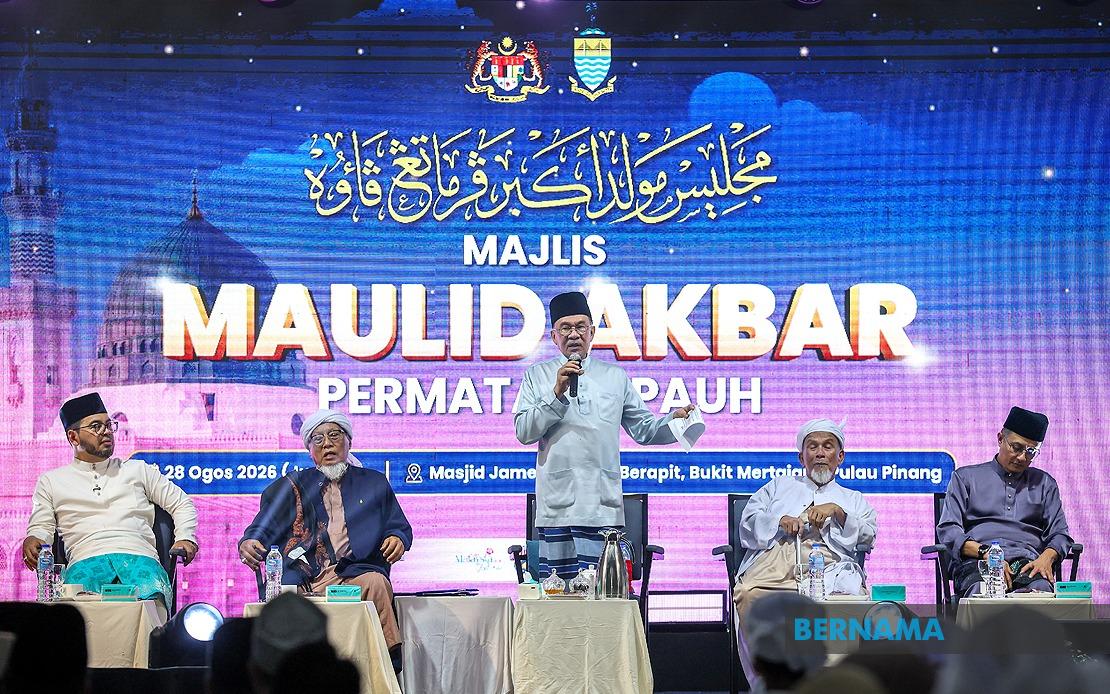
Prime Minister Datuk Seri Anwar Ibrahim has issued a forceful call for Muslims to become role models of virtue and ethical conduct in Malaysian society, arguing that respect and admiration must be earned through demonstrated values rather than claimed status. Addressing attendees at a Maulid Akbar ceremony held in conjunction with National Day at Masjid Tengah in Bukit Mertajam, Anwar outlined a vision where the Muslim community actively shapes national character through everyday actions that reflect Islamic principles of honesty, diligence and accountability.
The Prime Minister's remarks reflect a deliberate emphasis on bridging the gap between religious identity and practical conduct. He contended that when members of the Muslim community visibly work with dedication, maintain their commitments, resist the temptation to exploit authority, and refrain from dishonesty or financial misconduct, they naturally command the respect of their fellow citizens. This framework suggests that religious standing is not inherited or claimed through declaration, but rather continually validated through the quality of one's personal integrity and professional behaviour.
Anwar's message carries particular weight given Malaysia's ongoing struggle with corruption and governance issues. By positioning Muslims as custodians of moral standards, he implicitly links religious faith to practical anti-corruption efforts and institutional accountability. The connection resonates with broader efforts to rebuild public trust in government institutions and civil servants, many of whom are Muslim. His emphasis on "not cheating and not stealing money" addresses concrete, everyday ethical challenges that citizens encounter in their interactions with public officials and businesses.
The Prime Minister also articulated a more expansive vision of Islamic social responsibility that transcends communal boundaries. He stressed that Islam's fundamental message encompasses compassion and benevolence toward all people, obligating Muslims to nurture relationships and safeguard the wellbeing of the wider community regardless of ethnic or religious identity. This inclusive interpretation carries significance in Malaysia's multiethnic context, where religious harmony and cross-community cooperation remain essential to national stability and prosperity.
Central to Anwar's address was the concept of holistic development that balances multiple dimensions of human flourishing. He articulated that Muslims must actively cultivate knowledge and intellectual capacity alongside spiritual discipline, moral development and physical wellness, while also participating meaningfully in material progress and economic advancement. This framework rejects a false dichotomy between religious devotion and worldly success, instead proposing that genuine Islamic practice encompasses excellence across all these domains.
The Prime Minister drew an explicit connection between individual moral character and the success of Malaysia MADANI, the government's flagship development agenda. He argued persuasively that policies alone, regardless of sophistication, cannot achieve sustainable national progress without a solid ethical foundation. Economic growth and technological mastery, whilst essential, remain incomplete without corresponding advancement in the moral and spiritual dimensions that guide how such tools are deployed. This framing positions ethics not as peripheral to development strategy but as its essential foundation.
Anwar employed a memorable metaphor to encapsulate this integrated vision, suggesting that while Malaysia must aspire to reach the sky through ambition and innovation, it must simultaneously remain grounded in earth-based values of faith, character and moral principle. The metaphor captures the tension between forward progress and traditional foundations that characterises Malaysia's development challenge. By "remaining rooted," the Prime Minister indicated that rapid modernisation and technological adoption must not erode the values that provide coherence and direction to national life.
The presence of Minister in the Prime Minister's Department (Religious Affairs) Dr Zulkifli Hasan at the event underscored the government's intention to embed religious and moral considerations into policy implementation. This institutional alignment signals that the Prime Minister's moral exhortations are not merely rhetorical flourishes but are intended to inform how government departments and agencies operate and measure their effectiveness.
Anwar further elevated the role of Islamic scholars in national governance, arguing that religious leaders must actively engage with policymakers through constructive counsel and informed perspective. Rather than positioning scholars as external observers or critics, he framed them as essential partners whose insights about morality, social welfare and ethical frameworks should inform the development process. This approach seeks to integrate traditional Islamic learning with contemporary governance challenges.
The Prime Minister's overall message suggests a sophisticated political and moral strategy. By framing Muslim conduct as determinative of national success, he places responsibility for Malaysia's trajectory not solely on government policies but on the daily choices of individual citizens and institutional leaders. This distributed accountability model reflects both Islamic concepts of individual moral responsibility before God and practical recognition that governance depends ultimately on the ethical commitments of those implementing policy.
For Malaysian readers and policymakers, Anwar's speech articulates an alternative narrative to cynicism about corruption and institutional decay. Rather than portraying the challenge as inevitable or overwhelming, he presents individual and collective moral commitment as the solution. This framing has particular resonance given recent years of anti-corruption investigations and institutional reform efforts across the region, suggesting that Southeast Asian governments increasingly recognise that sustainable development requires simultaneous attention to economic metrics and ethical standards.
The timing of these remarks during National Day celebrations adds symbolic weight. By connecting Islamic principles of integrity to Malaysian national identity, Anwar attempts to reframe religious devotion not as a particularistic commitment but as foundational to shared civic values. For a nation with significant non-Muslim populations, positioning Islam's ethical teachings as beneficial to the entire society potentially strengthens interfaith cooperation and national cohesion around common ethical standards.

