Penang's flagship Mutiara Line Light Rail Transit project has achieved several significant construction and procurement milestones, signalling accelerated momentum toward completion. Malaysia Rapid Transit Corporation Sdn Bhd (MRT Corp) has formally appointed the MRCB-Theta Edge Berhad Joint Venture to deliver the RM3.028 billion System Turnkey Contract (STC), a decision expected to unlock parallel progression of both railway systems design and ongoing civil construction activities that will keep the project on track for integrated delivery.
The appointment of MRCB and Theta Edge to lead systems integration represents a pivotal moment for the 24.3-kilometre transit corridor, which when complete will connect key Penang nodes from Silicon Island through Komtar to Penang Sentral. Rather than completing infrastructure before installing systems, the concurrent approach adopted by MRT Corp allows detailed engineering of railway components to advance simultaneously with ground construction, reducing overall project duration and minimising the risk of misalignment between civil and systems elements. This methodology has become standard practice on major rail projects across the Asia-Pacific region, enabling faster commissioning and revenue generation.
The STC encompasses the full spectrum of modern rail transit infrastructure, spanning seven major packages that collectively form the nervous system and circulatory network of the completed line. These include procurement and installation of electric trains alongside depot maintenance equipment; an integrated signalling and automated train control system paired with automatic platform screen doors for passenger safety; permanent trackwork including conductor rails and dedicated maintenance vehicles; comprehensive power supply and distribution networks serving both operational and auxiliary requirements; centralised railway supervisory control and data acquisition (SCADA) systems; computerised maintenance management platforms designed to optimise asset lifecycles; telecommunications and information technology infrastructure; and a sophisticated automatic fare collection ecosystem. This integrated systems approach ensures operational interoperability and long-term maintainability.
Concurrent with systems procurement, the civil construction programme is advancing robustly across the alignment covered by Civil Main Contract 1 (CMC1), which extends from Silicon Island to Komtar. MRT Corp disclosed that foundation works have progressed substantially, with 45 pile caps and 32 pier columns already completed across 14 of the 19 designated construction sections. This geographic distribution of active construction sites across roughly three-quarters of the CMC1 footprint demonstrates intensive parallel working, wherein multiple contractor teams operate simultaneously along the corridor rather than in sequential stages. Such intensive activity typically accelerates delivery but requires sophisticated logistics coordination and materials management.
Land acquisition, frequently a critical path item on Malaysian infrastructure projects, has largely been resolved through coordinated effort between federal and state authorities. MRT Corp confirmed that 93 per cent of total land required for the CMC1 package has now been made available, reflecting productive cooperation between the Federal Government, Penang State Government, and relevant land agencies. Securing property access at this rate substantially de-risks the project timeline and allows construction crews to operate without halt due to access constraints. The remaining 7 per cent, whilst seemingly modest, may encompass strategically important corridor segments or commercially sensitive properties requiring sensitive negotiation.
The broader CMC1 package, which the MRT Corp designated contractor continues to subdivide into specialised subcontracts, has also achieved meaningful local industry integration. Bumiputera participation under CMC1 has surpassed the 20 per cent threshold as a proportion of total contract value, demonstrating compliance with federal participation requirements whilst building domestic construction sector capabilities. This local content level, achieved through targeted subcontracting to Bumiputera-owned firms and joint ventures, helps distribute economic benefits across Malaysia's construction ecosystem and develops supply chain resilience by reducing foreign dependency.
Depot facilities, essential for train maintenance, storage, and overnight stabling, are being constructed at Silicon Island. MRT Corp has commenced soil investigation drilling and geotechnical analysis necessary to inform detailed depot foundation design. Such investigations are prerequisite to finalising structural engineering and procurement specifications for depot equipment, which collectively represent significant project expense. The Sequential commencement of investigation work at Silicon Island, as detailed foundation and systems work progresses on the main line, maintains logical project phasing without creating idle contractor capacity.
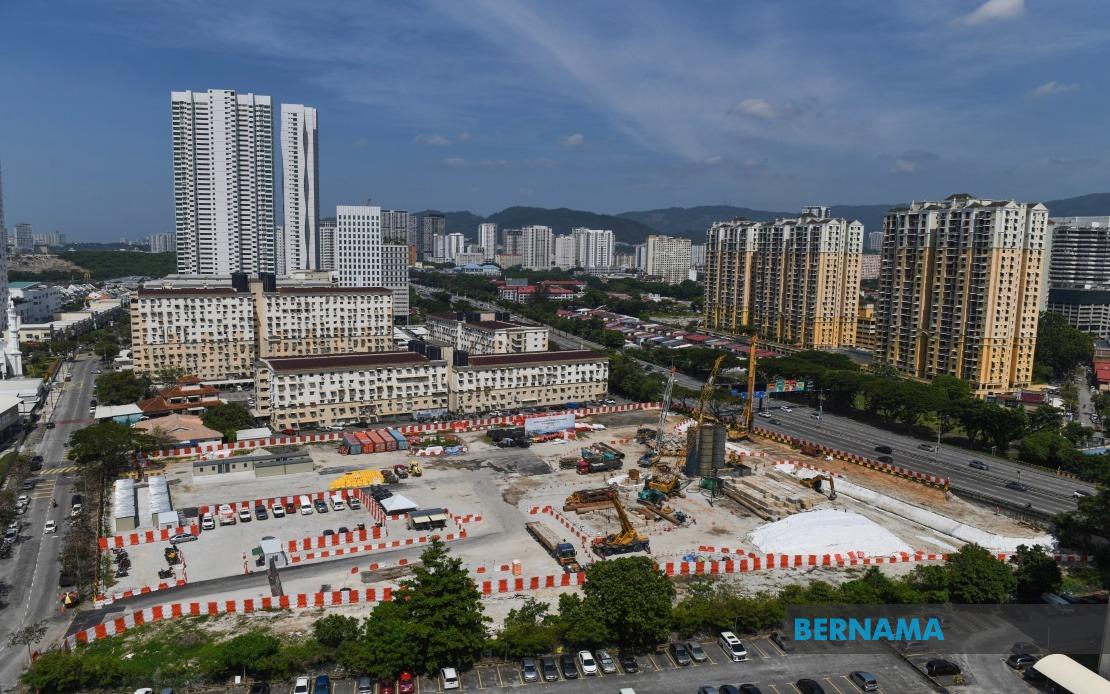
Facility preparation at the Tapak Pesta site, which the Penang State Government transferred to MRT Corp in April 2026, represents another concrete advancement. The corporation has completed demolition of pre-existing structures and executed site levelling and preparation works, positioning the location for imminent commencement of substantive construction activities. Such preparatory investments, whilst appearing invisible to public observers, consume months of critical path time and represent essential prerequisites for subsequent construction phases.
The tender process for Civil Main Contract 2 (CMC2), covering the extension from Komtar to Penang Sentral, continues toward competitive evaluation. MRT Corp confirmed that tender submissions have been received and comprehensive evaluations are underway, with contract award targeted for November 2026. CMC2 represents the southern extension of the core corridor and will complete the primary alignment. Staggering major contract awards across different time windows allows the corporation to spread financial exposure, permits lessons learned from CMC1 execution to inform CMC2 specifications and terms, and maintains competitive tension by avoiding contractor fatigue across the full scope.
For Malaysian stakeholders and Southeast Asian transit observers, the Mutiara Line represents important demonstration of whether Malaysian public infrastructure procurement can execute modern rail projects efficiently whilst maintaining local participation and domestic skill development. Penang's geographic position as a major regional trading hub and its strategic significance within the Malaysia-Thailand-Singapore economic corridor make successful project delivery consequential beyond the island state. Sustained progress at current velocity, maintained land acquisition momentum, and effective systems integration will determine whether Penang enters a transit-enabled development phase comparable to established rapid transit cities elsewhere in the region, potentially catalysing commercial property development and ridership behaviour change that extends benefits well beyond initial projections.

