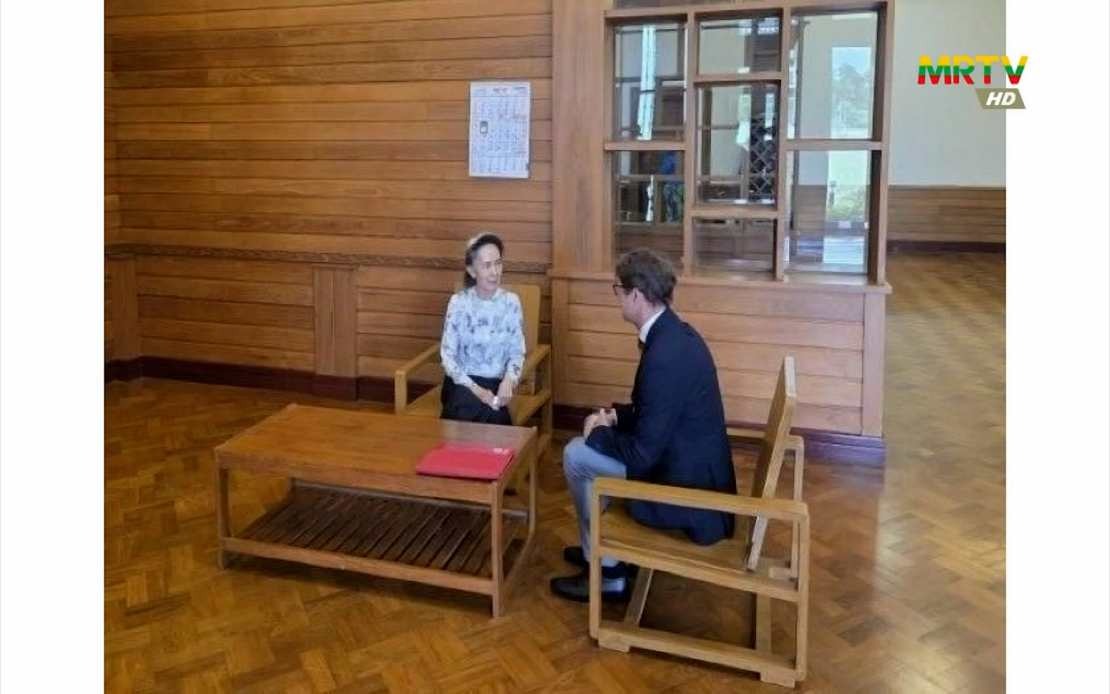
Myanmar's military-backed government announced on Monday that Aung San Suu Kyi, the country's ousted democratic leader, has been permitted to meet with a representative of the International Committee of the Red Cross, marking a significant moment of transparency in an otherwise opaque detention spanning more than three years. The encounter took place in the capital Naypyitaw between the 81-year-old Nobel Peace Prize winner and Arnaud de Baecque, the ICRC's Resident Representative to Myanmar, according to a statement from government spokeswoman Khine Khine Soe. This development arrives as ASEAN neighbours and international observers intensify calls for access to verify the health and whereabouts of one of Southeast Asia's most prominent political figures.
Suu Kyi's confinement began in February 2021 when the Myanmar military executed a dawn coup, dismantling an elected civilian government that she led and thrusting the nation of 51 million people into prolonged political and humanitarian crisis. The intervention reversed a decade of democratic progress in a country that had begun transitioning from junta rule in 2011. Her extended detention represents a dramatic reversal of fortune for someone who symbolised resistance to authoritarianism across the region and whose liberation from earlier house arrest had been celebrated as a triumph for democracy movements throughout Asia. The coup precipitated a cascade of protests, strikes, and armed conflict that has killed thousands and displaced hundreds of thousands, transforming Myanmar into one of the world's most unstable regions.
The exact circumstances of Suu Kyi's detention have remained shrouded in secrecy, with neither her precise location nor her physical condition independently verified by international observers until now. Her son, Kim Aris, disclosed last December that communication with his mother had ceased and that he received only sporadic, secondhand reports regarding her medical issues, including heart problems, bone deterioration, and dental ailments. The isolation from family members and the absence of transparent information have fuelled international concern about her wellbeing and raised questions about the legitimacy of her continued incarceration. Her legal representatives have consistently maintained that the charges against her are entirely fabricated to permanently eliminate her from Myanmar's political landscape.
The junta's initial legal proceedings against Suu Kyi, conducted largely in camera following the coup, resulted in a 33-year sentence on charges encompassing corruption allegations, election fraud incitement, and breaches of state secrecy legislation. Subsequent modifications reduced this sentence to 27 years, with an additional reduction of one-sixth in April leaving an outstanding term of 18 years to be served. These convictions have been universally condemned by human rights organisations and democratic governments as politically calculated prosecutions designed to neutralise her influence permanently. Her legal team and political allies argue that the charges lack substantive merit and serve exclusively as tools of political suppression by a military desperate to eliminate electoral competition.
Recent developments have included announcements from the military administration that Suu Kyi had been transferred to house arrest in late April, coinciding with a military-supervised election that elevated former junta leader Min Aung Hlaing to the presidency. However, substantiation of this claim remained absent until the Red Cross meeting provided photographic documentation. Government officials have repeatedly asserted that Suu Kyi maintains good health, yet international actors have sought independent verification of these claims, particularly given the history of military untransparency and the complete absence of previous foreign access to the detainee.
The photographs released by the government spokeswoman present the first direct visual evidence of Suu Kyi in many months. Images depict her dressed in traditional Burmese clothing meeting with de Baecque in a minimally furnished room containing only two chairs and a desk with wood panelling. Additional photographs show her celebrating a birthday with a cake inscribed with the date 19.6.2026, offering what government sources characterise as proof of her continued presence and apparent wellness. However, Reuters could not independently authenticate the location, date, or circumstances under which these images were captured, nor could verification be established that earlier versions existed prior to their public release. This limitation underscores the persistent verification challenges that characterise access to information about Suu Kyi's detention.
Regional diplomatic pressure has escalated notably in recent months, with ASEAN nations articulating demands for transparent access to Suu Kyi. Following discussions between Myanmar's foreign minister and other ASEAN counterparts in Bangkok, Thailand's chief diplomat Sihasak Phuangketkeow specifically called for access enabling independent verification of Myanmar's health assertions. The Philippines formally requested in May that an ASEAN special envoy be permitted to visit Suu Kyi, a petition the military government declined to accommodate. These representations reflect growing frustration among Myanmar's neighbours regarding the junta's opacity and the absence of international humanitarian access to verify conditions of detention for a figure of extraordinary regional significance.
Suu Kyi's historical trajectory compounds the international concern surrounding her current circumstances. As the daughter of General Aung San, Myanmar's independence hero and founder of the modern Burmese nation-state, she inherited formidable symbolic authority. During her previous 15-year detention under an earlier military regime, she conducted celebrated public resistance from her family residence on Yangon's Inya Lake, delivering passionate addresses to supporters who gathered beyond the property's metal gates. That period of confinement became emblematic of peaceful resistance to authoritarianism and resulted in her international prominence and 1991 Nobel Peace Prize award. Her incarceration now carries profound implications not merely for Myanmar but for perceptions of democratic backsliding across Southeast Asia more broadly.
The ICRC meeting may represent a narrow opening in Myanmar's information management regarding Suu Kyi, though fundamental transparency questions persist. The International Committee of the Red Cross, a respected humanitarian organisation with established protocols for prison visitation and detainee monitoring, typically conducts confidential assessments rather than public pronouncements regarding health evaluations. Whether this encounter will result in systematic ongoing access or represent a singular public relations gesture remains uncertain. The military government's historical reluctance to facilitate independent verification, coupled with its controlled release of photographic material, suggests that restricted access may continue characterising international observation of Suu Kyi's detention.
For Malaysian and broader Southeast Asian observers, Suu Kyi's case illuminates persistent anxieties about democratic resilience in the region. Myanmar's trajectory from democratic opening to military reassertion demonstrates that political transitions remain fragile and reversible, particularly where military institutions retain structural power and commitment to democratic norms remains shallow. The international community's limited capacity to influence Myanmar's junta conduct, despite coordinated ASEAN diplomacy, reveals constraints on regional pressure mechanisms. Malaysia, as an ASEAN member and observer of Myanmar's political trajectory, confronts questions about balancing diplomatic engagement with principled opposition to military authoritarianism—a balance reflected in ongoing regional debates about how to respond to the Myanmar crisis.

