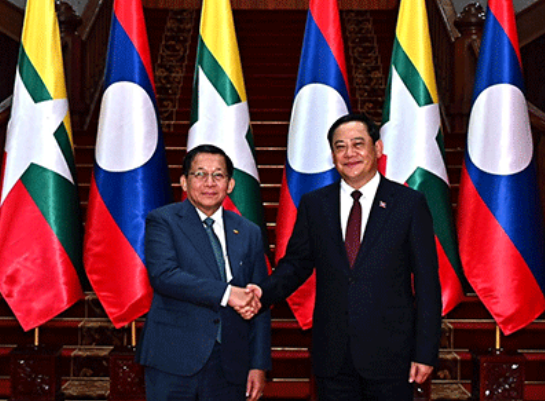
Myanmar's President Min Aung Hlaing has wrapped up an official state visit to Laos that reinforced bilateral ties and charted new directions for cooperation between the two neighbouring Southeast Asian nations. Accompanied by his wife and senior officials, the Myanmar leader spent July 3-5 in Vientiane at the invitation of Laotian President Thongloun Sisoulith, using the occasion to commemorate seven decades of continuous diplomatic relations and to signal both governments' commitment to deepening engagement across economic, security and cultural domains.
The carefully choreographed visit began with a full ceremonial reception at the Presidential Palace, where President Thongloun and his wife Naly Sisoulith welcomed the Myanmar delegation with the pageantry befitting a state-level engagement. This formal opening set the tone for substantive discussions between the two presidents, who used their bilateral talks to review existing cooperation frameworks and chart ambitions for the coming years. The emphasis on protocol and ceremonial respect reflected the importance both nations attach to their relationship, particularly given Myanmar's current political circumstances and its strategic positioning within the Mekong region.
During official talks, the two presidents addressed a broad spectrum of bilateral concerns and opportunities. They reviewed progress in political cooperation, discussed regional and international developments affecting their interests, and explored pathways for expanding collaboration. President Thongloun specifically acknowledged Myanmar's recent transition, offering congratulations on the conduct of its general election and formation of a new government—diplomatic language that underscores Laos's pragmatic approach to engaging with its neighbour regardless of Myanmar's internal political trajectory. Such recognition carries significance within ASEAN circles, where Myanmar remains a subject of diplomatic sensitivity.
The leadership discussions yielded concrete deliverables that translate bilateral rhetoric into practical commitments. Two memorandums of understanding were signed: one establishing tourism cooperation between Laos's Ministry of Culture and Tourism and Myanmar's Ministry of Hotels, Tourism and Culture, and another formalising "friendship city" relations between the capital cities of Vientiane and Naypyidaw. Additionally, Myanmar handed over snake antivenom serum to Laos's Ministry of Health, a seemingly modest gesture that reflects practical cooperation on public health challenges affecting border communities. These tangible outcomes matter because they demonstrate that high-level political engagement translates into measurable benefits for citizens.
The two governments identified multiple sectors for enhanced collaboration, encompassing defence and security arrangements, trade and investment frameworks, transport connectivity, energy projects, labour mobility, and educational exchanges. Particularly significant is their commitment to coordinate on border security and information sharing—a priority for landlocked Laos and Myanmar alike, given shared concerns about transnational crime, drug trafficking, and irregular migration along their common frontier. These security arrangements form a crucial but often overlooked dimension of bilateral relations in mainland Southeast Asia.
Cooperation through multilateral mechanisms featured prominently in discussions. Both nations pledged to strengthen collaboration within the Association of Southeast Asian Nations (ASEAN), the United Nations system, and the Mekong-Lancang Cooperation framework. For Laos, these commitments help anchor its foreign policy within established regional institutions. For Myanmar, engagement through these channels provides opportunities to rebuild international standing and demonstrate commitment to regional norms, particularly important given international scrutiny of its governance. The emphasis on working through established forums suggests both nations view their bilateral relationship as complementary to, rather than separate from, broader regional architecture.
Prime Minister Sonexay Siphandone met separately with President Min Aung Hlaing, further reinforcing the multi-level nature of Myanmar-Laos engagement. The Prime Minister characterised the visit as strengthening traditional friendship and good-neighbourly relations, welcoming the tangible outcomes from presidential-level discussions. This layered diplomatic engagement—involving presidents, prime ministers, and parliamentary speakers—ensures that bilateral initiatives gain institutional momentum and face reduced risk of stalling when individual leaders' attention shifts elsewhere.
Xaysomphone Phomvihane, President of Laos's National Assembly, also hosted the Myanmar leader, with discussions focusing on parliamentary cooperation and legislative support for implementing bilateral agreements. The National Assembly speaker's emphasis on monitoring implementation and ensuring practical benefits reflects growing attention to the gap between signing ceremonies and actual delivery of promised cooperation. By committing the legislature to oversight roles, Laos attempts to institutionalise bilateral agreements and insulate them from bureaucratic inertia. Xaysomphone noted that Laos was the first ASEAN member state visited by President Min Aung Hlaing for official engagements since his assumption of office—a detail that signals Myanmar's prioritisation of ties with its immediate neighbours.
Cultural dimensions of the visit extended beyond formal negotiations. President Min Aung Hlaing paid respects at Vientiane's Unknown Soldier Monument, honouring Lao revolutionary soldiers—a gesture symbolising shared historical experiences within the region's Cold War context, when both nations were aligned with the socialist bloc. He participated in traditional Baci ceremonies and attended an official state banquet, ceremonial activities that foster personal relationships among leaders and demonstrate cultural respect. Such events, though less visible in official communiqués, contribute to the interpersonal chemistry that can facilitate or hinder bilateral relations during inevitable disagreements.
The Myanmar President's itinerary extended to Luang Prabang, the UNESCO World Heritage city and former royal capital, where he was scheduled to visit temples and cultural landmarks. This cultural tour serves multiple purposes: it provides the visitor with exposure to Laos's heritage and tourism potential, offers opportunities for informal engagement with local officials and business leaders, and generates positive media coverage in both countries. For Laos, such visits reinforce its positioning as a cultural and spiritual destination, potentially spurring tourism growth and supporting its development agenda.
The state visit arrives at a moment of strategic importance for Myanmar-Laos relations. Myanmar, facing international criticism over governance issues, benefits from strong bilateral engagement with ASEAN neighbours who demonstrate willingness to cooperate without preconditions tied to internal political reform. Laos, navigating its own economic challenges and seeking to strengthen regional integration, gains from deepened ties with Myanmar that enhance its relevance as a transit corridor and cultural bridge. For Malaysia and other ASEAN members, the Myanmar-Laos engagement demonstrates that bilateral relationships within the bloc continue functioning despite regional tensions, suggesting ASEAN's institutional mechanisms retain residual strength.
The emphasis on economic cooperation deserves particular attention for regional observers. Trade, investment, transport links, and energy projects represent the substantive foundation for durable bilateral relations. While political goodwill matters, lasting partnerships depend on mutual economic benefit. The tourism cooperation memorandum, for instance, could generate revenue for both nations if effectively implemented, while improved transport connectivity reduces costs for traders and manufacturers operating across the border. Energy cooperation potentially addresses Myanmar's chronic power shortages while offering Laos revenue from hydropower exports—a sector that has defined Lao economic strategy for two decades.
Looking forward, the success of this visit will ultimately depend on implementation. Both governments have committed to numerous bilateral initiatives across multiple sectors, but translating these commitments into sustained cooperation requires institutional follow-through, adequate resource allocation, and continuing political will. The bilateral mechanisms and joint committees established through such visits provide frameworks for cooperation, but their effectiveness depends on regular engagement and genuine prioritisation by relevant agencies. For Malaysian observers and businesses seeking to operate within the wider Mekong region, the strengthening of Myanmar-Laos ties signals continued regional stability and maturing institutional frameworks for cross-border cooperation.

