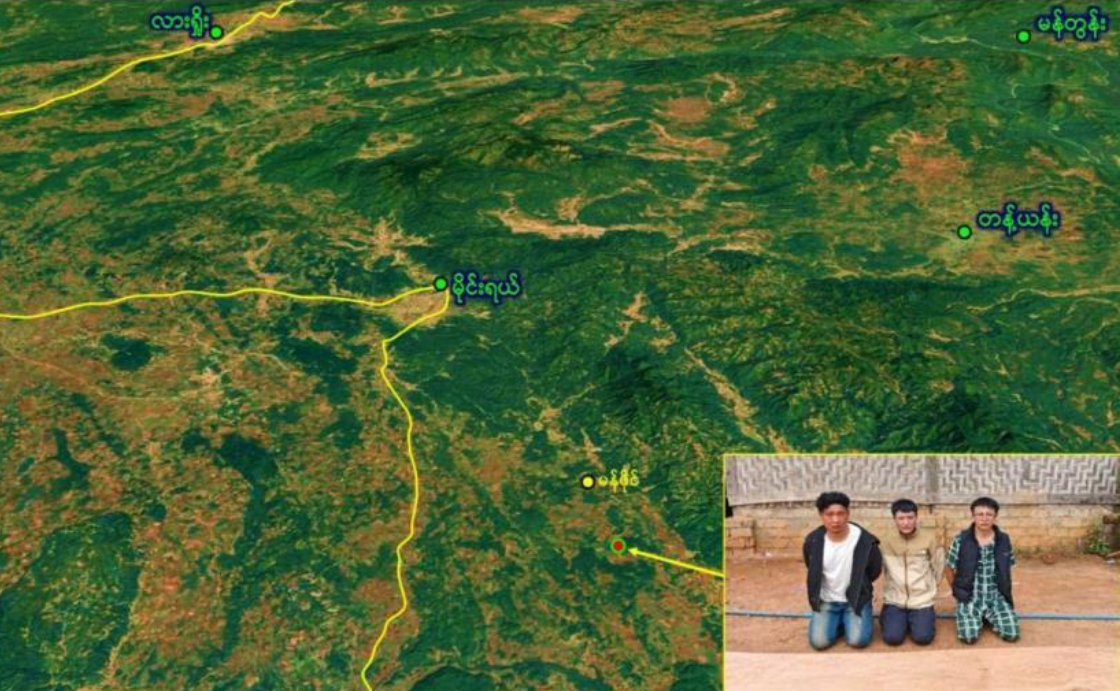
Myanmar's military has apprehended three Chinese nationals suspected of orchestrating an online gambling scam enterprise in the remote border region of Mongyai Township in northern Shan State, marking the latest enforcement action in a widening campaign against transnational cybercrime. The operation, concluded on August 26, resulted in the seizure of substantial infrastructure and equipment reportedly used to defraud victims across Asia, underscoring the persistent challenge posed by organised cross-border fraud networks operating from pockets of Myanmar's ungoverned spaces.
The three suspects allegedly crossed into Myanmar through illegal border crossings and established a clandestine operation in a sparsely populated area approximately 26 kilometres southeast of Mongyai town and five kilometres south of Manphai Village. Local residents tipped off security forces about suspicious activity in the vicinity, prompting military personnel conducting routine security patrols to investigate further. The intelligence-led operation revealed a more elaborate setup than initially suspected, with multiple structures dedicated to running the scam gambling enterprise.
Authorities uncovered a network of makeshift facilities constructed to house the operation and conceal it from detection. The main structure was a large corrugated iron-roofed building measuring 50 by 20 feet with bamboo walls, supplemented by five additional temporary shelters constructed from tarpaulins of varying dimensions. This multi-building arrangement suggests a relatively sophisticated operation designed to compartmentalise different functions—likely separating those handling victim communications, financial transactions, and technical management.
The equipment seizure reveals the technological sophistication now common among such operations. Authorities recovered 25 mobile phones, which would have been used to maintain victim contact and coordinate fraud activities across multiple jurisdictions. Five all-in-one computers indicate a dedicated technical infrastructure for managing the scam platform and processing financial transactions. Two power stations seized alongside the equipment suggest the location lacked reliable grid electricity, a common characteristic of operations deliberately situated in remote border areas beyond easy government reach.
Particularly notable was the Starlink satellite internet device recovered at the scene. The presence of satellite connectivity demonstrates how transnational scam networks have adapted to operate beyond the reach of traditional telecommunications infrastructure, allowing them to maintain operations in areas where conventional internet service is unavailable or monitored. This capability enables syndicates to establish operations in the most remote and difficult-to-police regions while maintaining seamless communication with victim contact centres and financial processing networks elsewhere.
Myanmar's intensified crackdown on online scam operations represents a recognition of the broader regional challenge posed by these networks. The country has become a significant staging ground for cybercriminal enterprises targeting victims across Southeast Asia, China, Taiwan, and beyond. Many such operations operate with tacit tolerance from local armed groups controlling border regions, creating a complex enforcement environment where military action alone cannot fully dismantle the underlying ecosystem enabling their existence.
For Malaysia and other regional economies, the Myanmar operation carries particular significance. Malaysian victims represent a substantial portion of targets for online gambling scams and related fraud schemes, with cybercriminals specifically targeting affluent Southeast Asian populations. The sophistication evident in this Mongyai operation—satellite connectivity, distributed infrastructure, multiple communication channels—reflects the evolution of organised cybercrime syndicates operating far beyond simple internet-based fraud and into fully professionalised criminal enterprises with significant capital investment and organisational complexity.
The Starlink seizure in particular illustrates how legitimate space technology has been repurposed by criminal networks. As satellite internet expands across remote regions, regulatory frameworks have struggled to keep pace, creating opportunities for syndicates to exploit gaps in oversight. This technological arms race between law enforcement and organised crime presents an emerging challenge for the entire region, particularly as bandwidth capacity expands and costs decline, making satellite internet increasingly attractive to criminal enterprises.
Myanmar authorities have committed to systematically dismantling all illegal structures used by scam operations and intensifying surveillance of border regions prone to such activity. However, enforcement challenges remain substantial. The porous nature of Myanmar's northern borders, the presence of non-state armed groups with competing interests, and the difficulty of policing vast mountainous terrain create an environment where new operations can quickly establish themselves following enforcement actions elsewhere. The fundamental economic incentives driving participation in these networks—the relative ease of generating substantial income compared to legitimate alternatives in border regions—remain largely unaddressed.
The arrested suspects will face prosecution under Myanmar's existing laws following completion of questioning and investigation, though the specific charges and potential sentences remain unclear from current reporting. Historically, Myanmar's judicial system has imposed varying penalties for online scam operations, with outcomes often dependent on factors including the suspects' cooperation with authorities and the extent of demonstrated victim harm. Foreign nationals arrested for cybercrime typically face charges under Myanmar's information and communications technology laws alongside broader criminal statutes covering fraud and illegal border crossing.
The broader regional context indicates that Myanmar's action, while significant, represents just one enforcement operation within a much larger criminal ecosystem. Intelligence assessments suggest dozens of similar operations remain active across Myanmar's border regions, with new syndicates continuously establishing operations to replace those disrupted. The financial returns from online scam gambling—where victims can lose hundreds of thousands of ringgit or more through manipulated platforms—provide sufficient incentive for organised crime networks to rapidly reconstitute operations following enforcement action.
For Malaysian authorities and regional law enforcement agencies, the Myanmar bust reinforces the necessity of international cooperation and intelligence sharing to disrupt victim contact chains and financial flows. Many scam operations targeting Malaysian victims maintain call centres in one country, technical infrastructure in another, and financial processing networks spanning multiple jurisdictions. Addressing these networks effectively requires coordinated action across borders, supported by agreements on information sharing and extradition—areas where Southeast Asian cooperation remains inconsistent and underdeveloped relative to the scale of the threat.

