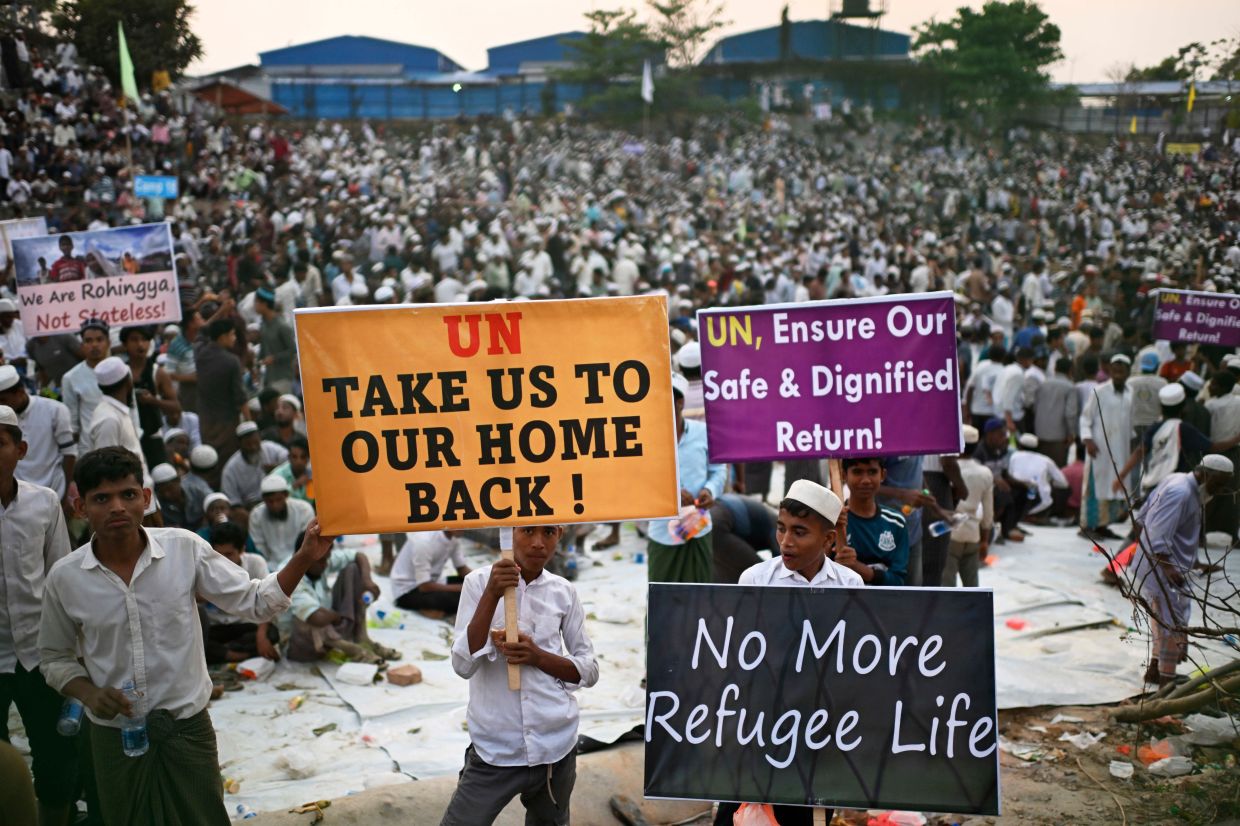
Myanmar's military-backed government announced Saturday that more than 300,000 Rohingya refugees sheltering in camps across Bangladesh are confirmed to have originally lived in Rakhine state, with assurances that it will permit their repatriation once security conditions in the region stabilise. The declaration by the Ministry of Foreign Affairs marks a significant moment in a humanitarian crisis that has now stretched across nine years, with the bulk of the persecuted minority still confined to sprawling refugee settlements in Bangladesh following a mass exodus triggered in August 2017.
The events of 2017 fundamentally reshaped the region's geopolitical landscape. Myanmar's military responded to insurgent attacks by Rohingya groups against guard posts in Rakhine by launching what became one of the most brutal operations in recent regional history. Over 700,000 Rohingya fled across the border into Bangladesh during this period, joining hundreds of thousands of others who had already sought refuge there after decades of systematic persecution and episodic violence orchestrated by Myanmar's military apparatus. The sheer scale and calculated nature of the operation prompted accusations of ethnic cleansing and genocide from the United Nations and numerous international human rights bodies, expressions of concern that Myanmar has consistently dismissed.
At the heart of this intractable dispute lies a fundamental question of nationality and belonging. Myanmar's government refuses to recognise the Rohingya as one of the country's 135 officially recognised ethnic minorities, instead categorising them as "Bengalis" to suggest they are immigrants from Bangladesh illegally settled in Myanmar. This denial of citizenship has been central to the exclusion and marginalisation of the Rohingya for decades, denying them voting rights, freedom of movement, and access to basic services. The framing itself becomes a tool of statelessness, positioning the Rohingya as perpetual outsiders in their homeland.
According to Myanmar's verification process, the government examined 828,824 refugees listed by Bangladesh and determined that 426,545 met criteria for verification. Of these verified individuals, 308,797 were identified as former residents of Rakhine. However, the government also reported that 113,507 people could not be verified through its process, and that 4,241 individuals were flagged as having involvement in what Myanmar characterised as terrorist activities. These figures reveal the profound challenge of documenting and establishing identity for populations that fled in chaos and have lived in limbo for nearly a decade.
The verification claim appears designed to demonstrate Myanmar's willingness to engage in repatriation discussions, yet it arrives alongside sweeping refutals of other displacement figures. Myanmar rejects assertions that more than one million people were displaced from Rakhine, instead contending that roughly 540,000 crossed into Bangladesh following the 2017 violence while more than 200,000 remained in northern Rakhine. These competing narratives reflect the broader information warfare that has characterised the crisis, with international observers and Myanmar providing vastly different accounts of events on the ground.
Any meaningful repatriation remains elusive, despite formal agreements signed years ago. Myanmar and Bangladesh concluded a two-year repatriation framework in 2018, yet virtually no refugees have returned under this arrangement. The security environment that was already fragile deteriorated dramatically following the military's February 2021 coup, which toppled Aung San Suu Kyi's elected government and sparked widespread armed resistance across Myanmar. This insecurity fundamentally undermined the conditions necessary for safe refugee returns and signalled that resolving the Rohingya crisis would take a backseat to regime consolidation.
The situation in Rakhine itself has become increasingly volatile and unpredictable. Fighting between the Arakan Army, an ethnic armed group based in Rakhine, and Myanmar's military has intensified since 2023 as competing forces battle for territorial control. The Arakan Army has captured substantial portions of Rakhine from the military in recent years, establishing effective control over much of the state. This fragmentation of authority and ongoing armed conflict creates precisely the conditions least conducive to refugee repatriation, as basic security cannot be guaranteed and infrastructure remains damaged.
The deteriorating humanitarian situation within the refugee camps themselves has become a secondary crisis. Poor conditions, including overcrowding, limited access to education and employment, and insufficient healthcare, combine with dramatic reductions in international humanitarian assistance to create an increasingly desperate environment. Facing what appears to be indefinite confinement with minimal prospects for return, growing numbers of Rohingya refugees have taken extraordinary risks by attempting perilous maritime journeys to Southeast Asian countries, particularly Malaysia and Indonesia. These journeys across the Indian Ocean in unseaworthy vessels have claimed numerous lives and highlighted the desperation driving escape attempts.
Malaysia has emerged as a primary destination for these refugee flows, a role that has complicated bilateral relations with Myanmar. Prime Minister Anwar Ibrahim stated in late July that Myanmar had committed to accepting 5,000 Rohingya refugees currently residing in Malaysia, framing this as part of a broader repatriation initiative. This announcement appeared to signal diplomatic progress and Malaysian efforts to manage its own refugee populations through coordinated returns. However, Myanmar's foreign ministry official Han Win Aung promptly contradicted this narrative, telling the Associated Press that repatriation discussions were narrowly focused on verified Myanmar nationals held in detention facilities in Malaysia and explicitly rejected suggestions that Myanmar would accept Rohingya populations.
This contradiction between Malaysian and Myanmar official statements underscores the fragility of any consensus on repatriation and the deep divisions that persist regarding the Rohingya's status and future. For Malaysia and other Southeast Asian nations hosting significant Rohingya populations, the impasse leaves them managing humanitarian obligations for populations that Myanmar refuses to systematically reintegrate. The verification announcement, while potentially laying groundwork for future discussions, does not alter the fundamental security and political obstacles that have prevented meaningful returns throughout the crisis's nine-year duration.
For the broader Southeast Asian region, the Rohingya crisis represents a test of collective humanitarian commitment and bilateral diplomacy. The persistence of the crisis reflects how security concerns, nationalist politics, and questions of state sovereignty can override international humanitarian norms. As conditions in refugee camps continue to deteriorate and maritime escape attempts increase, pressure will intensify on Myanmar to create conditions for safe return, and on countries like Malaysia and Bangladesh to manage populations they did not create. Without substantial shifts in Myanmar's security environment and political commitment to repatriation, the Rohingya appear destined to remain in prolonged limbo, neither fully accepted by host countries nor permitted to return home.

