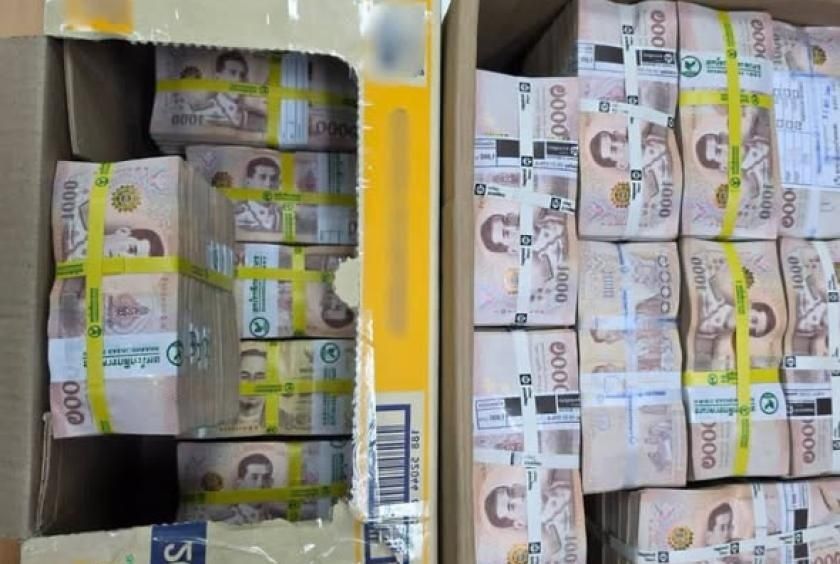
A 31-year-old Myanmar national faces charges after Thai customs officials intercepted what authorities believe was an attempt to illegally transport more than 23 million baht across the Thai-Myanmar Friendship Bridge at Mae Sai. The arrest highlights persistent challenges with currency smuggling in mainland Southeast Asia's border zones, where porous checkpoints and cross-border trade continue to present opportunities for financial crimes despite tightened security measures in recent years.
The incident unfolded when Thai customs personnel conducted a routine inspection of a privately owned vehicle displaying Myanmar licence plates as it traversed the Friendship Bridge on the Thai side of the Mae Sai border checkpoint. What appeared to be an ordinary commercial crossing became a significant enforcement action when officials examined the vehicle's contents more closely. The discovery of substantial quantities of Thai currency concealed within food packaging raised immediate red flags among the inspection team, triggering a full investigation into the shipment's origins and intended destination.
According to the seizure details released by Thai authorities, customs officials uncovered approximately 17 million baht in one carton and an additional 6.023 million baht in a second carton, with both sums carefully packed into plastic bags and hidden among dried fish and potato products. The deliberate choice of food items as concealment material reflects a common smuggling technique along regional borders, where everyday agricultural commodities are routinely transported across checkpoints and therefore attract less scrutiny than other goods. The method demonstrates a level of planning and sophistication in the operation, though authorities were able to detect the illicit cargo during their inspection procedures.
The total value of seized currency—23.023 million baht, equivalent to approximately US$689,077—underscores the scale of capital flight concerns that continue to preoccupy regional financial regulators. The amount represents a substantial sum that, if successfully transported, would have constituted a significant financial transaction without proper authorization or documentation. For Myanmar, where currency controls and foreign exchange management remain complex issues amid ongoing political and economic instability, such outflows are particularly concerning as they can deplete limited forex reserves and distort macroeconomic indicators.
Thai authorities have determined that the alleged offence violates multiple legal frameworks, specifically citing breaches of Thailand's Customs Act alongside violations of the kingdom's foreign exchange control regulations. These dual charges reflect the nature of the transgression, which involves not only the illicit movement of goods across borders but also the unauthorized transfer of currency beyond Thailand's jurisdiction. The regulatory structure governing such matters is designed to maintain oversight of capital flows and prevent the use of trade networks for money laundering or financing of illicit activities.
The Mae Sai border checkpoint, situated at one of the busiest crossing points between Thailand and Myanmar, processes thousands of vehicles and pedestrians daily, making it a focal point for both legitimate commerce and smuggling operations. The Friendship Bridge serves as a vital artery for regional trade and people movement, connecting the Thai province of Chiang Rai with Kyaikto township in Myanmar's Shan State. Given the volume of traffic and the economic incentives for illegal currency movement, maintaining effective customs enforcement at this location remains a persistent challenge for Thai authorities.
The driver remains in custody at Mae Sai Police Station as the investigation progresses. Thai law enforcement officials have indicated that the inquiry extends beyond the individual apprehended, with authorities actively pursuing leads to identify associates or network members who may have been involved in organizing or facilitating the smuggling attempt. Such investigations often reveal broader trafficking networks that coordinate multiple shipments across different border points, utilizing various concealment methods and transportation routes to maximize the volume of capital successfully moved.
The incident reflects broader patterns of financial crime and currency smuggling that have persisted throughout mainland Southeast Asia despite enhanced border security protocols. Myanmar's ongoing political turmoil and economic difficulties have created significant incentives for individuals and businesses to move capital out of the country, while Thailand's relative economic stability makes it an attractive destination for such transfers. The gap between official exchange rates and black market rates in some border regions further incentivizes illegal currency movement, as traders and individuals seek to maximize returns on cross-border financial transactions.
Regional experts have long noted that effective counter-smuggling operations depend on coordinated enforcement between neighbouring countries, intelligence sharing, and sustained investment in customs infrastructure and training. The Mae Sai case demonstrates that individual enforcement actions, while important for specific interdictions, represent only one component of a comprehensive strategy to combat capital flight and financial crimes. The challenge facing Thai and Myanmar authorities involves not only detecting and preventing individual smuggling attempts but also disrupting the underlying networks and economic incentives that fuel such activities.
For Malaysian readers following regional security developments, this incident underscores the complex interplay between trade facilitation and security enforcement at Southeast Asian borders. As Malaysia itself operates multiple border crossing points with significant daily traffic volumes, the technical and procedural challenges illustrated by the Mae Sai case have direct relevance to domestic customs operations. The sophistication of smuggling methods—particularly the use of everyday food commodities as cover for contraband—represents an ongoing training and vigilance challenge for customs personnel throughout the region.
The broader implications extend to regional financial stability and money laundering prevention frameworks. Uncontrolled currency movements can distort local money supplies, affect exchange rate stability, and provide channels for proceeds from organized crime or terrorism financing to move across borders undetected. Thailand's enforcement action, therefore, serves not merely as a discrete border security matter but as part of the interconnected system of financial controls that member states of the Association of Southeast Asian Nations maintain to protect regional economic integrity and security.

