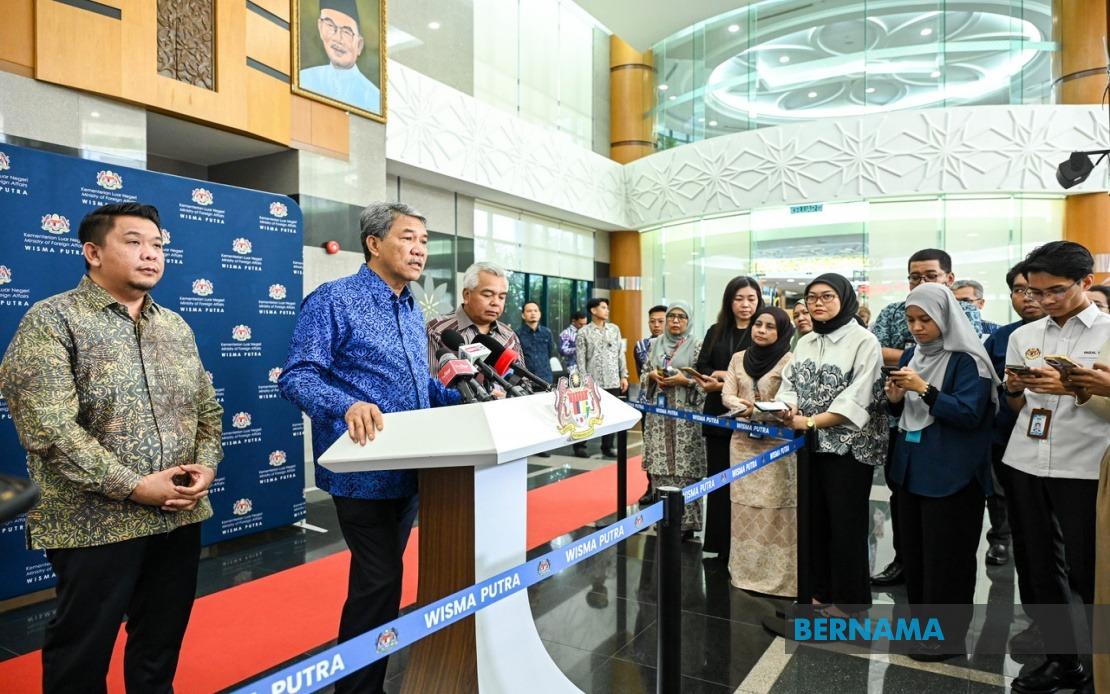
Myanmar has signalled its readiness to bring back 5,000 of its nationals currently sheltering abroad through maritime transport, Malaysian Foreign Minister Datuk Seri Mohamad Hasan disclosed on Monday following the 59th ASEAN Day commemoration in Putrajaya. The development emerged from recent diplomatic discussions between Mohamad and Myanmar's newly appointed Foreign Minister Tin Maung Swe, marking a potentially significant step in addressing one of Southeast Asia's most protracted displacement crises.
The prospect of repatriating a substantial cohort of refugees by ship, however, remains conditional on stringent safety guarantees for the returnees. Mohamad underscored that while Myanmar's willingness to facilitate the return represents genuine progress, the international community cannot simply accept assurances at face value. The fundamental question of whether these individuals can safely return to their homeland—and what circumstances might await them upon arrival—demands careful scrutiny before any maritime operation commences. This cautious stance reflects Malaysia's acute awareness that precipitous repatriations could expose vulnerable populations to renewed persecution or uncertain futures.
Malaysia has already conducted comprehensive identification and verification of the 5,000 individuals earmarked for return, demonstrating concrete preparatory work. Despite the absence of a formal timeline, Mohamad indicated that authorities intend to accelerate the repatriation schedule once safety protocols are finalised. This dual emphasis on speed and caution reflects the delicate balance Southeast Asian nations must strike between addressing humanitarian obligations and avoiding hasty decisions that could damage the credibility of refugee protection frameworks across the region.
Critically, Mohamad broadened the conversation beyond the predominant international focus on Rohingya displacement. Myanmar's refugee populations encompass multiple ethnic minorities facing upheaval, particularly the Chin and Karen communities who have endured sustained conflict and marginalisation. By highlighting this diversity, Malaysia's foreign minister challenged the often oversimplified Western narrative that treats Myanmar's refugee crisis as a monolithic Rohingya issue. This perspective gains urgency as ongoing instability since the 2021 military coup continues displacing diverse populations, each with distinct claims on humanitarian assistance and asylum protection.
ASEAN's institutional response to Myanmar's turmoil remains anchored in the Five-Point Consensus, a diplomatic framework agreed at the April 2021 ASEAN Leaders' Meeting. This agreement, which Myanmar's then-military junta pledged to honour, ostensibly commits the regime to ceasing violence, pursuing dialogue with opposition forces, and permitting humanitarian access. Mohamad reiterated that this foundational document must remain central to ASEAN's engagement strategy, cautioning against unilateral modification without collective leadership endorsement. His emphasis reflects growing concerns that Myanmar's current government might attempt to reshape or sideline the agreement if ASEAN members fail to maintain unified pressure.
The foreign minister's insistence that any revisions to the Five-Point Consensus must return to the negotiating table reveals underlying tensions within ASEAN's approach to Myanmar. Some member states have grown frustrated with the framework's limited success in restraining military violence or addressing humanitarian catastrophes, while others remain committed to dialogue-based solutions. Malaysia's position appears to defend the multilateral consensus-building process itself, arguing that fragmenting ASEAN's approach would prove counterproductive. This institutional conservatism carries risks, however, if the framework's demonstrated ineffectiveness continues to produce refugee flows that destabilise neighbouring countries.
For Malaysia specifically, the refugee situation represents an acute and persistent policy challenge. The country currently hosts approximately 170,000 registered UNHCR refugees, with an estimated additional 100,000 undocumented migrants. Myanmar's displaced populations constitute a significant proportion of this demographic, placing extraordinary strain on social services, housing, and labour markets in Malaysian urban centres. The prospect of repatriating even 5,000 individuals could theoretically ease this pressure, yet uncertainty about their legal status and safety upon return complicates Malaysia's humanitarian calculations. The nation must simultaneously appear compassionate to international observers while managing domestic political sensitivities surrounding immigration and resource allocation.
The maritime repatriation approach carries particular significance for Southeast Asia's maritime security architecture. Large-scale refugee movements by sea evoke memories of the 1970s Vietnamese boat people crisis and more recent Rohingya maritime disasters that claimed thousands of lives. Organising safe passage through Southeast Asian waters requires coordination among multiple naval authorities, transparent international oversight, and robust safeguarding protocols. Myanmar's stated willingness to facilitate this process through shipping logistics could serve as a confidence-building measure, yet practical implementation obstacles remain formidable.
ASEAN's collective engagement with Myanmar's crisis reflects the bloc's broader tension between respecting national sovereignty and addressing humanitarian imperatives. Myanmar's neighbours, particularly Thailand and Bangladesh, have absorbed enormous refugee populations while the military regime shows little meaningful progress toward political reform. Malaysia's diplomatic efforts to keep Myanmar engaged with ASEAN's consensus framework appear designed to maintain dialogue channels while avoiding outright confrontation that could trigger Naypyidaw's further isolation or defiance. Whether this gradualist approach ultimately produces substantive improvements in refugee protection or merely postpones reckoning with ASEAN's limited leverage remains an open question.
The repatriation initiative also intersects with broader regional migration management debates. Southeast Asian governments increasingly seek to manage cross-border population movements through organised frameworks rather than improvised emergency responses. If Myanmar's willingness to facilitate orderly returns through shipping channels can be translated into operational reality, it could establish a model for managing future displacement crises across the region. Conversely, if safety concerns prove insurmountable or returnees face mistreatment, the initiative could undermine confidence in coordinated repatriation mechanisms and encourage clandestine smuggling operations that prove far more dangerous for vulnerable populations.
Looking forward, Malaysia and its ASEAN partners face critical decisions about deepening investment in diplomatic engagement with Myanmar or pursuing alternative strategies. The five-point consensus framework has produced neither political reconciliation nor humanitarian breakthrough during its three years of existence. Yet abandoning collective ASEAN mechanisms might fragment the region's response capacity and eliminate remaining diplomatic leverage. Mohamad's cautious optimism about repatriating 5,000 refugees should be understood not as a breakthrough but rather as a marginal advance within a fundamentally constrained diplomatic environment where solutions remain frustratingly elusive.

