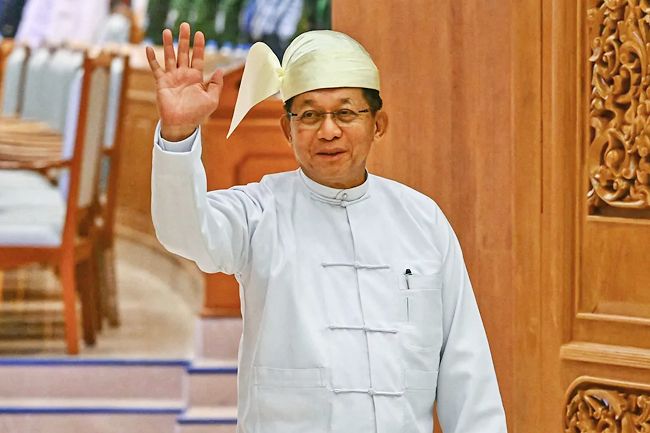
Myanmar's military leader Min Aung Hlaing is set to travel to Bangkok next month for high-level talks with Thai Prime Minister Anutin Charnvirakul, marking another diplomatic overture toward a nation that has become increasingly isolated within Southeast Asia since the 2021 coup. Thailand's Foreign Minister Sihasak Phuangketkeow confirmed the August 6-7 visit to international media on Tuesday, following what he characterised as substantive discussions with fellow ASEAN foreign ministers gathered in Manila to chart a path forward on Myanmar's troubled relationship with the regional bloc.
The visit underscores Thailand's distinctive position within ASEAN on the Myanmar question. As the country sharing the longest land border with Myanmar and home to millions of Burmese refugees and migrants, Bangkok has emerged as the primary advocate for Myanmar's gradual reintegration despite the controversy surrounding the military administration's legitimacy. This stance has created fissures among ASEAN members, with some nations maintaining a stricter position on accountability and democratisation while others, particularly Thailand, prioritise stability and pragmatic engagement.
Although Myanmar technically remains an ASEAN member state, it has faced systematic exclusion from the bloc's principal forums and decision-making structures since General Min Aung Hlaing orchestrated the coup that deposed the democratically elected government of Aung San Suu Kyi. This suspension reflects the organisation's unprecedented move to marginalise a member, yet it has stopped short of formal expulsion, leaving Myanmar in an awkward liminal space where it retains nominal membership without meaningful participation.
Thailand's strategy for managing Myanmar represents what officials characterise as a "dual-track approach," one that simultaneously addresses immediate practical concerns while maintaining a theoretical commitment to ASEAN's peace framework. Sihasak outlined the immediate bilateral agenda, which extends beyond ceremonial diplomacy to tackle concrete security and social problems that directly affect Thai communities. Transnational organised crime, large-scale financial fraud operations, and drug trafficking represent ongoing challenges that require cooperation from Myanmar's authorities, creating leverage points for Bangkok's diplomatic engagement.
The framework Thailand is proposing fundamentally redefines how progress toward Myanmar's rehabilitation should be measured. Rather than insisting on immediate and comprehensive democratic restoration—a standard that would make near-term engagement impossible—Bangkok advocates for incremental benchmarks that acknowledge the complex realities on the ground. These include steps such as granting international observers access to political prisoners, reducing violence in border regions, and opening dialogue channels with armed ethnic organisations operating in Myanmar's periphery.
Sihasak's comments reveal a calculated acceptance that transforming Myanmar's political system will require considerable time, making overnight solutions unrealistic. This pragmatic stance reflects recognition that maintaining complete isolation has not proven effective in driving change, and that sustained engagement, however limited, might create conditions for eventual progress. The approach represents a deliberate gamble that diplomatic doors left slightly ajar are more likely to facilitate future openings than doors slammed entirely shut.
The timing of Min Aung Hlaing's visit follows his controversial consolidation of power through heavily restricted elections that formalised his transition from coup leader to civilian president. While critics globally view these elections as lacking legitimacy, Thai officials appear willing to interpret them as potential stepping stones toward eventual conversations with ethnic armed organisations and Myanmar's fractionalised opposition movements. Thailand's vision involves positioning itself as a bridge-builder and facilitator, particularly regarding dialogue with ethnic groups positioned along the Thai-Myanmar border region.
Philippine Foreign Minister Theresa Lazaro introduced an additional element to ASEAN's Myanmar strategy by revealing discussions around appointing a permanent, long-term special envoy to replace the current system of yearly rotating representatives. The existing rotation framework has proven inadequate for the complex task of sustained engagement with Myanmar, lacking the continuity and institutional memory necessary for meaningful diplomatic progress. A dedicated, full-time envoy would represent a significant institutional commitment and signal ASEAN's determination to address the crisis through dedicated resources.
The discussions in Manila also touched upon Myanmar's compliance with ASEAN's five-point peace plan, a framework established to guide the country's political transition. However, the frank acknowledgment of what constitutes measurable progress suggests that ASEAN members are engaging in fundamental recalibration of expectations. Rather than rigid adherence to predetermined timelines, the bloc appears to be moving toward a more flexible monitoring system that tracks incremental improvements while maintaining pressure for eventual substantive change.
For Malaysia and other Southeast Asian nations observing these developments, Thailand's approach presents a test case for engagement strategy. The outcome of August's meetings will reveal whether Bangkok's gradualist methodology can produce tangible results or whether it risks legitimising a military regime without securing meaningful commitments toward genuine democratic restoration. The stakes extend beyond Myanmar itself, touching on broader questions about ASEAN's effectiveness as a regional organisation and the bloc's ability to balance collective interests against individual member state preferences.
The refugee and migrant populations in Thailand—numbering in the millions—represent a crucial humanitarian dimension to these diplomatic calculations. Border violence, drug trafficking, and human smuggling networks all directly impact Thai citizens and communities, making Bangkok's engagement with Myanmar's authorities a matter of immediate national interest rather than abstract principle. This practical reality explains Thailand's willingness to maintain channels of communication even when other ASEAN members express reservations about appearing to accommodate the junta.
As Myanmar navigates its isolation and internal conflict, the August meetings in Bangkok will indicate whether ASEAN has finally settled on a coherent strategy for its troubled neighbour or whether the bloc remains fractured on fundamental questions of principle versus pragmatism. Thailand's visibility in leading these diplomatic efforts suggests that regional consensus, however uncomfortable, may be gradually consolidating around some form of engagement framework.

