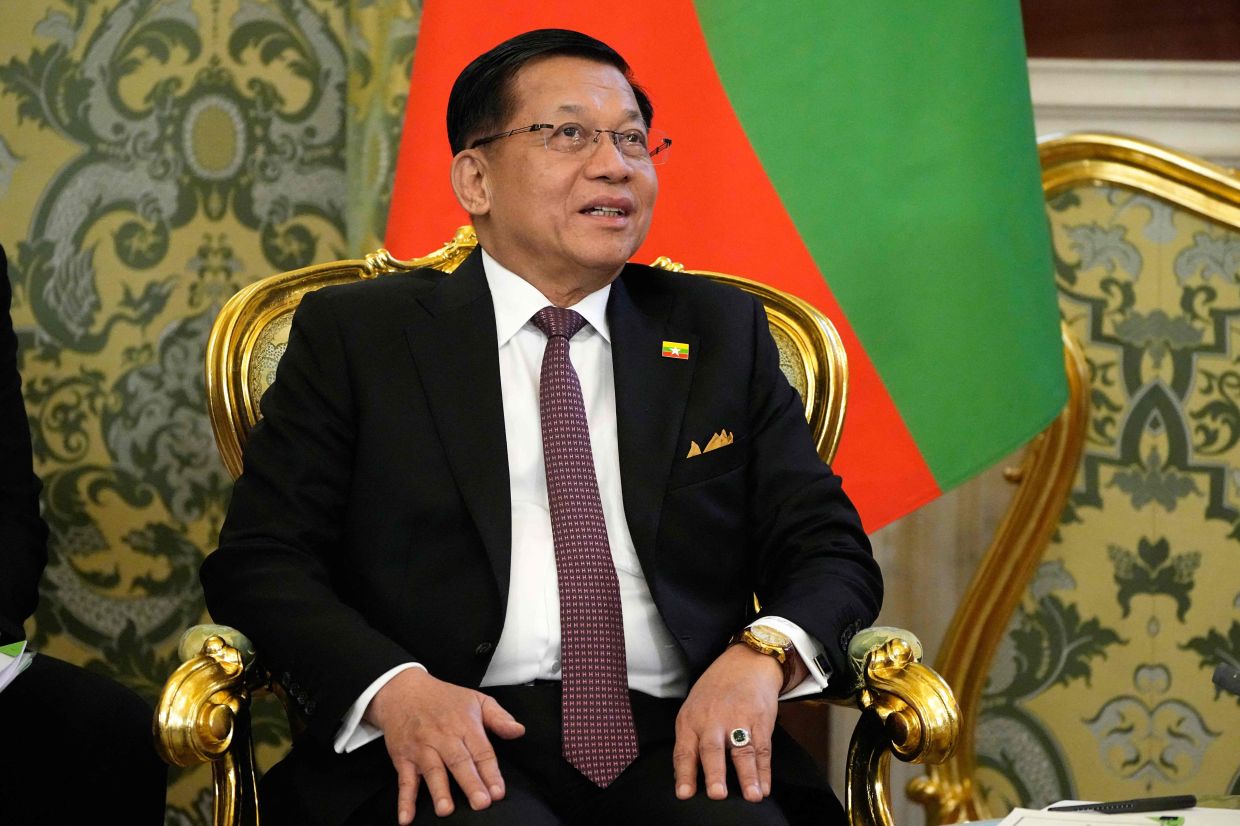
Myanmar's military leader Min Aung Hlaing is set to make an official visit to Cambodia in early September, marking another step in his sustained diplomatic offensive across the region and beyond. The announcement, confirmed by Cambodia's Senate, positions the journey as a bilateral strengthening exercise, with senior officials including the Minister of the Royal Palace and representatives from the National Committee for Organising National and International Festivals already inspecting potential venues in Phnom Penh to prepare for his reception.
The visit represents the latest leg in an extended tour that has already encompassed Russia, China, India, Thailand, and Laos since Min Aung Hlaing's election as president in April. Cambodian officials frame the encounter as a natural extension of regional cooperation, with Senate President's spokesperson Chea Thyrith emphasizing that the engagement aims to "strengthen the friendship between Cambodia and Myanmar" and highlighting the mutual benefits of closer bilateral collaboration. This characterization reflects Cambodia's own diplomatic positioning within Southeast Asia and its historical engagement with Myanmar's internal dynamics.
However, the Myanmar leader's peripatetic diplomacy has drawn sharp scrutiny from international human rights organizations and democracy advocates, who view the visits as a calculated strategy to gain external validation for a government widely condemned for systematic abuses. Since orchestrating the February 2021 coup that deposed democratically elected leader Aung San Suu Kyi and led to her detention, the junta has presided over what observers describe as widespread violations including the arbitrary imprisonment of thousands of activists, dissidents, and ordinary citizens. The April election that elevated Min Aung Hlaing to the presidency has been characterized by international observers as fundamentally flawed, lacking the transparency and competitive dynamics essential to democratic legitimacy.
The significance of Min Aung Hlaing's diplomatic tour cannot be separated from Myanmar's deepening international isolation. The Association of Southeast Asian Nations, of which Myanmar is a member, has effectively sidelined the country from high-level summits, refusing full participation until demonstrable progress is made toward resolving the political crisis. This exclusion represents an unprecedented rebuke within Asean's traditionally consensus-oriented framework, underscoring the severity of international concern regarding Myanmar's trajectory. By cultivating relationships with individual nations, particularly regional powers and fellow authoritarian or semi-authoritarian regimes, Min Aung Hlaing attempts to circumvent this collective pressure and establish parallel legitimacy.
Cambodia's willingness to host the Myanmar leader reflects broader geopolitical considerations within Southeast Asia. During Cambodia's tenure as Asean chair in 2022, the government invested considerable diplomatic energy in attempting to mediate Myanmar's crisis, seeking pathways toward reconciliation and stability. This engagement positioned Cambodia as a bridge-builder, and the incoming visit signals continuity in that role. According to Kin Phea, president of the International Relations Institute of Cambodia, the visit serves dual purposes: supporting Min Aung Hlaing's consolidation of international standing while simultaneously providing Cambodia an opportunity to leverage its own historical experience in post-conflict reconstruction and national healing.
Phea's analysis illuminates a nuanced dimension often overlooked in simplistic readings of such diplomatic exchanges. Cambodia's own complicated past involving civil conflict, authoritarian governance, and gradual democratization creates a particular vantage point for engagement with Myanmar's predicament. The suggestion that Cambodia might share insights regarding reconciliation, institutional rebuilding, and sustained peace-building processes acknowledges that diplomatic engagement can extend beyond ceremonial functions to substantive knowledge exchange. Yet Phea simultaneously cautions that external engagement, however well-intentioned, possesses inherent limitations when internal political will remains contested.
Crucially, Phea emphasizes that Cambodia's individual diplomatic gestures toward Myanmar carry less weight than the collective Asean framework. The five-point consensus agreement, established as Asean's conditions for Myanmar's full reintegration, represents the binding measure against which progress will ultimately be assessed. This consensus encompasses demands for an immediate end to violence, dialogue among Myanmar's stakeholders, provision of humanitarian assistance, and acceptance of an Asean envoy's mediation efforts. No single bilateral visit or individual nation's diplomatic recognition can override this collective requirement, a point that both clarifies and constrains Cambodia's role in the broader regional drama.
The timing of Min Aung Hlaing's Cambodia visit, following similar journeys to major regional and international powers, suggests a strategic sequencing designed to accumulate diplomatic capital and demonstrate sustained international engagement. Each visit generates media coverage, creates photographic evidence of governmental interactions, and incrementally normalizes the Myanmar junta's presence on the diplomatic stage. For observers tracking Myanmar's political evolution, these visits embody a troubling pattern whereby authoritarian consolidation proceeds through calculated image management and international relation-building, even as fundamental human rights concerns remain unaddressed.
For Malaysia and other Asean members, Myanmar's diplomatic tour carries implications for regional cohesion and the credibility of Asean's principles. The bloc's founding emphasis on non-interference and consensus decision-making faces persistent tension with its adoption of the five-point consensus as a binding condition for Myanmar's reintegration. Individual member states' diplomatic engagements with Myanmar must navigate between supporting regional stability and avoiding actions that might be construed as undermining collective Asean positions. Cambodia's approach—maintaining engagement while deferring ultimate judgments to regional consensus—offers one model, though not without critics who worry it inadvertently legitimizes exclusionary practices.
The broader significance of this Cambodian episode extends beyond bilateral Myanmar-Cambodia relations into questions about how Southeast Asia manages internal crises in an era of fragmented international responses. While Western nations and some regional partners maintain clear positions opposing Myanmar's military rule, countries including Cambodia, Thailand, and others pursue more accommodating diplomatic strategies. This divergence reflects genuine differences in strategic interests, historical relationships, and political systems across the region. For Myanmar's millions of citizens enduring political uncertainty and economic hardship, these diplomatic choreographies proceed with limited bearing on their daily struggles for stability, employment, and basic security.

