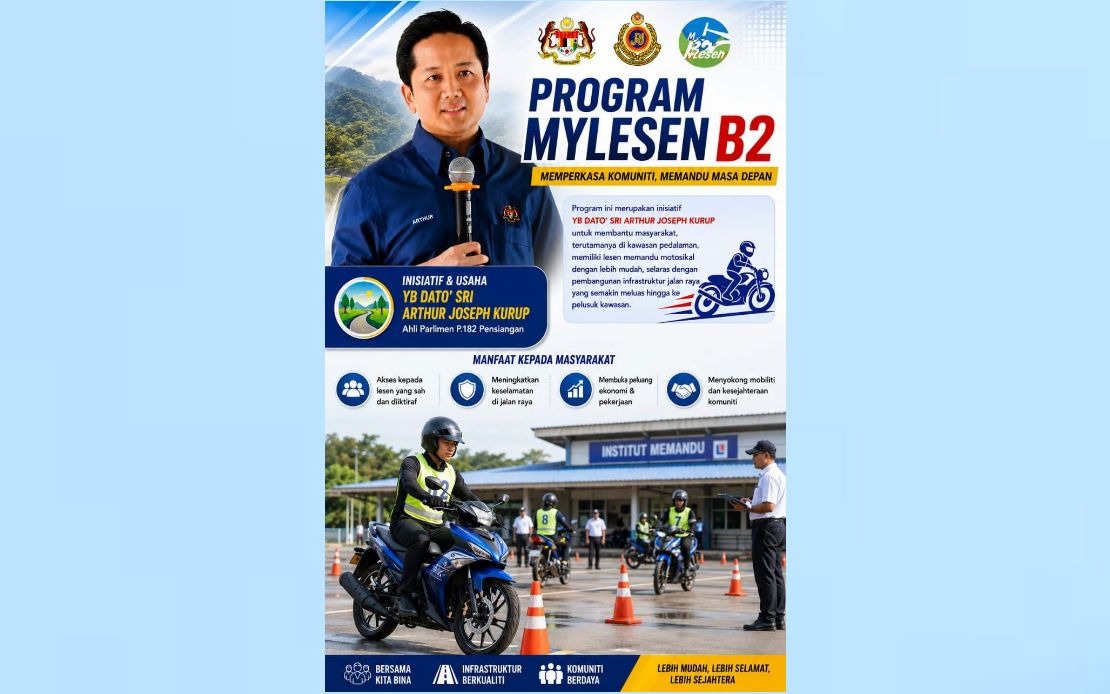
The MyLesen B2 programme has resumed delivery in Pensiangan, Sabah, addressing a persistent mobility challenge for residents in rural and remote areas who have historically faced barriers in obtaining valid motorcycle riding licences. By bringing licensing services directly to communities, the initiative eliminates the need for prospective riders to undertake expensive and time-consuming journeys to urban training centres, a significant logistical and financial burden for many rural Malaysians.
Datek Seri Arthur Joseph Kurup, the Member of Parliament for Pensiangan and Minister for Natural Resources and Environmental Sustainability, spearheads this localized licensing effort. He emphasises that the scheme maintains full regulatory rigour: all participants must complete mandatory training courses and pass the required examinations before being certified to ride. This balance between accessibility and safety standards ensures that expanded licensing does not compromise road safety protocols or create a two-tiered system where rural riders receive different or inferior training than their urban counterparts.
The underlying rationale extends beyond mere convenience. In rural and interior regions of Sabah, motorcycles serve as essential transport for daily economic and social activities. Young people particularly depend on reliable motorised transport for accessing employment, education, and healthcare facilities often distributed across dispersed settlements. Without valid licences, rural residents face legal risks, potential fines, and insurance complications, effectively pushing informal or illegal riding practices underground rather than encouraging compliance with traffic regulations.
MyLesen B2 targets individuals aged between 16 and 63, with particular emphasis on first-time licence applicants who have never previously held a driving licence of any category. This demographic includes school leavers entering the workforce, career changers, and older residents who have previously relied on unlicenced riding or alternative transport. By reaching across this age spectrum, the programme recognises that licensing needs extend well beyond the teenage cohort and acknowledges late-life economic mobility aspirations in rural communities.
Kurup underscores a dimension often overlooked in transportation policy: the economic empowerment that formal licensing enables. A valid motorcycle licence opens employment pathways previously closed to unlicenced riders, particularly in logistics, delivery, agricultural services, and tourism sectors where motorised transport is essential. For young women and men in rural areas facing limited local opportunities, the licence functions as a foundational economic credential, multiplying income potential and entrepreneurial possibilities. This framing positions licensing not merely as a safety mechanism but as a poverty-reduction and employment-creation tool.
The durability of the licence itself—remaining valid for lifetime use provided regulatory compliance is maintained—represents another incentive for participation. Unlike temporary permits or community-level arrangements, a formal MyLesen B2 licence provides permanent legal status, removing the anxiety of future enforcement actions or the need for periodic re-qualification. This permanence particularly appeals to individuals who view formal licensing as a significant life milestone and investment in their futures.
Operationally, the programme's accessibility is enhanced through service delivery at the Pensiangan Parliamentary Service Centre and the Sook State Assemblyman's Service Centre, embedding licensing registration within existing government service infrastructure familiar to local residents. This multi-location approach reduces friction in the application process and signals political commitment to decentralising government services beyond state capitals. The availability of registration forms at these accessible points removes another barrier—the need to travel to licensing offices to obtain application materials.
Road safety considerations form the philosophical foundation of MyLesen B2's expansion into Pensiangan. Rural areas frequently experience higher rates of motorcycle-related accidents, partly because enforcement is lighter and informal riding practices are more tolerated. By bringing formal training and licensing infrastructure into these communities, authorities encourage greater awareness of traffic laws, safety practices, and defensive riding techniques. The programme thus contributes to a longer-term cultural shift toward compliance with road safety standards in regions where motorcycle use is ubiquitous.
For Southeast Asia more broadly, Pensiangan's experience reflects a region-wide challenge: extending transport regulation and formal licensing to peripheral regions where informal practices persist. Malaysia's approach through MyLesen B2 offers a model combining accessibility with regulatory integrity—neither abandoning safety standards nor accepting that geographic remoteness justifies exclusion from formal systems. This balance is particularly relevant for neighbouring countries grappling with similar tensions between rural development aspirations and transport safety imperatives.
The programme's success will depend on sustained investment in training infrastructure and instructor availability in rural areas, as well as ongoing demand from residents. Monitoring will reveal whether accessibility improvements actually increase licence uptake or whether other barriers—cost, time commitments, or cultural preferences—limit participation despite proximity to services. Early uptake data from Pensiangan will inform whether MyLesen B2 should expand further into other rural constituencies across Sabah and beyond.
Ultimately, MyLesen B2's return to Pensiangan represents a deliberate policy choice to invest in transport equity and regulatory reach in underserved areas. Rather than concentrating licensing services in urban centres and implicitly accepting that rural residents must navigate urban bureaucracies, the initiative brings state capacity to communities. This approach acknowledges that motorcycle ownership and use are economic realities in rural Malaysia, and that formalising and regulating these practices benefits both individual riders and collective road safety outcomes more effectively than enforcement-focused alternatives.

