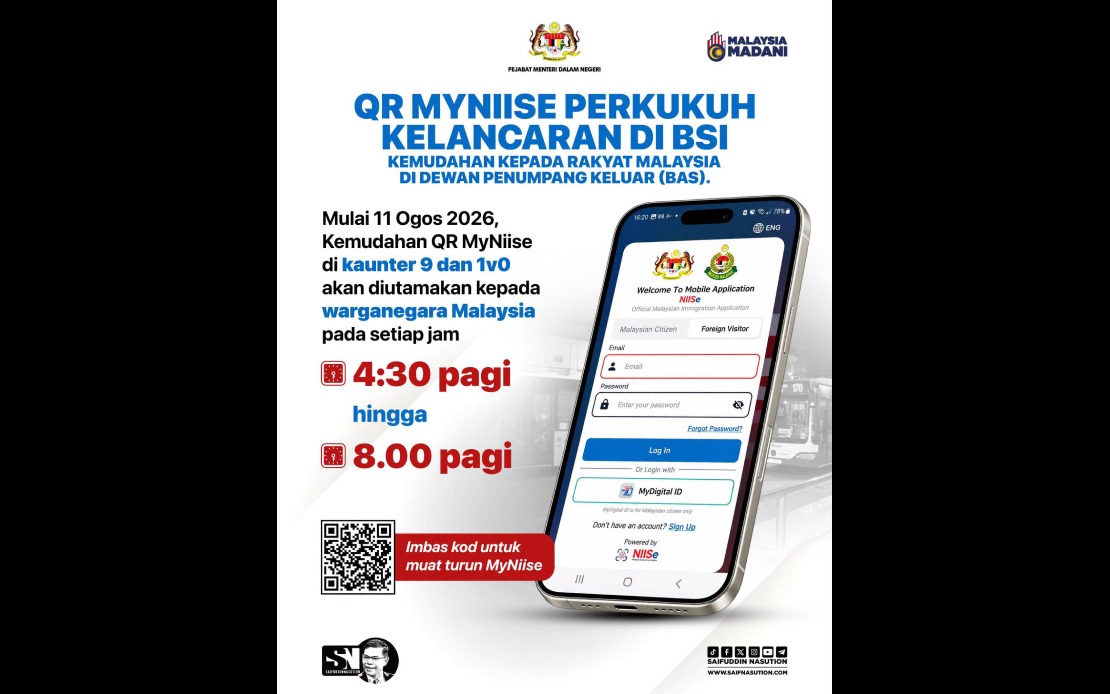
Malaysia's Home Minister Datuk Seri Saifuddin Nasution Ismail has introduced expedited immigration clearance for travellers using the National Integrated Immigration System (MyNIISe) QR code at Bangunan Sultan Iskandar (BSI), effective immediately. The initiative grants priority access at dedicated counters during the critical morning commute window, reflecting the government's commitment to modernising border operations and alleviating congestion at one of Southeast Asia's busiest land crossings.
The dedicated MyNIISe QR processing lanes have been established at counters 9 and 10 in the Bus Departure Hall, operating specifically during the 4.30 am to 8 am window when cross-border traffic peaks. This temporal focus acknowledges the particular strain on immigration services during early morning hours, when thousands of Malaysian workers rush to catch buses and reach their workplaces in Singapore before business hours commence. The minister's announcement, shared through his official Facebook channel, frames the initiative as a direct response to the documented challenges faced by daily commuters navigating the border during high-traffic periods.
The MyNIISe system represents a cornerstone of the government's digital transformation agenda, positioning Malaysia alongside regional peers in leveraging technology to enhance citizen services. The platform can be accessed across multiple ecosystems, available through the Apple App Store, Google Play Store, and Huawei App Gallery, ensuring broad compatibility with devices commonly used by the cross-border working population. This multi-platform availability is particularly significant in the Malaysian context, where smartphone penetration spans diverse income brackets and technology preferences.
For the estimated hundreds of thousands of Malaysians engaged in daily commutes to Singapore, the MyNIISe QR innovation addresses a genuine pain point. The early morning rush has historically created bottlenecks at immigration counters, with workers departing at dawn to navigate both border procedures and subsequent transport logistics. Even marginal reductions in processing time accumulate meaningfully over the course of a working week, translating into saved commute hours and reduced stress for time-sensitive travellers. The minister's framing explicitly acknowledges this reality, validating the experiences of daily cross-border workers who have contended with inconsistent wait times and unpredictable clearance periods.
The prioritisation strategy reflects a growing regional trend of deploying technology to manage immigration flows at major land borders. The Johor-Singapore crossing, handling well over one million cross-border trips monthly, faces perpetual pressure to balance security imperatives with efficiency demands. By channelling early adopters of digital systems into dedicated lanes, authorities create a natural incentive structure encouraging broader MyNIISe adoption while simultaneously reducing pressure on conventional queuing systems. This approach has been deployed successfully at comparable border crossings across Southeast Asia, where digital-first immigration processing has demonstrably improved throughput during peak hours.
The BSI facility's expansion follows an apparent successful pilot or limited deployment phase, suggesting the government has gathered operational data validating the MyNIISe system's effectiveness. The decision to allocate specific counters during defined hours indicates careful capacity planning rather than ad-hoc implementation. Immigration officials at BSI have presumably undergone training to manage the dual-system environment, ensuring that priority processing does not inadvertently create new bottlenecks or inconvenience non-digital users.
From a Malaysian economic perspective, streamlined cross-border commuting carries broader implications for labour market efficiency. Singapore's reliance on Malaysian workers across various sectors—from healthcare and education to construction and domestic services—means that smoother immigration procedures directly enhance the productivity and reliability of cross-border talent flows. Every minute saved at immigration represents cumulative economic value, both in terms of individual worker productivity and in reduced congestion externalities affecting broader supply chains and commerce dependent on Johor-Singapore connectivity.
The timing of this announcement, in mid-August, positions the initiative as part of the government's ongoing public service modernisation messaging. The Home Ministry's emphasis on reducing congestion while maintaining security standards reflects an increasingly sophisticated understanding of border management as a balancing act between facilitation and control. The MyNIISe deployment suggests confidence in the system's maturity and security protocols, implying that priority access does not compromise screening standards but rather optimises processing sequences for pre-registered, digitally-compliant users.
Longer term, this initiative may serve as a demonstration case for expanded MyNIISe deployment across Malaysia's other immigration entry points. The Kuala Lumpur International Airport, Port Klang, and numerous other land borders handle substantial traveller volumes and could potentially benefit from similar priority processing mechanisms. Success at BSI—measured in user adoption rates, processing time improvements, and stakeholder satisfaction—would provide empirical justification for broader rollout, gradually shifting Malaysia's immigration infrastructure toward digital-first operations.
For businesses employing cross-border workers and logistics operators managing time-sensitive shipments, the MyNIISe initiative offers tangible operational benefits. Predictable border clearance times reduce scheduling uncertainty, potentially allowing for optimised transport timing and reduced vehicle idle time at the crossing. Over the course of months and years, such efficiency gains compound, contributing measurably to operational cost reduction and service reliability improvements across multiple economic sectors dependent on Johor-Singapore connectivity.

