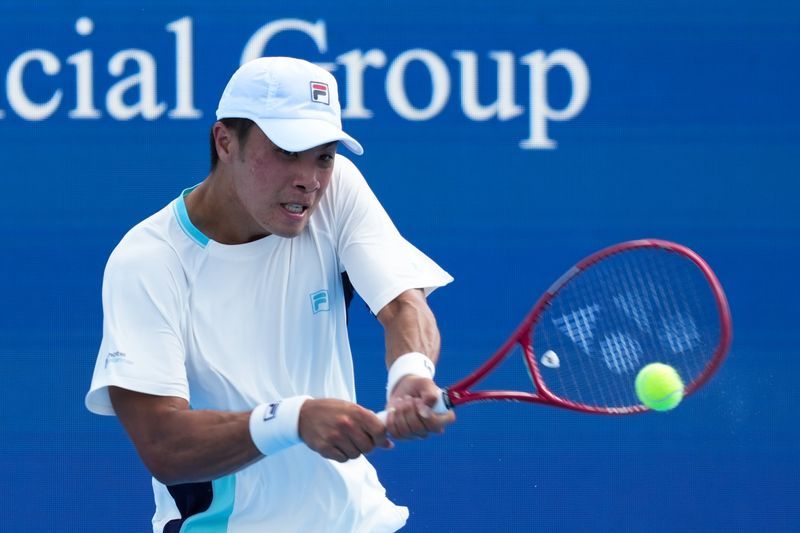
Brandon Nakashima's remarkable ascent through the North American hard-court season reached another peak on Friday when the 25-year-old American outlasted sixth-seeded compatriot Taylor Fritz in Cincinnati, advancing to the Masters 1000 semifinal with a 7-6(9) 4-6 6-3 victory. The triumph represents a defining moment in what has become the strongest run of Nakashima's career, punctuated by his ability to absorb pressure in critical moments and convert opportunities when momentum hangs in the balance.
The significance of Nakashima's performance extends beyond a single match victory. By reaching the Cincinnati Open semifinals, the world No. 27 has now secured back-to-back appearances at this stage of Masters 1000 events, having advanced equally far the previous week at Montreal. For tennis observers tracking the development of American male players heading into the U.S. Open later this month, Nakashima's consistency at this level signals genuine progress in his transition from occasional challenger to reliable contender at sport's highest echelon.
The opening set epitomized the quality of service-oriented tennis that both players brought to the court. Neither Nakashima nor Fritz surrendered a break opportunity throughout the opening frame, forcing the match into a tiebreak where precision and nerve became paramount. After an extended tiebreak featuring multiple lead changes and mini-break exchanges, Nakashima finally broke through when his opponent's ball sailed long on what would prove the decisive point. Converting his fifth set point demonstrated the mental fortitude that increasingly characterizes Nakashima's approach in tight situations.
Fritz responded emphatically to the setback, seizing control of the second set through aggressive returning that immediately destabilized Nakashima's service rhythm. The sixth seed's willingness to attack on return carried through to the conclusion of the frame, with Fritz clinching the set and leveling the match through an ace that underscored his capacity to execute when it mattered most. The structure of the match—with Fritz demonstrating capability but ultimately unable to sustain it—would define the afternoon's broader narrative.
The decisive third set became a study in momentum's volatility. Fritz initially seized the advantage, converting an early break to move to 3-2 through Nakashima's accumulating unforced errors. Yet the American's response was immediate and decisive. From 30-0 down, Nakashima recovered to break back at 3-3, a recovery that psychologically reoriented the encounter. His capacity to generate breaks from difficult serving positions has become a hallmark of his recent performances, distinguishing him from earlier iterations of his career when such resilience proved inconsistent.
From that pivotal moment at 3-3, Nakashima seized control definitively. He captured the final three games straight, with Fritz's error rate climbing as the 27th seed's confidence blossomed correspondingly. The disparity in unforced errors between the players widened perceptibly as fatigue and frustration took their toll on Fritz, who found himself unable to execute the service holds and returns that had threatened to control the match's trajectory moments earlier. This pattern—where Nakashima outlasts rather than outplays opponents—has become characteristic of his recent hard-court prowess.
The broader context of Nakashima's ascent matters considerably for those assessing American men's tennis. Entering the Cincinnati match with a 1-4 record against Fritz, Nakashima faced a head-to-head deficit that suggested Fritz possessed a tactical blueprint for success. Overcoming that historical disadvantage through sheer determination, particularly in a three-set encounter against a player ranked significantly higher, underscores genuine tactical improvement and psychological growth. His fourth top-10 victory of the season indicates he has developed the consistency required to compete regularly against elite opposition.
The semifinal matchup awaiting Nakashima features either Italian 10th seed Lorenzo Musetti or fellow American Frances Tiafoe. Regardless of the opponent, Nakashima enters as a player carrying momentum into the U.S. Open, where the hard courts of Flushing Meadows will reward the precise serving and aggressive baseline tennis that have characterized his recent performances. For Malaysian and Southeast Asian tennis enthusiasts, Nakashima represents part of a broader American resurgence in men's tennis, with younger players beginning to fill the gap created by retirement of previous generations.
The significance of consecutive Masters 1000 semifinals should not be understated. These results suggest Nakashima has moved beyond the category of occasional giant-killer into a player capable of sustained excellence at the sport's highest level. His mental resilience, demonstrated through multiple comebacks across both Montreal and Cincinnati, provides the foundation upon which further advancement might be built. The U.S. Open, commencing later this month, will test whether this hard-court excellence translates into the sustained pressure of a Grand Slam tournament.

