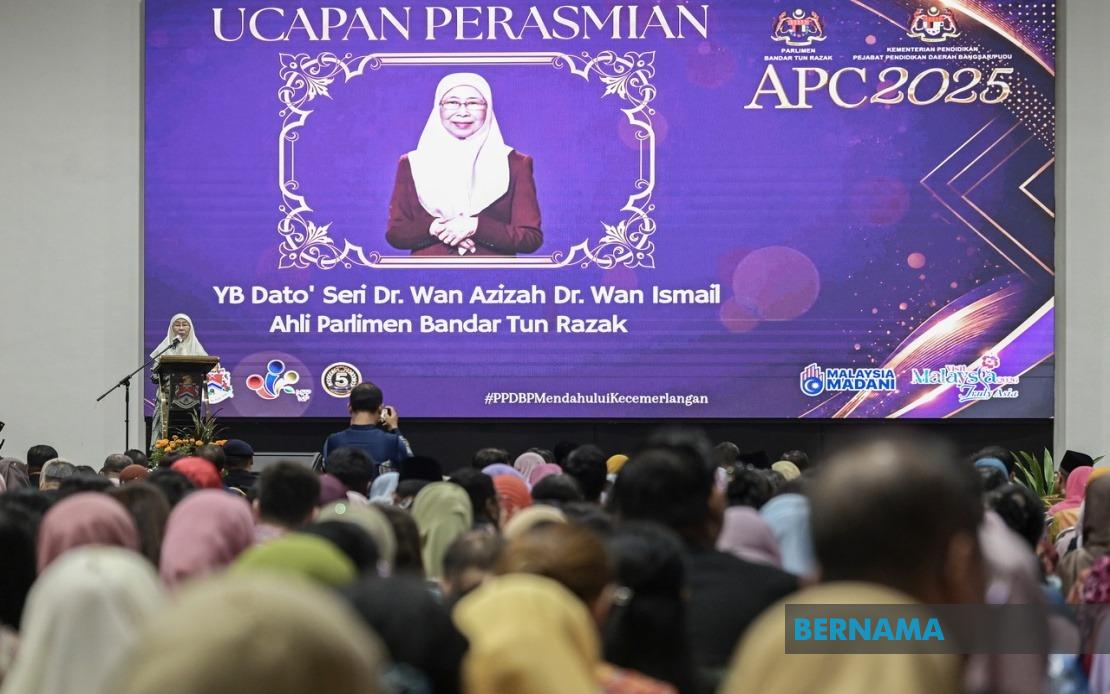
Malaysia's development cannot be measured solely through gross domestic product figures or skyline expansions, according to Prime Minister's wife Datuk Seri Dr Wan Azizah Wan Ismail, who argues instead that genuine national progress hinges on cultivating citizens equipped with intellectual rigour, moral integrity and compassion. Speaking at the 2025 Excellent Service Award ceremony organised by the Bangsar/Pudu District Education Office at the Kuala Lumpur City Hall Training Institute on July 23, the Bandar Tun Razak Member of Parliament articulated a philosophical framework that positions human capital development at the centre of national resilience—a perspective that carries particular significance given Malaysia's transition towards knowledge-based economic models.
The education sector occupies a pivotal position in this vision, Dr Wan Azizah underscored, precisely because teachers represent the primary institutional force shaping adolescent consciousness during formative years. Her observation acknowledges an institutional reality that extends beyond pedagogical theory: urban Malaysian children increasingly spend their waking hours within school premises while parents navigate demanding careers, making educators de facto guardians of character formation alongside their academic responsibilities. This demographic shift reflects broader structural changes in Malaysian society, where dual-income households and career mobility have redefined the traditional boundary between familial and institutional child-rearing.
Schools, from this perspective, function not as knowledge factories churning out credentialled graduates but as crucibles for developing integrated human beings capable of navigating moral complexity. Dr Wan Azizah articulated this distinction by emphasising that educational objectives transcend information transfer, instead encompassing the cultivation of integrity, social grace and empathetic consciousness. The framing implicitly critiques educational paradigms that reduce schooling to examination preparation and credential acquisition, suggesting instead a more holistic developmental agenda centred on the formation of character alongside cognitive advancement.
The artificial intelligence revolution presents an additional imperative for this values-centred educational approach, Dr Wan Azizah argued. As algorithmic systems increasingly mediate information flows and automate routine cognitive tasks, the competitive advantage bestowed by conventional knowledge accumulation diminishes correspondingly. Instead, human capacities for ethical reasoning, critical evaluation and distinguishing substantive truth from manufactured falsehood emerge as increasingly scarce and valuable capabilities. This insight resonates particularly acutely within Southeast Asian contexts, where rapid digitalisation and information proliferation have outpaced institutional capacity for media literacy and epistemic discernment.
The ceremony itself honoured 746 educators and administrative personnel drawn from 143 schools across the Bangsar/Pudu district, with approximately 1,000 attendees witnessing the recognition of exemplary professional commitment throughout 2025. This scale of acknowledgment reflects both the numerical significance of the teaching profession within Malaysia's institutional infrastructure and the deliberate decision to grant public visibility and validation to educational work that frequently operates beneath public consciousness. By ceremonially elevating teachers' contributions, the event performs a cultural function beyond mere awards distribution, repositioning educators as custodians of national development rather than functionaries executing bureaucratic mandates.
Dr Wan Azizah's remarks contextualise this recognition within a broader governmental narrative concerning educational reform and excellence. Her invocation of the nation's greatest asset residing in its children signals alignment with developmental ideologies that position human resource development as foundational to sustained competitive advantage. This framing acknowledges implicitly that Malaysia's demographic dividend and labour market advantages cannot be indefinitely sustained without deliberate institutional investment in human capacity development, particularly as regional competitors advance technological capabilities and global labour markets reward increasingly specialised expertise.
The presence of senior government officials at the ceremony, including the Prime Minister's Political Secretary Datuk Azman Abidin and Kuala Lumpur Federal Territory Education Department director Megat Affandi Ismail, underscores institutional prioritisation of education sector engagement. Such high-level participation validates the educational sector's strategic importance within governance architecture while signalling executive commitment to recognising teaching profession contributions. The political symbolism extends beyond ceremonial protocols, communicating to educators that their work receives acknowledgment at decisional heights within government apparatus.
Dr Wan Azizah's emphasis on values-based education acquires particular resonance within Malaysian contexts characterised by religious and cultural pluralism. Educational systems serving diverse populations require deliberate pedagogical attention to universal ethical principles transcending sectarian boundaries, enabling students from varied faith and cultural traditions to engage meaningfully with shared civic frameworks. The invocation of compassion, ethical conduct and character development as educational objectives implicitly acknowledges this pluralistic reality, suggesting educational approaches oriented toward commonalities rather than particularities.
The institutional challenge articulated through Dr Wan Azizah's remarks extends beyond individual teacher performance toward systemic questions concerning curriculum design, assessment methodologies and educational priorities. If character formation and critical thinking represent genuine educational objectives, corresponding institutional mechanisms must facilitate their development and measurement. This raises substantive questions concerning pedagogical practices, teacher training programmes and examination systems—whether existing institutional arrangements genuinely support the ambitious developmental agenda her remarks articulate or whether structural misalignments persist between stated objectives and operational reality.
The temporal dimension of this discourse merits consideration as well. The recognition of 2025 service excellence occurs within an accelerating technological transformation period characterised by unprecedented information abundance and algorithmic mediation. These contextual factors lend urgency to Dr Wan Azizah's emphasis on ethical reasoning and truthfulness discernment, capabilities increasingly essential as digital systems proliferate and misinformation vectors multiply. The awards ceremony thus functions as a symbolic affirmation that human institutional actors—teachers and administrators—retain essential roles within contemporary educational ecosystems despite technological advancement.
Looking forward, the implications of this educational philosophy extend throughout Malaysian society's development trajectory. If policymakers genuinely embrace the proposition that national strength derives from cultivating ethically grounded, intellectually sophisticated citizens, corresponding resource allocation and institutional restructuring would necessarily follow. Teachers would require enhanced compensation reflecting their developmental significance, professional development resources would expand to support advanced pedagogical practices, and examination systems would evolve to assess capacities beyond rote knowledge retention. Whether governmental commitment translates into such substantive institutional reforms remains an open question requiring sustained scrutiny and advocacy from educational professionals and civil society.

