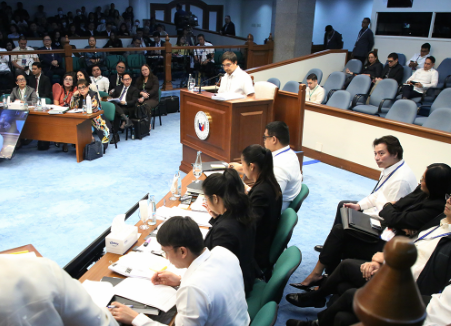
The impeachment trial of Vice President Sara Duterte took a significant turn on Tuesday when National Bureau of Investigation regional director Jeremy Lotoc testified that the Vice President possessed both the means and the intent to execute her publicly announced death threats against President Ferdinand Marcos, first lady Liza Araneta-Marcos and former Speaker Martin Romualdez. Speaking before the Senate impeachment court on the fifth day of proceedings, Lotoc unequivocally stated that Duterte was "capable" of carrying out the threats, reinforcing the prosecution's argument that her remarks crossed from political rhetoric into criminal conduct and a fundamental betrayal of constitutional duty.
Lotoc, who previously headed the NBI's Cybercrime Division investigation into Duterte's statements, grounded his assessment in both her official position and her family's political prominence. When pressed by Senate President Sherwin Gatchalian, the NBI official explained that her office as Vice President—the constitutionally designated successor to the presidency—gave her exceptional access to resources, influence and institutional power that ordinary citizens lack. Beyond her current role, Lotoc cited her political lineage, noting that her father Rodrigo Duterte served as president and that this background factored into the bureau's conclusion that she possessed tangible capability to implement her threats. This reasoning reflects a significant investigative finding: that Duterte's elevated position in the state apparatus, combined with her proven track record in wielding political influence, created conditions under which her threats could materially be executed.
Central to the prosecution's case is the contention that Duterte explicitly stated she had enlisted someone to carry out revenge killings should she face harm. During her November 23, 2024 online press conference and a subsequent November 26 interview, Duterte reiterated that she had spoken to a third party with instructions to exact revenge against the President and his family if she were killed. Lotoc testified that the NBI interpreted these statements as genuine declarations of intent rather than political posturing or rhetorical flourish. The investigation determined that elements of the crime of grave threats had been satisfied, leading the bureau to recommend criminal charges be filed with the Department of Justice. This assessment placed considerable evidentiary weight on the Vice President's own words, treating her public admissions as substantive evidence of a conspiratorial arrangement rather than idle speculation.
When Senate President Gatchalian questioned whether the NBI had concrete evidence identifying the alleged hit man or confirming such a person's existence, Lotoc acknowledged a critical investigative shortcoming. The Cybercrime Division possessed no independent corroboration—no intercepted communications, no witness statements, no financial transactions—that would establish the identity of the purported assassin or even verify that such an arrangement genuinely existed. Pressed further, Lotoc conceded that the bureau's entire conclusion rested fundamentally on Duterte's own statements and admissions. This admission raises a methodological question about the nature of the evidence: whether public declarations, even from a high-ranking official, constitute sufficient basis for concluding that a criminal conspiracy has been formed without supporting corroborative material.
The investigation's progress was further constrained by Duterte's refusal to cooperate. Lotoc testified that the NBI sought to question the Vice President directly to explore whether she had genuinely contracted an assassin, but she never appeared before the bureau. Instead of submitting to interrogation, Duterte submitted a written denial disputing the charges. Lotoc dismissed this response as legally insufficient, arguing that a mere written denial could not erase the fact that she had made the incriminating statements and allegedly approached someone with the request. This created a procedural impasse: the prosecution needed Duterte's own testimony to either confirm or clarify her intentions, but her absence meant investigators could not probe the veracity of her claims through direct questioning or assess whether contextual factors might alter the interpretation of her remarks.
During redirect examination, private prosecutor Amado Virgil Ligutan highlighted a crucial distinction in Duterte's response strategy. The Vice President had never explicitly denied making the controversial statements; instead, she had specifically denied hiring an assassin. This semantic separation became significant in Lotoc's retelling. He pointed to her November 26 interview as evidence that she reinforced rather than retracted her earlier declarations, suggesting that her reaffirmation demonstrated seriousness rather than extemporaneous speech. The prosecution used this pattern of reiteration to argue that Duterte remained committed to her stated position, treating the repetition across multiple public forums as evidence of deliberate intent and resolve rather than a single momentary outburst.
The defence's cross-examination strategy focused on technical deficiencies in the NBI's documentation, raising questions about typographical and clerical errors within the bureau's investigative records. However, Lotoc dismissed these objections as substantively irrelevant, contending that administrative mistakes in written documents did not undermine the investigative conclusions or the factual basis for determining that grave threats had occurred. The prosecution's adviser Robert Ace Barbers subsequently characterised the defence approach as tactical misdirection, arguing that attacking the form of the NBI's presentation rather than engaging with the substance of its findings represented an implicit acknowledgment that the core testimony could not be effectively challenged on factual grounds.
Another dimension of the case involved Duterte's invocation of "Operation Romanov," which she cited as evidence that there were genuine threats against her own life that motivated her defensive statements. When questioned about this alleged operation, Lotoc testified that the NBI traced the term's origin to Davao City Mayor Sebastian "Baste" Duterte during a January 2024 rally, and that it was directed at President Marcos and his family rather than at the Vice President herself. This finding directly contradicted Duterte's framing that she was responding to credible threats against her person. Furthermore, when vlogger Princess Maui introduced "Operation Romanov" during Duterte's November 23 online briefing, the NBI assessed her information as unreliable after she declined to appear before investigators to substantiate her claims. The bureau's conclusion was stark: it could not validate any such operation, and without the Vice President's cooperation or that of her associates, the investigation reached a dead end.
The prosecution's broader constitutional argument framed Duterte's conduct as betrayal of public trust—an impeachable offence under the Philippine Constitution. The argument rested on the proposition that a Vice President, as the nation's second-highest official and the constitutionally designated successor to the presidency, bears an elevated duty to uphold the Constitution and to refrain from conduct that undermines the rule of law or threatens the safety of the sitting president and government leadership. Duterte's public assassination threats, the prosecution contends, violated this heightened standard of conduct and raised serious questions about her fitness to remain in office and her suitability to assume the presidency should circumstances require it. This framing transforms the case from a criminal matter involving ordinary grave threats into a constitutional question about institutional loyalty and the moral qualifications necessary for high office.
The testimony also exposed a fundamental evidentiary asymmetry that will likely shape the trial's trajectory. The prosecution relies primarily on Duterte's own public statements as the foundation for its case, while the defence can point to the absence of independent corroborating evidence and the Vice President's refusal to clarify her intentions through direct interrogation. This asymmetry creates a scenario in which the credibility and interpretation of the Vice President's statements become the central battleground of the trial. Senators voting on the impeachment charges must ultimately determine whether her remarks constitute criminal grave threats and impeachable betrayal of public trust, or whether they fall within the bounds of political rhetoric, however inflammatory and inappropriate, that does not cross into actionable criminal conspiracy. The decision will hinge on how the senator-judges weigh the significance of Duterte's own words against the lack of additional evidence substantiating an actual conspiracy to commit murder.

