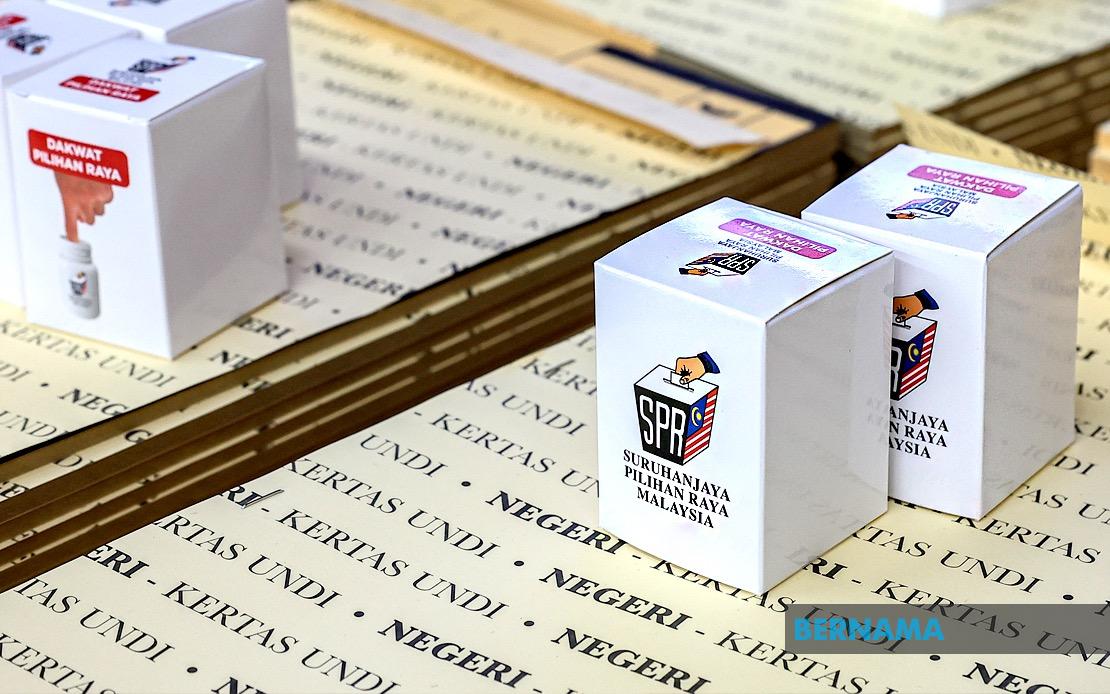
As Johor's 16th state election enters its final stretch, election officials are preparing for an early voting phase involving nearly 25,000 registered voters drawn exclusively from the armed forces and law enforcement communities. The figure of 24,751 early voters highlights the significant role that security personnel play in the state's electoral process, with dedicated polling infrastructure established to accommodate their participation ahead of the main polling day scheduled for Saturday, July 11.
The early voter contingent comprises two distinct groups of equal importance to Johor's security apparatus. Military personnel and their spouses account for 12,041 of the total, whilst police officers and their families make up the remaining 12,710 voters. This division reflects a deliberate administrative arrangement to manage the voting process for two large institutional constituencies whose operational demands would otherwise make participation in regular polling challenging.
The infrastructure mobilised for early voting demonstrates the scale of the electoral machinery at work. A total of 64 polling centres have been designated statewide, with the distribution reflecting each institution's footprint across Johor. Specifically, 53 of these centres have been allocated for police personnel and their spouses, whilst 11 serve the military vote. All facilities will commence operations simultaneously at 8 am, ensuring coordinated national security sector participation across the state.
Among the police contingent, voting arrangements follow two distinct modalities tailored to operational realities. Some 12,067 officers, their families, and civilian dependents will cast their votes in person at designated centres, representing the overwhelming majority of police-affiliated early voters. However, a smaller yet significant group of 643 police voters will exercise their franchise through postal ballot mechanisms, accommodating those whose duties prevent physical attendance at polling stations on the designated early voting date.
The deployment of security personnel to facilitate voting operations underscores the administrative complexity involved in managing such a significant early voting exercise. The police force alone will station 3,565 personnel across all relevant early polling locations, a figure encompassing 647 commissioned and senior officers, 2,806 rank-and-file constables, and 112 civilian administrative staff. These officers will shoulder multiple responsibilities extending well beyond the immediate polling environment.
Their mandate spans a comprehensive range of election security operations reflecting broad concerns about maintaining order throughout the voting process. Security control at each polling centre represents the most visible function, though escort duties for ballot boxes require dedicated personnel to ensure the integrity of collected votes. Traffic management around polling facilities, targeted crime-prevention patrols in surrounding areas, and the operation of command centres monitoring the overall process constitute additional layers of security provision. Furthermore, law enforcement personnel have been tasked with maintaining order across all affected localities, a preventive measure designed to deter any disruptions to the electoral exercise.
Operational logistics for early voting reflect the varying voter densities across the state's police and military installations. Polling centres will not all remain open for identical periods, instead closing in a staggered fashion between noon and 6 pm depending on their respective caseloads. The smallest facilities, such as the Buloh Kasap Police Station in Segamat, Tenang Police Station in Labis, and Bandar Penawar Police Station, each serving between six and 28 voters, are scheduled to close at the earliest hour. This flexible approach maximises operational efficiency whilst ensuring all registered voters can participate.
The largest concentrations of early voters are clustered at major institutional facilities reflecting command hierarchies and deployment patterns. The Federal Reserve Unit Hall No 2 at Johor Police Headquarters emerges as the single largest early polling centre, handling 1,338 voters who are affiliated with the Stulang state constituency. A substantial secondary facility operates at the KEMAS Preschool adjacent to the 6th General Operations Force Battalion in Bakri, serving 927 voters for the Bukit Naning state constituency. These figures illustrate how institutional clustering of security personnel generates substantial electoral concentrations in specific constituencies.
Weather considerations add another dimension to early voting preparations. The Malaysian Meteorological Department has forecasted morning rainfall across four districts—Batu Pahat, Muar, Pontian, and Tangkak—potentially affecting voter logistics and field operations in these regions. The remainder of Johor is expected to experience fair weather conditions, facilitating smoother voting and security operations in the state's other constituencies. Such meteorological forecasts inform contingency planning for poll officials and security coordinators.
The broader electoral context frames this early voting exercise as a preliminary phase of a significantly sized state election. The 16th Johor State Election will ultimately involve 172 candidates contesting across 56 state constituencies, making it a substantial electoral undertaking. The early voting scheduled for tomorrow represents the opening salvo in a multi-day electoral calendar, with the main polling date set for Saturday, July 11. This staggered approach, whilst accommodating security sector participation, also serves to distribute administrative load and reduce voter congestion at polling centres.
For Malaysian readers, the Johor election carries particular significance as Johor represents the nation's second-largest state by electoral weight and a traditionally influential political entity within the Malaysian federation. The security sector's participation in this election, accommodated through dedicated early voting arrangements, reflects democratic principles of universal suffrage applied across all demographic groups and institutional categories. The careful orchestration of voting logistics, security deployment, and administrative coordination demonstrated in these early voting preparations illustrates the operational complexity underlying Malaysia's electoral system, particularly when managing participation by large institutional constituencies whose regular duties might otherwise constrain their voting access.

