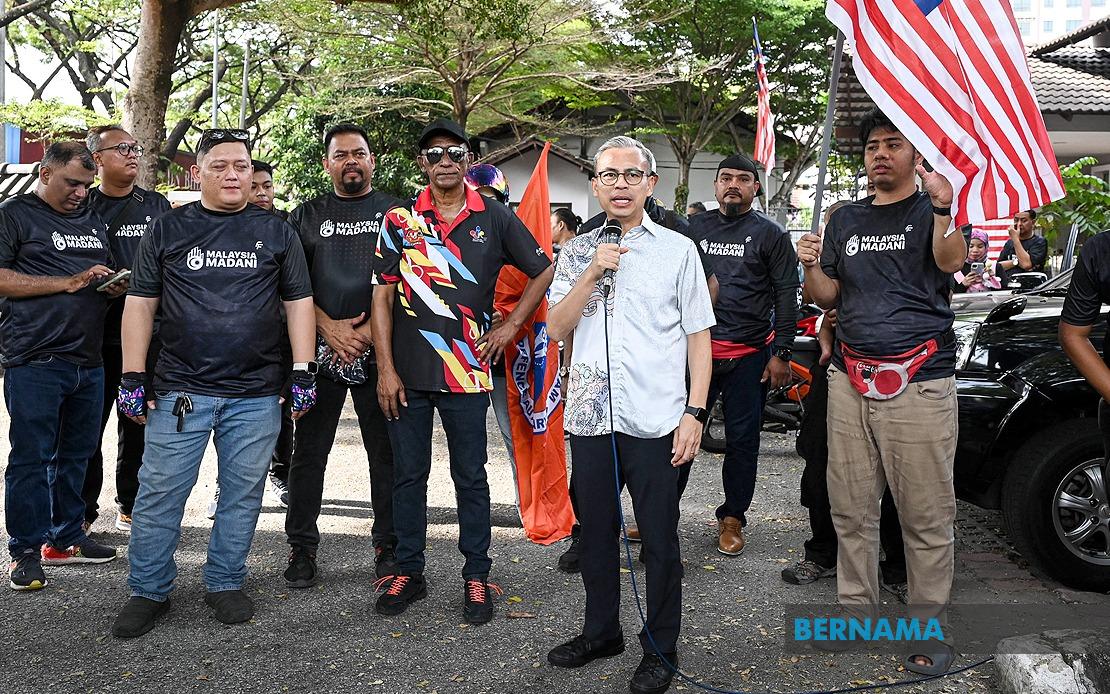
A significant display of community spirit unfolded in Kuala Lumpur as nearly 300 motorcyclists converged for the Lembah Pantai Kembara Merdeka Convoy on Merdeka eve, a coordinated effort designed to energise pre-independence day celebrations across the parliamentary constituency. The event, which drew participants from the area's diverse demographic tapestry, served as both a festive spectacle and a deliberate statement about the possibilities of multi-ethnic collaboration in Malaysia's urban landscape.
Communications Minister Datuk Seri Fahmi Fadzil, who represents Lembah Pantai, positioned the convoy as more than ceremonial pageantry. Speaking at the programme, he articulated the underlying philosophy that motivated the gathering: to consolidate the various communities inhabiting the constituency into a collective expression of Malaysian identity. The convoy's structure and routing deliberately traversed multiple neighbourhoods, ensuring that the message of unity permeated different residential areas rather than concentrating activity in a single location.
Fahmi's remarks emphasised the distinctive character of Lembah Pantai as a constituency where residents routinely navigate cross-cultural friendships and professional relationships. He framed the convoy as an opportunity to transform these everyday social bonds into visible, public demonstrations of national consciousness. By bringing together individuals from different ethnic and religious backgrounds on motorcycles bearing Malaysian insignia, the event created a moving tableau of the pluralistic Malaysia that political leaders frequently invoke in speeches but less frequently manifest in concrete civic activities.
The motorcade's operational design reflected strategic thinking about grassroots engagement. Commencing at Taman Seri Sentosa, the convoy proceeded through a carefully planned route that incorporated five designated stops: Kampung Pasir, IWK Eco Park, Vista Angkasa in Kampung Kerinchi, and ultimately concluding at Bangsar LRT station. This deliberate mapping ensured maximum visibility and accessibility, allowing residents along the route to witness the procession while creating touchpoints where community representatives could directly participate in the festivities.
A symbolic dimension underscored the convoy's patriotic messaging. At each designated pit stop, organisers distributed Jalur Gemilang flags to representatives of the Resident Representative Council and community groups. This flag-transfer mechanism served dual purposes: it operationalised a tangible connection between the visiting motorcyclists and stationary community anchors, while simultaneously propagating nationalist sentiment through a physical object that participants would carry forward into their respective neighbourhoods. The Jalur Gemilang, Malaysia's national flag, thus became a vehicle for dispersing patriotic consciousness throughout the constituency.
For Malaysian observers, the event illuminates an important approach to grassroots political engagement that extends beyond conventional rally formats. Rather than concentrating populations in fixed venues where speeches dominate, the convoy model encourages mobility and distributed participation. This approach proves particularly effective in densely urbanised constituencies like Lembah Pantai, where residents often experience fragmented community interactions. The motorcycle convoy creates a shared visual and experiential moment that transcends individual neighbourhoods, fostering what might be termed "performed unity"—a public enactment of social cohesion that aims to reinforce communal identity.
Fahmi's invocation of future collaborative activities suggests that the convoy represents merely one component of a broader engagement strategy. His explicit appeal for continued participation in upcoming community programmes, including charitable initiatives and additional Merdeka celebrations, indicates an attempt to crystallise temporary enthusiasm into sustained civic involvement. This approach recognises that single events, however symbolically resonant, require institutional reinforcement through repeated interaction and shared purpose to generate lasting attitudinal change.
The timing of the convoy—positioned explicitly as a Merdeka eve event—anchors the activity within Malaysia's most significant national commemoration. Independence Day celebrations carry particular weight in contemporary Malaysian political discourse, serving as occasions when political figures emphasise national cohesion and shared historical narratives. By situating the motorcycle convoy within this ceremonial calendar, organisers implicitly linked community-level unity in Lembah Pantai to the nation-building project itself, suggesting that everyday demonstrations of inter-ethnic harmony contribute to broader national resilience.
From a Southeast Asian perspective, Malaysia's sustained emphasis on engineered inter-ethnic events merits attention. The region encompasses numerous societies where communal tensions periodically surface; Malaysia's institutional commitment to programming designed to reinforce plural coexistence—even when critiques observe such efforts as sometimes superficial—represents a particular governance response to diversity management. The Lembah Pantai convoy exemplifies this approach: a state-supported, politically-led initiative designed to demonstrate and rehearse the mechanics of harmonious multi-ethnic interaction.
The motorcyclists who participated embodied an important demographic consideration. Urban motorcycle communities in Malaysia span socioeconomic strata and ethnic categories, making them potentially effective vehicles for demonstrating broad-based participation. By recruiting motorcyclists rather than participants assembled through formal organisational structures, event planners accessed populations who might otherwise remain disconnected from orchestrated political activities, thereby expanding the convoy's representative legitimacy.
For political analysts, the convoy illustrates contemporary Malaysian electoral strategy's emphasis on hyperlocal engagement and community-visible patriotic expression. Rather than concentrating political capital in state-level pronouncements or federal ceremonies, Lembah Pantai's leadership invested resources in neighbourhood-scale activities designed to accumulate positive sentiment through repeated direct exposure. This grassroots emphasis suggests that political credibility increasingly derives not merely from legislative accomplishment but from demonstrated commitment to community presence and inter-ethnic facilitation.
As Malaysia continues navigating complex questions about national identity, social cohesion, and communal relations, events such as the Lembah Pantai Kembara Merdeka Convoy offer tangible evidence of ongoing institutional efforts to sustain plural coexistence. Whether such efforts sufficiently address underlying structural tensions remains contested, yet their persistence indicates that Malaysian political leadership maintains investment in public demonstrations of unity as essential components of governance strategy.

