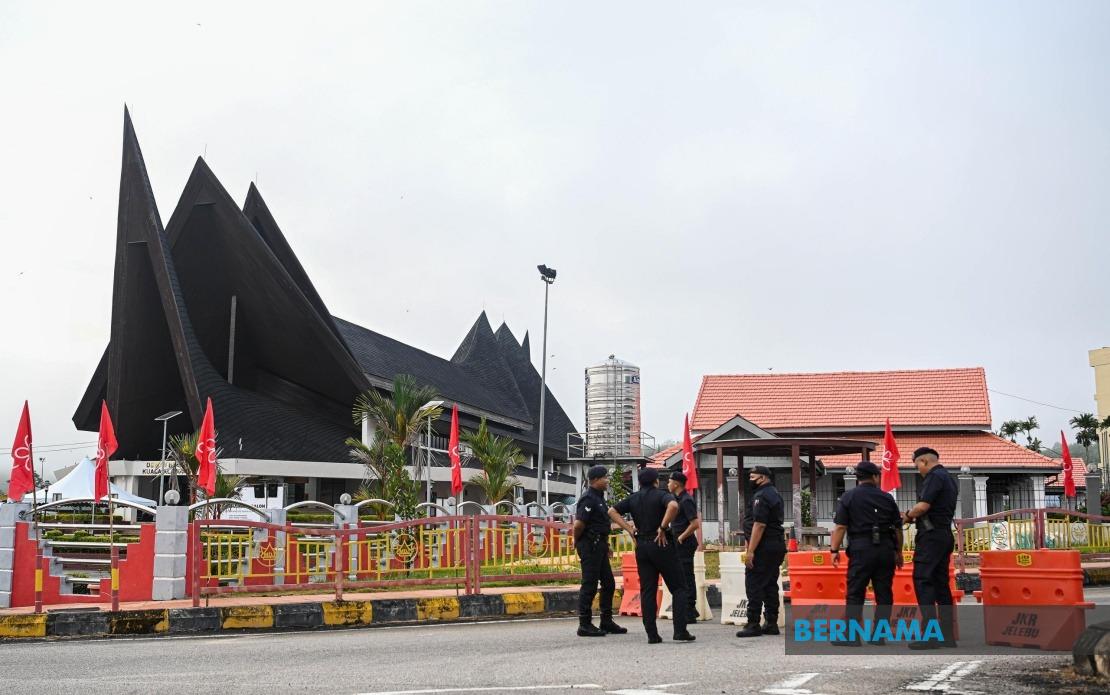
Negeri Sembilan's political landscape shifted into high gear on July 18 as nomination day unfolded across eight centres throughout the state, with clear skies and favourable conditions providing an orderly backdrop for candidates and their supporters to formally declare their intention to contest the 16th state assembly election. The nomination process, which commenced at 9 am and concluded by 10 am, marked a crucial threshold in the electoral cycle, transforming months of political positioning and coalition negotiations into concrete candidacies on the ballot.
Election Commission officials completed extensive preparations at each nomination venue to facilitate the process without disruption, while the atmosphere grew increasingly animated as political party representatives and their backers began assembling from early morning. Members of the media converged on the compounds as early as 7 am to document the proceedings, capturing the moment when formal documents were submitted and candidates' names entered the official record. The smooth logistics reflected institutional competence in managing a complex electoral machinery across a geographically diverse state.
The dissolution of the 36-seat state assembly on June 5 set the election timeline in motion, with the Election Commission subsequently announcing July 28 as the early voting date and August 1 as the general polling day. This compressed schedule compressed gave political parties roughly six weeks from dissolution to campaign, a period that would prove consequential in shaping voter sentiment and determining which coalitions could effectively mobilise their organisations and translate organisational strength into electoral performance.
Nearly 890,000 Negeri Sembilan residents hold the authority to determine the state's political direction, comprising 867,151 ordinary voters alongside 16,884 military personnel and their spouses and 5,455 police personnel. This substantial electorate base, distributed across constituencies of varying demographic composition, represented diverse interests that competing coalitions would need to address during their campaigns. The composition of the voter rolls suggested that defence and security personnel would constitute a meaningful, though minority, bloc within the broader electoral equation.
Packatan Harapan pursued an ambitious strategy by contesting every single seat, signalling confidence in its capacity to articulate a vision capable of resonating with voters across all constituencies. Barisan Nasional, the coalition that governed Malaysia for decades before losing federal power in 2018, committed to competing in 25 seats, effectively conceding territory to other parties while concentrating its organisational and financial resources in targeted battlegrounds. Perikatan Nasional, the Islamist-oriented coalition, announced participation in 11 seats, positioning itself as an alternative to PH and BN while maintaining a focused geographic footprint.
Three smaller parties—Parti Orang Asli Malaysia, Parti Sosialis Malaysia, and Parti Barisan Jemaah Islamiah Se-Malaysia—each nominated candidates for a single seat, reflecting their niche positioning within Malaysia's fragmented political ecosystem. These micro-parties rarely win, but their participation enriches democratic contestation by providing voters with additional ideological choices and preventing the major coalitions from achieving total electoral hegemony.
Pertubuhan Pribumi Bersatu Malaysia adopted a distinctive approach by running as an independent entity rather than formally aligning with Perikatan Nasional or Barisan Nasional, despite longstanding connections to both coalitions. Bersatu announced its candidacy for 24 seats, with an additional two seats allocated to Parti Bersepakat Hak Rakyat Malaysia, which agreed to use the Bersatu logo despite remaining technically separate. This arrangement reflected the pragmatic coalition-building common in Malaysian electoral politics, where formal unity and informal cooperation frequently diverge.
The 2023 Negeri Sembilan state election established baseline expectations for evaluating the coming contest. Pakatan Harapan's capture of 17 seats granted the coalition control of the assembly, though its majority remained modest and vulnerable to defection or strategic realignment. Barisan Nasional's 14 seats positioned it as a credible opposition force capable of forming government if opposition votes fractured sufficiently, while Perikatan Nasional's five seats proved inconsequential to government formation but demonstrated the party's capacity to contest statewide elections despite being newer and less institutionally entrenched than its rivals.
The electoral arithmetic heading into August 1 suggested that seat distribution would prove considerably more competitive than the simple allocation of nomination slots implied. Voter preference, campaign effectiveness, the intensity of contested constituencies, and the possibility of strategic voting could substantially alter expected outcomes. Negeri Sembilan's status as a peninsular heartland state, neither particularly urban nor purely rural, meant that its election would generate broader implications for understanding Malaysian political dynamics and coalition viability beyond the state's borders.
The nomination process itself represented democracy functioning according to formal procedures, yet Malaysian political analysts recognised that the crucial contest would unfold during the three-week campaign period and on polling day itself. Ground-level organising, media coverage, social media engagement, and interpersonal persuasion would determine whether the coalitions contesting could convert their candidacies into actual government control or opposition presence. The fair weather that characterised nomination day provided an auspicious start to the electoral season, though forecasting which political forces would ultimately claim victory remained genuinely uncertain at this juncture.

