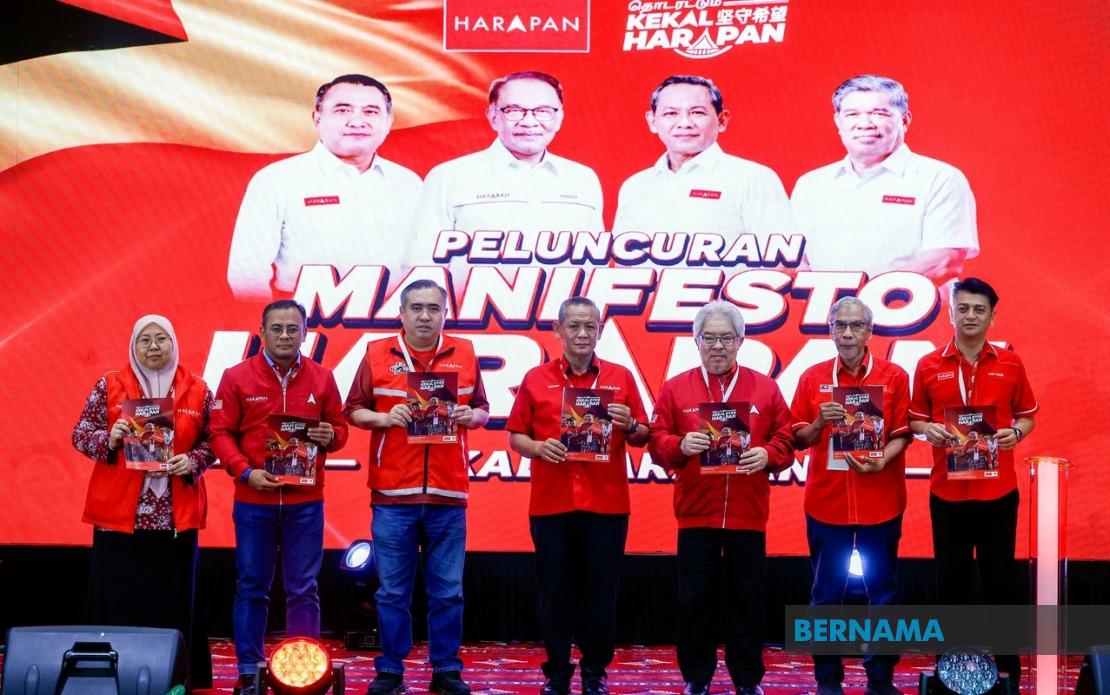
Pakatan Harapan has positioned its Negeri Sembilan state election manifesto as a document grounded in practical delivery rather than empty campaign rhetoric, according to state coalition chairman Datuk Seri Aminuddin Harun. Speaking in Seremban on July 20, the Menteri Besar stressed that the manifesto represents genuine commitments emerging from the coalition's governance record in the state, offering a blueprint that balances consolidation of existing achievements with strategic enhancements over the coming five-year term.
The thematic framing of the manifesto, 'Negeri Sembilan Kekal Harapan' (Negeri Sembilan Stays With Harapan), encapsulates a strategy of emphasizing continuity and progressive improvement rather than radical transformation. Aminuddin articulated a subtle but significant distinction between the coalition's earlier approach and its current messaging. During the initial period in office, the focus was necessarily on launching new initiatives and establishing governmental frameworks. The current manifesto, by contrast, pivots toward deepening and refining those earlier interventions to maximize their impact on residents' lives.
The manifesto comprises ten key commitments that reflect this philosophy of evolved governance. Rather than presenting an expansive wish list of new programmes, the document signals PH's intention to operationalize and strengthen existing schemes within resource constraints. This approach reflects a more mature phase of governance, where consolidation and optimization replace the urgency of initial implementation. For Malaysian voters increasingly skeptical of campaign promises, this messaging strategy targets the perception that Pakatan Harapan has learned from its tenure and understands the practical limitations of ambitious agenda-setting.
Aminuddin's emphasis on creating "a strong foundation for Negeri Sembilan that can benefit future generations" introduces an intergenerational dimension to PH's campaign narrative. This framing situates the coalition's governance philosophy within a longer temporal arc, suggesting that the benefits of present-day initiatives will accrue over decades rather than within a single electoral cycle. Such messaging attempts to reframe what might otherwise appear as limited ambitions into a sustainable development paradigm, particularly resonant with Malaysian voters concerned about economic inequality, infrastructure deficits, and social cohesion.
The eight-year track record invoked by Aminuddin becomes crucial context for understanding PH's campaign strategy in Negeri Sembilan. Unlike federal-level politics where the coalition has faced mounting criticism following its 2018-2020 tenure, the state-level experience offers a more localized and arguably more defensible narrative. Voters can assess tangible outcomes in areas such as local infrastructure, health services, and social programmes. This ground-level accountability contrasts sharply with abstract political debates, making the manifesto's appeal to demonstrated performance potentially effective in a state election context where incumbency carries substantial weight.
The coalition's strategic choice to contest on implementation quality rather than expansive promises reflects broader trends in Malaysian electoral politics. As voters become more discerning about the gap between campaign pledges and governmental delivery, parties are gradually calibrating messaging toward what appears achievable. Pakatan Harapan's approach in Negeri Sembilan can be interpreted as an acknowledgment of this electoral maturation, signaling to voters that the coalition operates with realistic expectations and fiscal prudence rather than the boundless optimism that characterized earlier campaign cycles.
For Aminuddin personally, who is contesting the Linggi state seat, the manifesto represents an opportunity to consolidate his political position as a competent administrator rather than a radical reformer. His dual role as Menteri Besar and coalition chairman amplifies the significance of the manifesto launch, casting it as both a state-level document and an endorsement of his continued leadership. The emphasis on deliverables effectively becomes a referendum on his administrative record, a calculation that appears confident in the outcomes achieved during the tenure.
The timing of the manifesto launch and election campaign occurs within a broader context of Malaysian federalism and state-level politics. Negeri Sembilan, as a state with significant economic importance and a demographically diverse population, represents a microcosm of broader political trends affecting Malaysia. The coalition's strategy in the state may signal approaches being considered for other state-level contests, particularly in states where PH holds office or aspires to power. Success in Negeri Sembilan would validate the "consolidation and optimization" messaging framework for potential deployment elsewhere.
For Southeast Asian observers and regional analysts, the Negeri Sembilan election carries significance beyond state-level politics. Malaysia's political trajectory influences perceptions of democratic governance and electoral competition across the region. PH's evolution from opposition movement to governing coalition to incumbent state administrator reflects broader patterns of political institutionalization affecting democracies throughout Southeast Asia. The manifesto's emphasis on delivery over rhetoric mirrors international trends where voter skepticism of political promises has prompted parties to emphasize track records and measurable outcomes.
The manifesto's structure around continuity and improvement also suggests organizational learning within Pakatan Harapan. The coalition's difficult experience in federal government between 2018 and 2020 appears to have informed a more cautious and measured approach to campaigning and governance promises. By positioning itself as a steward of existing frameworks rather than a revolutionary force, PH attempts to escape the criticism that it overpromised and underdelivered at the federal level. This recalibration represents a calculated political strategy to restore credibility among voters wearied by grandiose campaign pledges.
Ultimately, the Negeri Sembilan manifesto reflects a particular moment in Malaysian political development where parties increasingly recognize that governing competence and demonstrable results matter more to voters than rhetorical flourishes. Aminuddin's insistence on the manifesto's focus on deliverables frames the upcoming election as a choice between proven administration and untested alternatives. Whether this strategy proves electorally effective will partly depend on whether Negeri Sembilan voters prioritize continuity and incremental improvement or seek transformative change from competing coalitions. The manifesto's success will be measured not in campaign resonance but in whether PH can again translate pledges into tangible improvements in residents' daily lives.

