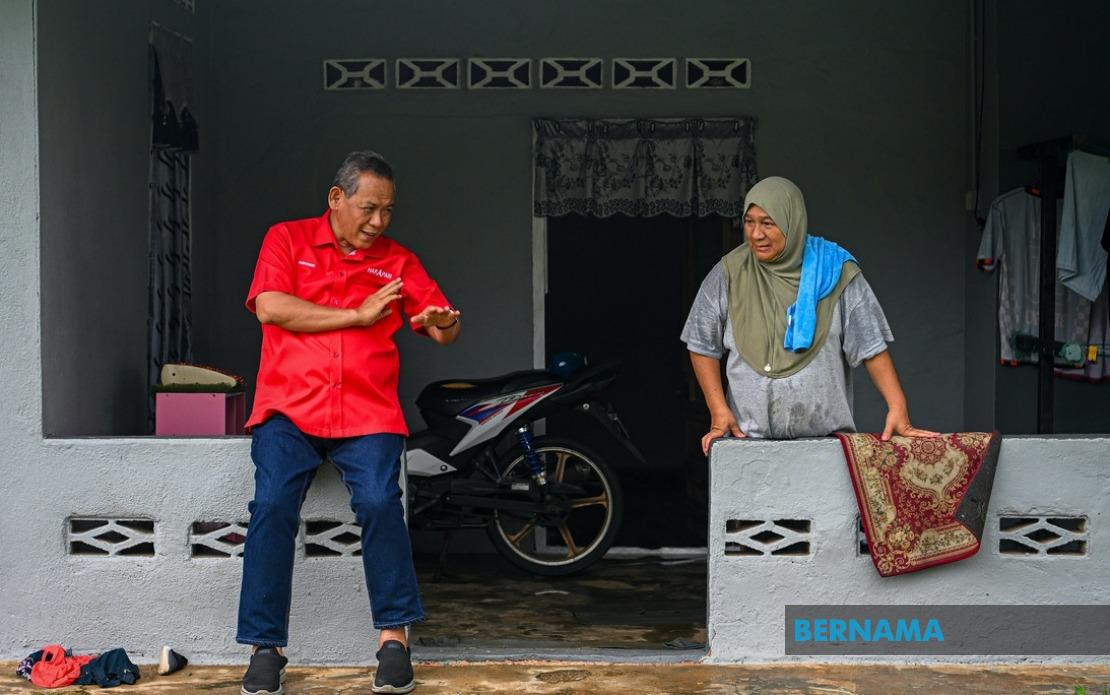
Pakatan Harapan enters the Negeri Sembilan state election campaign with a deliberate strategy centred on administrative competence and political stability, leaning heavily on Menteri Besar Datuk Seri Aminuddin Harun's governance record across nearly two terms in office. The coalition's leadership believes that emphasising clean governance and accountability will resonate with voters fatigued by political uncertainty and scanning for predictability in their state administration.
According to PH election director Datuk Seri Amirudin Shari, the party's early campaign activities have generated encouraging grassroots feedback during the initial three days of canvassing. Speaking as both the Gombak Member of Parliament and Selangor Menteri Besar, Amirudin highlighted that party workers have encountered receptive constituents across Negeri Sembilan without encountering significant voter grievances against the incumbent administration. This absence of controversy represents a critical campaign asset for the coalition in a political climate where scandal and misgovernance have previously toppled administrations.
The absence of major corruption scandals or administrative failures during PH's tenure in Negeri Sembilan forms a centrepiece of the coalition's messaging strategy. Amirudin stressed that the administration has maintained integrity throughout its time in office, a quality he positioned as increasingly valued by Malaysian voters who have witnessed political crises in other jurisdictions. While acknowledging that initial campaign enthusiasm may not always manifest visibly at large public gatherings, Amirudin expressed confidence that the substantive feedback collected through party networks would translate into electoral support. This distinction between visible campaign metrics and actual grassroots sentiment reflects the sophisticated understanding coalition strategists possess about modern electoral dynamics.
Beyond Aminuddin's personal credibility, PH credits its organisational machinery as a decisive advantage in defending its Negeri Sembilan position. The coalition's robust grassroots network has been cultivated over years of governance and community engagement, providing infrastructure that extends campaign messaging directly to voter households. This ground-level presence, Amirudin suggested, would prove instrumental in securing both traditional PH constituencies and persuading swing voters concerned about governance quality.
The coalition is also leveraging Prime Minister Datuk Seri Anwar Ibrahim's national standing to enhance candidate prospects at the state level. Amirudin pointed to the Johor state election experience, where Anwar's visible campaign participation and policy achievements under his federal administration boosted confidence in PH candidates contesting state seats. The party recognises that voter satisfaction with federal performance can generate momentum for state-level campaigns, particularly when the same coalition governs both levels. This vertical integration of political messaging—connecting state-level governance to prime ministerial leadership—represents a key strategic tool for PH in maintaining voter confidence.
The coalition is preparing to launch a comprehensive manifesto that synthesises its existing governance initiatives with fresh policy proposals designed to address Negeri Sembilan-specific development needs. This document will form the centrepiece of PH's campaign messaging, presenting voters with a coherent vision for sustained economic development and strengthened household purchasing power across the state. The manifesto's dual focus on continuity and innovation attempts to satisfy both voters seeking steady governance and those demanding responsive policy solutions.
Negeri Sembilan's electoral landscape reflects a three-way competition that has intensified in recent state elections. In the 2023 contest, PH secured 17 seats, establishing the strongest mandate despite Barisan Nasional capturing 14 seats and Perikatan Nasional winning five seats. This configuration placed PH clearly in control but without overwhelming dominance, meaning that consolidating existing support while marginal gains would substantially strengthen the coalition's position. The state government's stability has not been tested by internal defections or coalition fractures since the 2023 election, an important achievement given Malaysia's recent history of legislative volatility.
The Negeri Sembilan State Legislative Assembly was dissolved on June 5 following standard procedures, triggering the electoral machinery and campaign season. Nearly 900,000 registered voters—889,490 to be precise—are eligible to participate, with 867,151 ordinary voters, 16,884 military personnel and spouses eligible for early voting, and 5,455 police personnel also permitted early access to polls. These figures represent a substantial electorate across a geographically diverse state, presenting considerable campaign logistics challenges for all competing coalitions. Early voting has been scheduled for July 28, with the main polling day set for August 1, allowing both advance voting for special constituencies and full-scale election day participation.
PH's campaign messaging reflects broader regional political trends across Southeast Asia, where governance stability and administrative integrity have become defining electoral issues. Voters across Malaysia increasingly distinguish between parties based on concrete administrative performance rather than ideology alone, a shift that benefits incumbent coalitions with demonstrable governance records. The emphasis on clean administration and service delivery resonates particularly in Negeri Sembilan, a state comprising urban, semi-urban, and rural constituencies with diverse economic interests requiring consistent governance attention.
The stakes for PH in Negeri Sembilan extend beyond merely retaining state control; a decisive victory would reinforce the coalition's narrative of stable, accountable governance heading into potential federal political developments. Conversely, a marginal result or loss would substantially damage PH's credibility on administrative competence, its core campaign pillar. This high-stakes dynamic has motivated PH to concentrate on substantive governance messaging rather than personalised attacks or opposition-focused campaigning, reflecting confidence in its institutional record.
For Malaysian observers and regional analysts, the Negeri Sembilan election provides a significant test case of whether voter preferences favour incumbents emphasising governance continuity and administrative performance. The result will offer important insights into whether Malaysian electorate has stabilised around evaluating parties primarily on competence metrics, or whether other factors including regional political identities and opposition coalition dynamics remain decisive. As one of Malaysia's smaller states, Negeri Sembilan often previews broader national electoral sentiment, making the August 1 contest particularly instructive for understanding contemporary Malaysian political behaviour.

