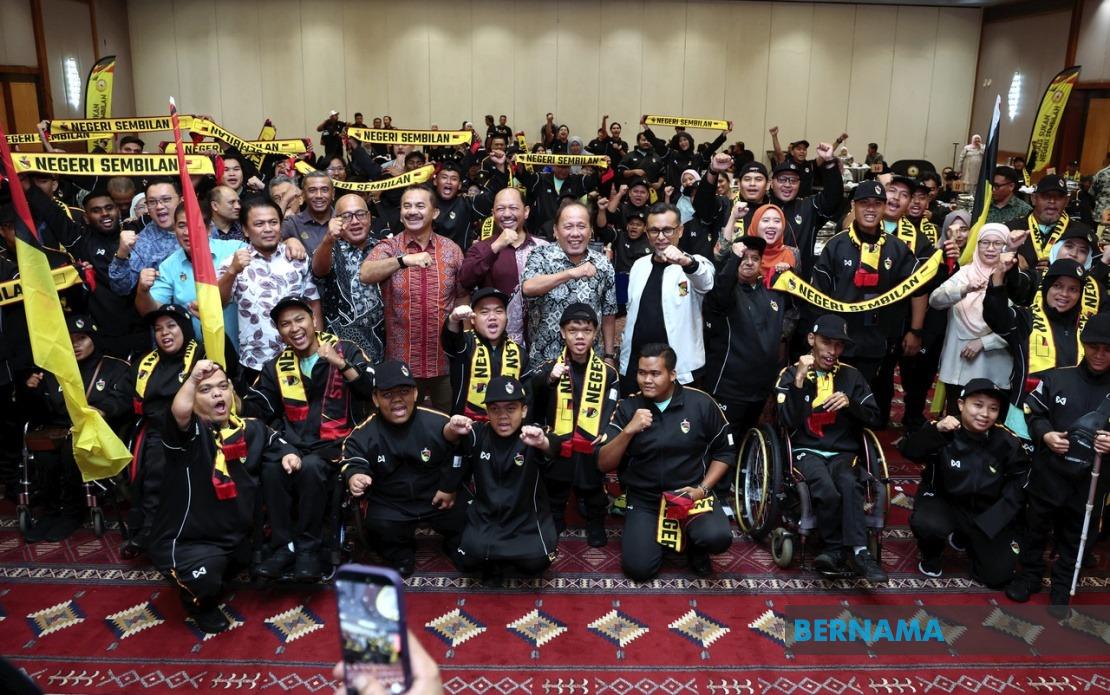
Negeri Sembilan's leadership has laid down an ambitious challenge for its para athletes competing at the 2026 Para Malaysia Games (Para SUKMA), targeting 12 gold medals from a contingent of 80 competitors. The games, set to commence on September 5 in Selangor, represent a significant opportunity for the state to recover from recent setbacks and reestablish its sporting credentials on the national stage. Menteri Besar Datuk Ismail Lasim unveiled the target during a flag handover ceremony held in Seremban, signalling the state's determination to deliver a standout performance in adaptive sports competition.
The timing of this announcement comes immediately after Negeri Sembilan concluded its participation in the regular SUKMA 2026 championships on Monday, where the state's overall performance fell considerably short of expectations. This backdrop adds particular significance to the Para SUKMA campaign, as it provides a platform for redemption and an opportunity to demonstrate that the state remains a serious contender in Malaysian sports. The leadership's public commitment to a specific medal target underscores how the para games have become integrated into broader state sporting ambitions, rather than operating in isolation from the main SUKMA competition.
Ismail Lasim framed the 12-gold objective not as mere numerical aspiration but as a reflection of the rigorous preparation and mental fortitude that para athletes must demonstrate throughout their training cycles. His remarks emphasised that achievement of the target depends fundamentally on athletes channelling their inherent determination and discipline, characteristics he identified as defining the para sports community. This rhetorical positioning shifts the burden of responsibility squarely onto the athletes themselves, while simultaneously acknowledging their capabilities and resilience. The Menteri Besar's confidence in the achievability of the goal suggests that performance metrics and athlete assessments have informed the target-setting process.
Historical context reveals important nuances in assessing the reasonableness of this goal. At the 2024 Para SUKMA Games held in Sarawak, Negeri Sembilan's contingent secured 14 gold medals alongside 19 silver and 20 bronze medals, placing them among the competitive states in adaptive sports. The reduction from 14 golds to a 12-gold target for 2026 might initially appear conservative, yet it reflects realistic expectations given the unpredictability inherent in athletic competition and the presence of other emerging powerhouses in para sports across Malaysia. The comparison also highlights that maintaining consistency across para competitions remains a genuine challenge for state sports bodies.
The contrast with mainstream SUKMA performance sharpens the current situation. At SUKMA 2026, Negeri Sembilan accumulated only seven gold medals from a total of 48 medals won, representing a dramatic decline from the 19 gold medals garnered from 56 total medals at the equivalent games in 2024. This pronounced deterioration across the broader sporting calendar has clearly motivated the state leadership to prioritise and adequately resource the para contingent, potentially allocating enhanced support and attention to ensure better outcomes. The allocation of financial incentives for medal-winning athletes at Para SUKMA signals this renewed commitment and may serve to concentrate focus and motivation among competitors.
Negeri Sembilan's approach to the para games reflects broader Southeast Asian trends in disability sports development, where several countries are progressively elevating the status and investment in adaptive athletics. Malaysia's SUKMA framework, which includes dedicated Para SUKMA championships, positions the nation comparatively well in regional disability sports governance. However, individual states must balance ambition with resource constraints, making target-setting both a performance management tool and a political statement about the state's commitment to inclusivity in sports.
The presence of State Youth and Sports Development Action Committee chairman Datuk Mustapha Nagoor and Negeri Sembilan Sports Council director Marhizah Abdul Razak at the flag handover ceremony underscores the multi-stakeholder coordination required to support para athlete preparation. Such institutional engagement typically indicates that the target is underpinned by concrete support mechanisms including coaching staff, medical facilities, training allowances, and competition preparation logistics. The institutional visibility also serves to communicate to athletes that their efforts receive high-level political and administrative backing.
The September 5 start date provides a relatively compressed preparation window for final training intensification and competition readiness. Para athletes often require longer adaptation periods to specific competition venues and environments compared to able-bodied competitors, necessitating efficient use of the available timeframe. The location in Selangor, Malaysia's most economically developed state with superior sporting infrastructure, should theoretically provide high-quality competition conditions that could support strong performances.
For Malaysian disability sports advocates, the Para SUKMA framework represents a crucial mechanism for talent identification, international exposure, and athlete career development. The Commonwealth and Asian Games increasingly feature robust para sport programmes, and athletes who distinguish themselves at domestic Para SUKMA events frequently progress to these international platforms. Negeri Sembilan's investment in achieving its 12-gold target thus carries implications extending beyond state sporting pride, potentially nurturing athletes capable of competing on continental and global stages.
The state's positioning of this challenge also reflects wider Malaysian sporting politics, where inter-state competition drives investment and performance standards. The public articulation of specific targets creates accountability frameworks that can either energise teams through clarity of purpose or generate pressure that potentially undermines performance if unmet. Whether the 12-gold outcome materialises will significantly influence perceptions of Negeri Sembilan's sporting trajectory and its capacity to develop competitive programmes across both mainstream and adaptive athletics.

