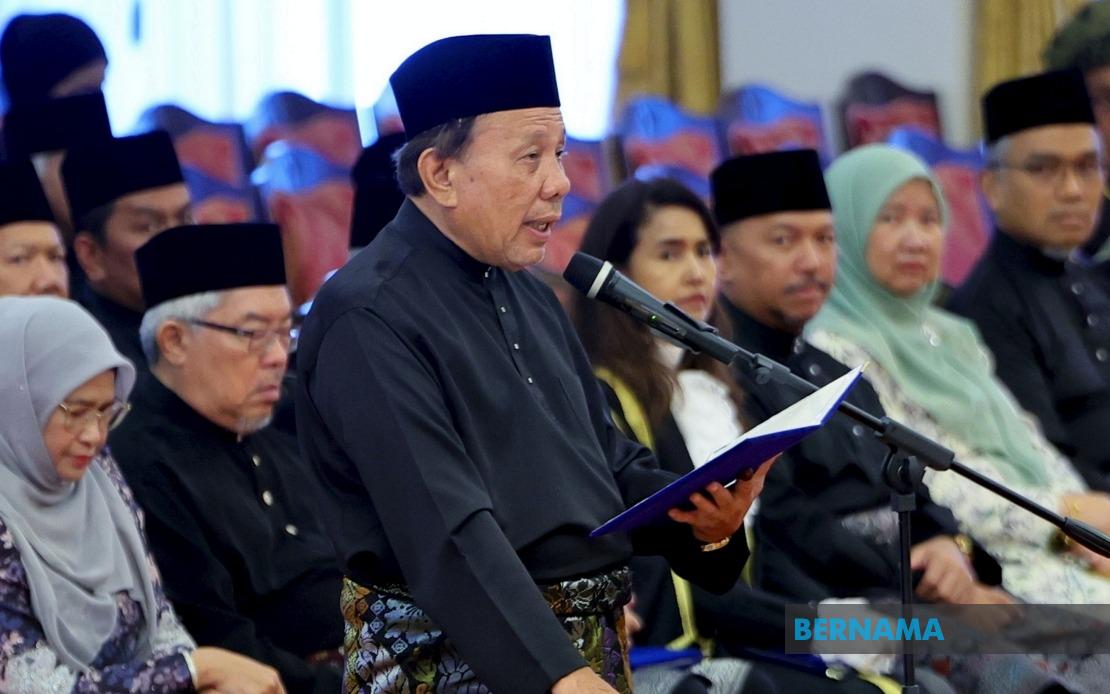
Datuk Ismail Lasim took his oath as Negeri Sembilan's new Menteri Besar during a ceremony at Istana Besar Seri Menanti on August 2, marking the beginning of his tenure following the state's 16th general election held the previous day. In his swearing-in address before Yang Dipertuan Besar Tuanku Muhriz Tuanku Munawir, the newly appointed leader articulated a vision centred on accountability and responsiveness to constituents across the peninsular state. His inaugural remarks set the tone for what officials describe as an administration built on the foundation of public trust earned through the recent electoral mandate.
The incoming Menteri Besar framed his assumption of office as a profound responsibility rather than a mere honour, emphasising that the confidence demonstrated by voters carries with it an obligation to deliver competent governance. Ismail stressed that his administration would operate according to principles of equity, public accountability and operational effectiveness, underscoring that these commitments represent the core expectations voters placed upon his government. The pledge reflects a broader recognition among Malaysia's state-level political leadership that electoral legitimacy must be translated into demonstrable administrative performance, particularly in meeting citizen expectations for service delivery and inclusive policymaking.
Beyond administrative competence, Ismail articulated a commitment to preserving Negeri Sembilan's constitutional and institutional frameworks. He reaffirmed his government's dedication to upholding the sovereignty of the Yang Dipertuan Besar and honouring the principles of constitutional monarchy and parliamentary democracy that underpin Malaysia's political system. This emphasis on institutional respect carries particular significance in Negeri Sembilan, where the Ruler functions as an active constitutional participant in state governance rather than a ceremonial figurehead alone.
A distinctive element of Ismail's policy platform concerns the preservation and advancement of Adat Perpatih, the matrilineal customary law system unique to Negeri Sembilan. The incoming leader specifically highlighted the values embedded within this traditional system—consensus, fairness, communal unity and collective wisdom—as foundational principles that should inform contemporary state governance. This framing suggests an attempt to anchor modern policy formulation within the state's historical and cultural identity, implying that development initiatives will be filtered through culturally sensitive lenses rather than imposed through purely technocratic approaches.
On the substantive policy front, Ismail outlined a development agenda spanning multiple sectors critical to state prosperity. His administration intends to prioritise economic strengthening through strategic investment attraction, with particular emphasis on quality rather than quantity in capital inflows. Employment generation features prominently in the outlined priorities, reflecting concerns about job availability that resonate across Malaysia's labour market. Additionally, the new government signalled commitment to upgrading educational infrastructure, expanding healthcare access, addressing housing deficits and supporting agricultural development—a portfolio spanning concerns affecting both urban and rural populations within the state.
The Menteri Besar articulated a philosophy of development that transcends conventional metrics focused solely on infrastructure construction and gross economic output. Instead, he advocated for a broader conception of progress encompassing social cohesion, institutional strength and public confidence in governance structures themselves. This perspective aligns with evolving discussions in Malaysia and Southeast Asia regarding sustainable development models that prioritise citizen welfare and social stability alongside economic expansion, particularly as states confront challenges from automation, climate change and demographic shifts.
Critical to Ismail's governance model is an emphasis on administrative integrity and civil service professionalism. He pledged to establish an institutional culture prioritising trustworthiness, efficient operations and transparent decision-making processes, coupled with expectations that the state bureaucracy maintain high standards of dedication and responsibility. For Malaysian states historically grappling with perceptions of administrative inefficiency or lack of transparency, such commitments carry particular weight, potentially influencing public confidence in state-level institutions and their capacity to deliver services effectively.
The new Menteri Besar specifically highlighted the importance of consensus-building and receptiveness to constructive feedback as governance principles. This commitment to listening to diverse viewpoints and accepting criticism suggests an administrative philosophy emphasising collaborative decision-making over top-down directives. For Negeri Sembilan specifically, this approach may prove valuable given the state's demographic diversity and the varied interests that must be reconciled in regional policymaking. The emphasis on long-term thinking and intergenerational responsibility further indicates that immediate political considerations will ideally be balanced against sustainable outcomes benefiting future populations.
Ismail's statement regarding institutional relationships emphasised the importance of constructive engagement between multiple stakeholders—including the Royal Institution, state and federal government structures, the civil service, private sector entities and community organisations. This systems-wide perspective recognises that state-level governance effectiveness depends upon functional relationships across institutional boundaries and spheres of responsibility. For Malaysia's federal system, such coordination proves essential given overlapping jurisdictions and the need for alignment between state and national policy objectives, particularly in areas like education, healthcare and infrastructure development.
In acknowledging his predecessor Datuk Seri Aminuddin Harun, Ismail positioned his administration as a continuation of previous governmental efforts rather than a complete break with the past. This framing allows for the incorporation of development foundations already established whilst creating space for new initiatives and corrective adjustments. The recognition of Aminuddin's tenure reflects broader Malaysian political practice of maintaining institutional continuity while signalling fresh leadership, potentially easing administrative transitions and ensuring that ongoing projects continue without significant disruption.
For Malaysian observers and residents of Negeri Sembilan, the new Menteri Besar's inaugural statements establish a baseline against which future performance will be evaluated. Whether his administration successfully translates pledges regarding transparency, equity and people-focused governance into concrete policy outcomes will determine his political legitimacy and credibility with constituents. The coming months will prove instrumental in testing whether these commitments translate into administrative practice or remain aspirational rhetoric. As Southeast Asia confronts evolving governance challenges, Ismail's administration presents a case study in whether state-level leaders can effectively bridge electoral promises with institutional delivery mechanisms, public sector capacity constraints and competing resource demands.

