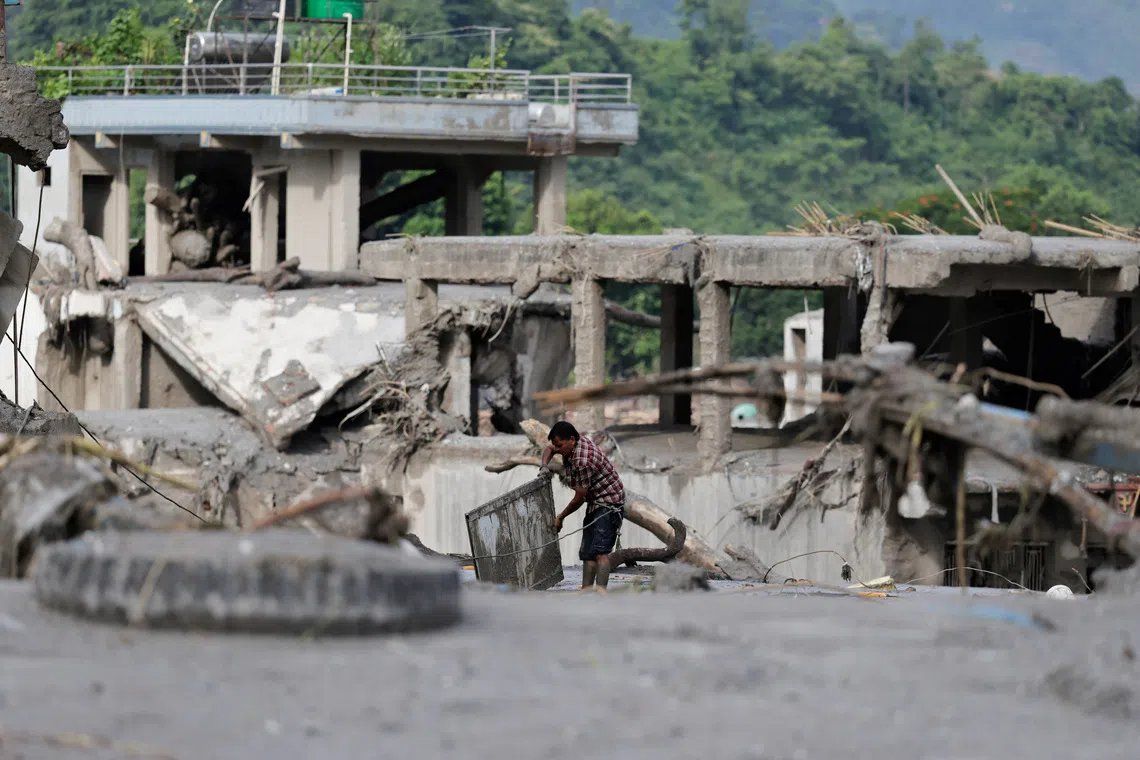
The catastrophic aftermath of this week's glacier-induced flooding in the Nepal-Tibet border region has spawned a fresh crisis: two swollen lakes that threaten to burst with potentially devastating consequences. Both the Nepali and Chinese authorities issued simultaneous warnings on Thursday (Aug 27) as these naturally formed barriers continue accumulating water, posing what experts characterize as an imminent secondary hazard for communities and rescue teams still responding to the initial disaster that claimed at least 362 lives.
The original calamity unfolded when a massive glacier collapse sent torrents of rock, ice, mud and debris cascading into the river systems that carve through the steep Himalayan terrain. The initial deluge swept through valleys and hillsides straddling the Nepal-China border, leaving devastation in its wake. More than a week after the disaster, search and rescue efforts continue across debris-choked landscapes, with over 1,000 people reported missing and communities still reeling from the scale of destruction. The dual-nation nature of the disaster has required coordinated emergency responses, yet now both governments must grapple with managing the secondary threat posed by the accumulated water.
Nepal's disaster management authority moved swiftly to alert the public to the danger presented by the lake that has formed at the flood site, where accumulated debris is now functioning as an unintended dam. The water level in this impoundment continues climbing as upstream flows push against the natural blockade. The authority issued a public notice requesting residents in low-lying areas downstream, along with rescue personnel actively engaged in recovery operations, to relocate to elevated terrain and maintain distance from riverbanks. The message underscores how rescue workers themselves have become vulnerable to a potential secondary flood event even as they conduct their humanitarian mission.
The situation on the Chinese side of the border presents quantifiable dimensions to the threat. Chinese water resources officials have calculated that approximately three million cubic meters of water—a volume equivalent to roughly 1,200 Olympic-size swimming pools—are expected to flow into an already-dammed lake within Chinese territory over a three-day window. This accumulation, coming into a water body that already holds significant volume behind engineered infrastructure, creates what authorities characterize as substantial risk of dam breach or catastrophic overflow. The predicted peak flow is anticipated around September 1, giving officials a narrow window to prepare protective measures.
The meteorological situation compounds anxieties about containment. Weather forecasts indicate rainfall across the affected region during the coming week, which would further increase water volumes pushing against both the natural debris dam in Nepal and the engineered infrastructure in China. Zhu Jinfeng, a researcher specializing in hydrology at China's water resources ministry, articulated the escalating risk during comments to state television, noting that as water volumes continue accumulating, so too does the probability of uncontrolled release. The statement reflects growing concern within technical circles that the twin-lake situation may move beyond manageable parameters.
For rescue operations personnel working in the valleys below these potential hazards, the warnings have translated into immediate operational adjustments. Teams like the unit led by Pawan Koirala began shifting their deployment away from riverbed areas after authorities issued the cautionary notices. With thirteen members under his direction, Koirala made the pragmatic assessment that continuing rescue work in proximity to the threatened waterways posed unacceptable risk. The decision reflects a broader pattern emerging across both countries' emergency response systems: rescue workers must now balance the humanitarian imperative to search for missing persons against the genuine possibility of being themselves overwhelmed by a secondary flood event.
The glacier collapse that triggered this sequence of disasters represents a significant event in the region's geological narrative. Climate change impacts on the Himalayas have increased the frequency of such destabilization events, as warming temperatures weaken the structural integrity of ancient ice masses. The 362 confirmed deaths and over 1,000 missing persons constitute the human cost of this particular collapse, but the secondary hazards now emerging suggest the full toll may continue mounting if the water containment situation deteriorates.
For Malaysia and other Southeast Asian nations, the situation carries important implications regarding disaster preparedness in mountainous regions and the cascading consequences of climate-related geological events. Many Southeast Asian countries contain river systems originating from high-altitude zones, and glacial regions in Myanmar, Bhutan and the broader Himalayan range create similar conditions where glacier collapse could trigger both immediate and secondary flooding. The Nepal-China experience demonstrates the necessity for robust early warning systems, rapid inter-agency communication, and the flexibility to modify emergency response protocols as new hazards emerge from the initial disaster.
Both governments are deploying technical expertise to monitor the situation constantly. Chinese water resources ministry personnel are tracking inflow rates and assessing the structural integrity of the dammed reservoir, while Nepali authorities maintain surveillance of the debris-formed lake. The international dimension of this crisis—with the disaster affecting border communities from two nations—necessitates coordination that has reportedly proceeded relatively smoothly despite the bilateral complexities that sometimes characterize Nepal-China relations on other matters.
The immediate challenge facing both nations involves managing the rescue and recovery operations while simultaneously preparing for potential secondary disasters. This dual-track approach consumes substantial resources and attention from emergency management officials already stretched by the scale of the initial catastrophe. Should either lake breach catastrophically, the resulting flows would imperil not only rescue workers but also communities further downstream that have already endured tremendous loss and upheaval.

