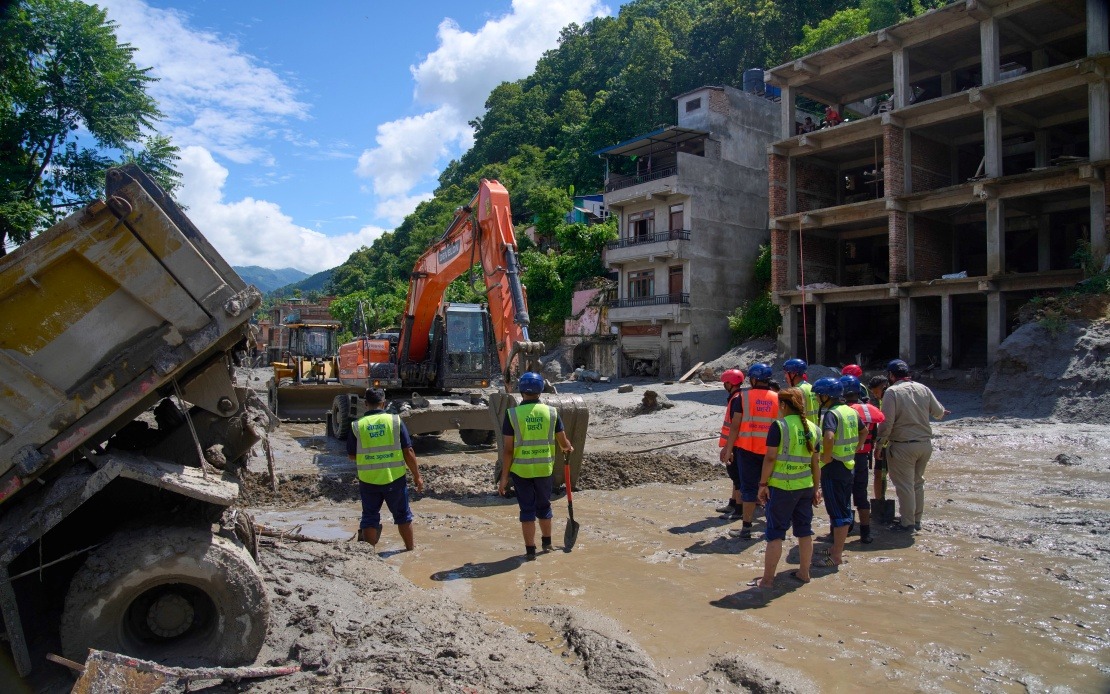
Nepal's Foreign Ministry has taken decisive action by establishing an Emergency Response Team to manage the complex coordination challenge posed by the devastating floods that struck the Bhotekoshi River region in Rasuwa on Wednesday morning. This specialized unit has been tasked with centralizing efforts to locate missing foreign nationals, verify their status, and provide critical support to those affected by one of the region's most severe natural disasters in recent memory.
The catastrophe has proven particularly severe in scale. By Thursday evening, confirmed fatalities had reached 359 people, with rescue teams continuing to pull survivors from floodwaters and debris. Among those rescued so far, 31 have been brought to safety, yet the true human cost remains difficult to fully quantify. More than 800 individuals remain unaccounted for across the disaster zone, a figure that includes hundreds of foreign tourists who were in the region when the flooding commenced. The majority of the missing are nationals of India and Nepal, though the incident has affected visitors from multiple countries.
The Emergency Response Team's mandate extends beyond simple search coordination. The unit serves as a unified information hub, gathering data on foreign nationals affected by the disaster, validating reports before dissemination to prevent misinformation in an already chaotic situation, and maintaining close liaison with relevant governmental and international agencies. Critically, the team will provide consular assistance—a function that becomes increasingly important as families abroad seek answers about their loved ones and diplomatic missions attempt to identify and account for their citizens.
Recognizing the multinational scope of this crisis, Nepal's Foreign Ministry has established multiple communication channels to gather intelligence on missing persons. The public, diplomatic missions, international organizations, and families of affected individuals are encouraged to report any information through dedicated phone lines operated on WhatsApp at +977-9744441227 or +977-9744441228, or via email correspondence directed to [email protected]. This multi-channel approach acknowledges both the geographic dispersal of relatives worldwide and varying communication preferences during crisis situations.
For Malaysia, the tragedy carries direct relevance despite preliminary uncertainty. Malaysian Foreign Minister Datuk Seri Mohamad Hasan confirmed that while Malaysian nationals may be among those affected, the exact number of Malaysians unaccounted for remains unverified pending official confirmation from Nepali authorities. This uncertainty reflects the broader challenge facing all nations with citizens in the region—the initial phase of any major disaster involves significant information gaps, making rapid and accurate identification of nationals a priority for diplomatic missions.
The establishment of this coordinated response mechanism highlights the complexities inherent in managing transnational disasters. When flooding strikes in remote mountainous terrain, simultaneously affecting nationals from multiple countries, no single authority possesses complete information. By creating a centralized clearinghouse for verified information, Nepal's approach reduces duplication of effort and minimizes the circulation of unconfirmed rumors that can compound family distress.
The scale of this disaster underscores vulnerabilities in the Himalayan region, where tourism remains a significant economic activity but infrastructure and early warning systems remain limited. The Bhotekoshi River floods represent a stark reminder that adventure tourism and trekking destinations in Nepal, while offering extraordinary experiences, carry inherent risks amplified by seasonal weather patterns and geographic factors. The region's popularity with international tourists means that natural disasters here automatically acquire international dimensions requiring diplomatic coordination.
For Malaysia and other Southeast Asian nations with nationals in Nepal, this situation demands vigilant engagement with Nepali authorities through both bilateral channels and multilateral frameworks. The Foreign Ministry's decision to maintain uncertainty rather than confirm unverified figures reflects appropriate caution—premature claims of Malaysian casualties could trigger unnecessary alarm, while delays in finding missing nationals prolong anguish for families awaiting news.
The Emergency Response Team's work will likely extend well beyond immediate rescue operations. In coming weeks and months, the unit will assist with victim identification, facilitate repatriation of remains, process insurance and compensation claims, and support the grieving process for affected families. For diplomatic missions including Malaysia's representation in Nepal, collaboration with this team becomes essential for fulfilling consular obligations to citizens.
As search and rescue operations continue in challenging terrain and deteriorating weather conditions, the coordination infrastructure established by Nepal's Foreign Ministry represents a critical institutional response to human tragedy. The effectiveness of this system will ultimately be measured not merely in administrative efficiency but in lives saved, families reunited, and dignified care provided to those affected by this catastrophe.

