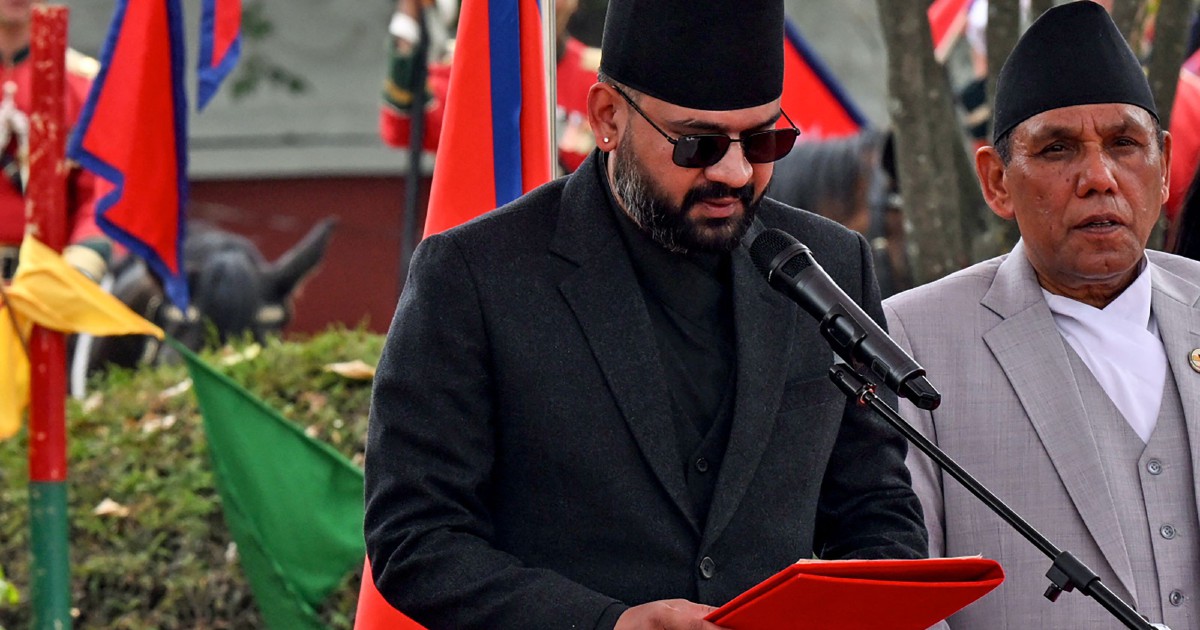
Nepal's Prime Minister Balendra Shah has secured official clearance to continue wearing his distinctive dark sunglasses within the legislature after officials confirmed legitimate medical grounds for the practice, marking an unusual intervention into parliamentary dress codes and decorum standards.
The approval came after parliament speaker Devendra Paudel had previously discouraged the wearing of sunglasses inside the chamber, citing traditional parliamentary conventions that generally expect lawmakers to appear without eyewear that obscures facial features. Such protocols exist in legislatures across democracies worldwide, rooted in the principle that representatives should be clearly visible and identifiable to their colleagues and the public during proceedings.
However, an official statement released on Tuesday clarified that Shah's case presents exceptional circumstances warranting deviation from standard parliamentary protocol. The medical justification suggests the Prime Minister requires the sunglasses to address a specific health condition, though officials did not elaborate on the precise nature of the medical issue necessitating the eyewear during legislative sessions.
This development reflects broader tensions between rigid institutional rules and individual accommodation within formal governmental settings. Nepal's parliament, like many legislative bodies, maintains established conventions governing appearance and deportment, yet such rules typically include provisions for documented medical or disability-related accommodations. The situation underscores how contemporary parliaments increasingly navigate balancing rigid traditions with modern understandings of individual circumstances and accessibility requirements.
Prime Minister Shah's signature sunglasses have become recognizable elements of his public persona, frequently visible during official events and media appearances. The eyewear choice has attracted attention both domestically and internationally, becoming a distinctive feature of his political branding. This endorsement by officials suggests parliamentary authorities prioritise health considerations over strict adherence to aesthetic uniformity.
Nepal's parliament operates within a relatively young democracy, having transitioned to a democratic federal democratic republic structure in 2015 following centuries of monarchy and various political upheavals. The legislature consequently continues developing and refining institutional practices, sometimes navigating the tension between preserving formal traditions and accommodating contemporary needs. Such precedents established during these formative years can shape parliamentary culture for decades.
The decision carries implications for how Nepal's parliament approaches accommodation requests more broadly. By granting Shah's exemption based on medical grounds, officials establish a framework through which other lawmakers might similarly petition for exceptions to dress code or appearance requirements. This could lead to more flexible parliamentary regulations that acknowledge individual circumstances while maintaining overall professional standards.
From a Southeast Asian perspective, Nepal's experience reflects broader regional patterns in how newer or reformed democracies balance institutional formality with individual accommodation. Many ASEAN and South Asian legislatures face similar questions about updating parliamentary conventions inherited from colonial-era or earlier governance structures. The outcome in Kathmandu may offer instructive lessons for regional democratic institutions grappling with comparable issues.
The parliamentary speaker's initial caution likely reflected concerns about maintaining institutional dignity and visual clarity during proceedings, particularly relevant in an era of extensive media coverage and live parliamentary broadcasting. When citizens and international observers view legislative sessions, maintaining a professional appearance remains important for public confidence in democratic institutions. Yet simultaneously, excluding individuals from full participation in democratic processes due to health-related needs contradicts modern accessibility principles.
This resolution demonstrates how institutional flexibility can ultimately strengthen democratic governance by ensuring all qualified representatives can participate fully regardless of medical circumstances. By permitting Shah to wear his medically necessary sunglasses, parliament affirmed that formal conventions should not override fundamental inclusion principles. The decision signals that Nepal's legislature, while maintaining respect for traditional parliamentary standards, recognises the importance of accommodating individual circumstances.
The outcome also reflects growing global recognition that physical appearance requirements in professional settings require careful reconsideration. Many workplaces and institutions have progressively relaxed rigid dress codes and appearance standards, acknowledging that such rules often served outdated purposes rather than contemporary functional needs. Parliamentary bodies increasingly examine whether their conventions actually serve institutional objectives or primarily perpetuate historical practices.
Moving forward, the precedent established through this decision may prompt Nepal's parliament to formally review and potentially revise appearance-related protocols. Such codification would provide clearer guidance for future accommodation requests and prevent similar situations requiring ad hoc interventions from officials. Establishing transparent frameworks for exceptions ultimately strengthens institutional credibility by demonstrating reasoned decision-making rather than arbitrary rule enforcement.
For Malaysian observers of regional parliamentary developments, Nepal's experience illustrates how democracies navigate the continuous evolution of institutional practices. While Malaysia's own parliament maintains distinct customs and protocols, the underlying tension between institutional tradition and individual accommodation remains universally relevant. How different regional parliaments address such questions reflects their respective approaches to democratic inclusivity and institutional adaptation in rapidly changing societies.

