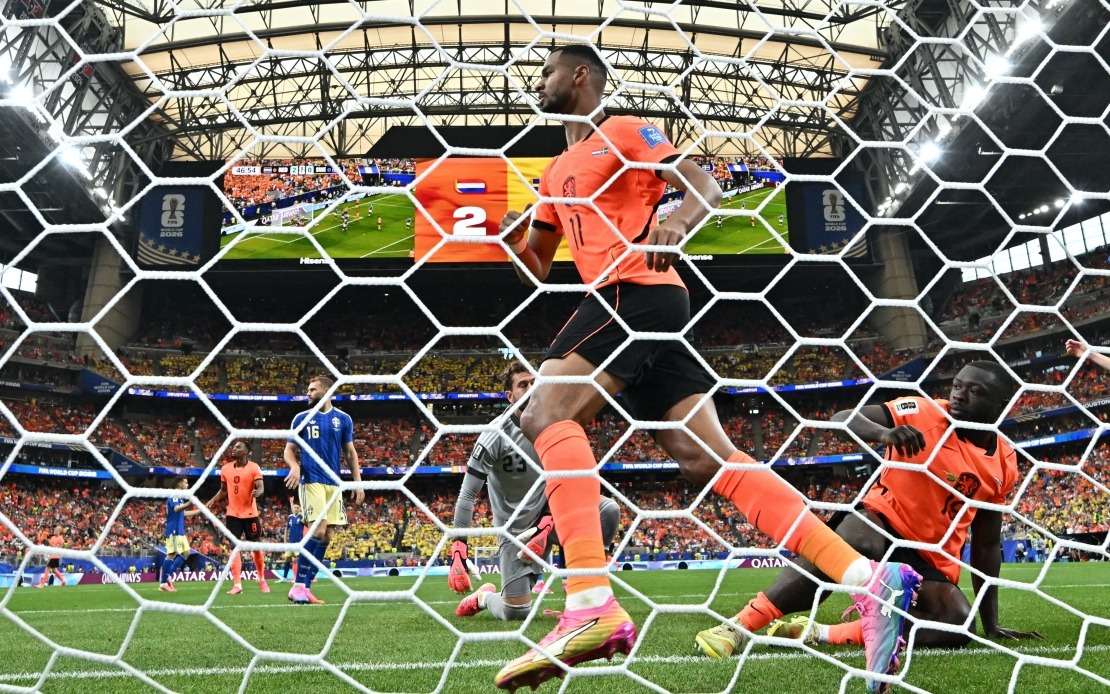
The World Cup tournament marked a historic scoring milestone on Saturday when Dutch winger Cody Gakpo found the net during the Netherlands' commanding 5-1 performance against Sweden, bringing the competition's total to 100 goals in just its 33rd match. The pace at which this milestone was achieved has not been seen since Switzerland hosted the tournament in 1954, when the 100-goal threshold was crossed after merely 20 games. With an average of over three goals per contest, this World Cup has established itself as one of the most prolific scoring tournaments in the competition's storied history.
Comparative analysis reveals just how extraordinary the current pace truly is. When Brazil hosted the World Cup a decade ago, it required 36 matches before the tournament accumulated 100 goals, while Spain 1982 similarly needed 36 contests to reach that figure. The 1978 tournament held in Argentina and the 1994 edition hosted by the United States both took 38 matches, demonstrating that the present tournament's efficiency in producing goals significantly outpaces recent decades. This remarkable scoring surge has generated considerable discussion among football analysts and tournament observers seeking to understand the underlying causes.
The official match ball has emerged as one leading explanation for the heightened scoring environment. The Trionda, designed specifically for this tournament, has allegedly compromised goalkeepers' ability to accurately read and respond to strikes from distance. Evidence supporting this theory includes the unusual frequency of goals originating beyond the penalty area, with at least 10 such strikes recorded during the early stages. This disruption to the traditional goalkeeper advantage has fundamentally altered the dynamics between attacking and defending play, potentially shifting the balance toward more entertaining, wide-open football.
Environmental and tactical factors have similarly contributed to the offensive explosion. The significant heat prevalent throughout the tournament venues has induced fatigue among defenders, creating opportunities for attackers to exploit momentary lapses in concentration and positioning. Furthermore, the introduction of mandatory three-minute cooling breaks during matches has granted coaching staff valuable windows to reorganise defensive shape and implement tactical modifications. Rather than simply allowing teams to rest passively, these breaks have become strategic moments where coaches can recalibrate their approach and address emerging vulnerabilities.
The tournament's expansion to 48 competing teams represents perhaps the most contentious structural change, with supporters arguing it has naturally inflated scoring margins. Several results early in the competition appeared to validate this concern: Germany's opening demonstration saw them dismantle Curaçao 7-1, while Canada dismantled Qatar 6-0 with comparative ease, and Tunisia experienced consecutive heavy defeats at the hands of Sweden and Japan by matching 5-1 and 4-0 scorelines respectively. These lopsided contests initially suggested that widening the tournament field had simply created more mismatches between elite and developing football nations.
However, deeper examination of the tournament's results presents a more nuanced picture that challenges this simplistic interpretation. Curaçao demonstrated resilience by securing a goalless draw against Ecuador, while Cabo Verde frustrated Spain in an equally stalemate encounter, suggesting that expanded participation has not automatically produced one-dimensional football. Even Qatar, despite playing the majority of their match against Canada with numerical disadvantage after early dismissals, mounted a competitive resistance that indicated the tournament retained genuine unpredictability. These defensive performances suggest the competitive range remains wider than apocalyptic predictions concerning expansion might have suggested.
Underdogs competing in the tournament have similarly defied assumptions about the weakness of newly included nations. Both Jordan and Uzbekistan, despite ultimately falling to Austria and Colombia respectively, mounted organised defensive performances and created legitimate scoring opportunities while losing 3-1. These results indicate that tactical discipline and organisational competence have partially offsetted the raw quality differential between traditional powerhouses and emerging football nations. The fact that these matches remained genuinely contested affairs rather than ceremonial beatings suggests the expanded format may actually be producing more competitive balance than anticipated.
The combination of these multiple factors—the controversial ball design, environmental stress, tactical innovation, and structural expansion—has created a perfect storm of offensive productivity. Rather than representing a single dominant cause, the elevated scoring appears to result from several reinforcing elements working simultaneously. This multi-faceted explanation acknowledges that no single innovation or circumstance entirely accounts for the phenomenon, but rather their convergence has fundamentally altered the tournament's character and rhythm.
For regional audiences across Southeast Asia, this World Cup's openness carries particular significance. The expanded format offers greater opportunities for Asian football to assert itself on the global stage, with additional qualification slots and tournament berths reducing the traditional monopoly held by established European and South American powers. The high-scoring environment may suit attacking-minded teams willing to embrace open, entertaining football rather than defensive pragmatism. As the tournament progresses, observing whether this scoring trend sustains or normalises will provide crucial insights into the viability and appeal of the expanded format, potentially influencing competitive structures in future international football competitions.
%22%2F%3E%3C%2Fpattern%3E%3C%2Fdefs%3E%3Crect%20width%3D%22100%25%22%20height%3D%22100%25%22%20fill%3D%22url(%23ph2l9nug)%22%2F%3E%3Crect%20width%3D%22100%25%22%20height%3D%22100%25%22%20fill%3D%22url(%23ph2l9nup)%22%2F%3E%3Ctext%20x%3D%2250%25%22%20y%3D%2250%25%22%20text-anchor%3D%22middle%22%20dominant-baseline%3D%22central%22%20fill%3D%22rgba(255%2C255%2C255%2C0.95)%22%20font-family%3D%22Georgia%2C%20'Times%20New%20Roman'%2C%20serif%22%20font-weight%3D%22700%22%20font-size%3D%22170%22%20letter-spacing%3D%22-0.02em%22%3ETambirat%3C%2Ftext%3E%3C%2Fsvg%3E)
%22%2F%3E%3C%2Fpattern%3E%3C%2Fdefs%3E%3Crect%20width%3D%22100%25%22%20height%3D%22100%25%22%20fill%3D%22url(%23ph4ena0g)%22%2F%3E%3Crect%20width%3D%22100%25%22%20height%3D%22100%25%22%20fill%3D%22url(%23ph4ena0p)%22%2F%3E%3Ctext%20x%3D%2250%25%22%20y%3D%2250%25%22%20text-anchor%3D%22middle%22%20dominant-baseline%3D%22central%22%20fill%3D%22rgba(255%2C255%2C255%2C0.95)%22%20font-family%3D%22Georgia%2C%20'Times%20New%20Roman'%2C%20serif%22%20font-weight%3D%22700%22%20font-size%3D%22194%22%20letter-spacing%3D%22-0.02em%22%3EBintulu%3C%2Ftext%3E%3C%2Fsvg%3E)