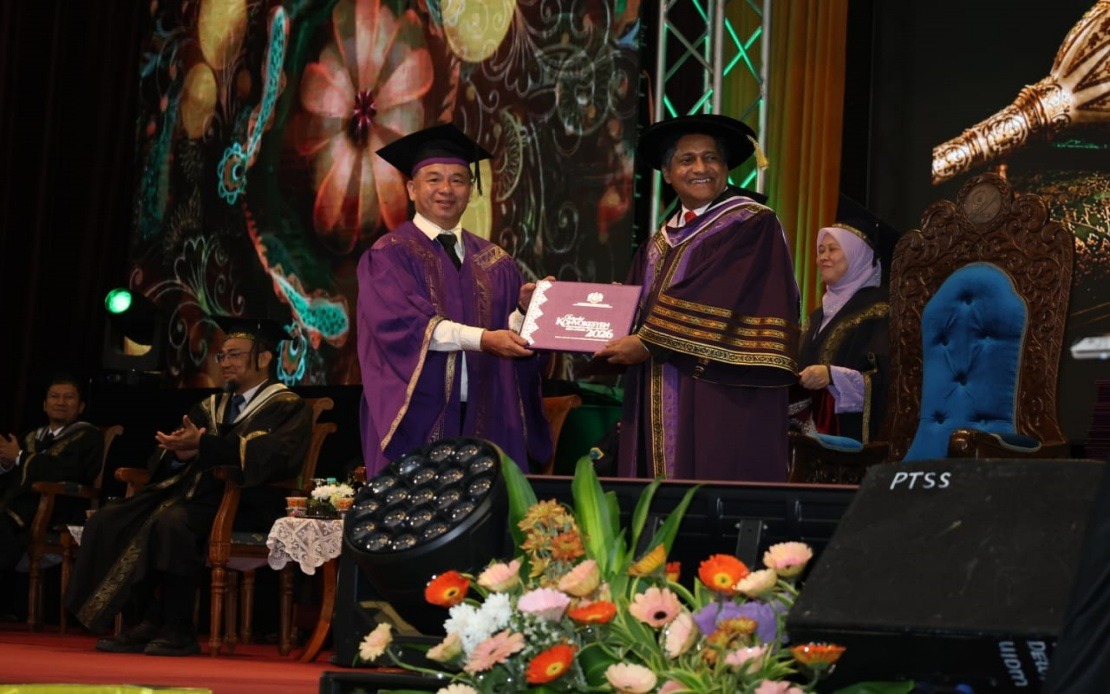
A 57-year-old student in Bukit Mertajam has rewritten the record books at Seberang Perai Polytechnic, becoming the institution's oldest graduate after successfully completing his Diploma in Electrical and Electronic Engineering at the PSP Convocation Ceremony 2026. Heng Meng Lai's achievement represents far more than a personal milestone—it underscores a powerful message about perseverance and the possibility of reinvention at any stage of life, especially relevant in Malaysia's push toward a knowledge-based economy that increasingly demands continuous upskilling.
Heng's educational journey spans nearly half a century of deferred ambitions. Growing up as the third of seven children in a household marked by financial hardship, he watched his mother shoulder the burden of supporting the family alone after his father's death when Heng was just nine years old. She worked long hours in a sewing factory, embodying the kind of resilience that would later define her son's own pursuit of academic credentials. These formative experiences did not discourage Heng from learning; rather, they instilled in him a conviction that education represented the pathway to a better life, even if that path would have to wait decades to materialize.
For much of his working life, Heng pursued survival and stability. He began as a storekeeper before advancing to the role of production line supervisor at an electronics factory—a position that ironically planted the seeds for his eventual return to formal education. His hands-on experience in the electronics sector ignited a deeper curiosity about the engineering principles that governed the work he performed daily. This organic interest, cultivated through years of practical exposure, proved more powerful than any recruitment campaign when he finally decided to pursue formal qualifications in Electrical and Electronic Engineering.
The decision to enroll at Seberang Perai Polytechnic at an age when most of his peers were contemplating retirement required considerable courage. Heng would find himself surrounded by classmates young enough to be his children, navigating lecture halls and laboratory work with people who represented two or three generations removed from his own. Yet he articulated clearly his fundamental belief: that learning transcends age, and that the accumulation of years should not extinguish the desire for credentials and new knowledge.
What could have been an alienating experience instead became a testament to the institution's commitment to inclusive education. Heng credited the lecturers at Seberang Perai Polytechnic with creating an environment where he never felt marginalized despite being dramatically older than his cohort. The faculty provided patient guidance and consistent encouragement, demonstrating that quality pedagogy adapts to the learner rather than forcing the learner to conform to rigid institutional molds. This institutional support proved crucial in helping Heng transition from the world of factory floors to the world of academic rigor.
The significance of Heng's accomplishment extends beyond his personal satisfaction, though that dimension remains important. His journey highlights the capabilities of Malaysia's polytechnic system to serve not just school-leavers but also working adults seeking to formalize knowledge gained through experience. In an era where technological disruption threatens job security and competitive advantage hinges on updated skills, individuals like Heng represent proof that educational institutions can and should remain accessible to mid-career and late-career workers seeking professional transformation.
Mohd Ruzi Hamzah, the director of Seberang Perai Polytechnic, correctly identified the broader implications of Heng's achievement. Beyond celebrating a record, the institution recognized that this graduate exemplifies the principle that education constitutes a universal right rather than a privilege reserved for youth. Heng's trajectory—from storekeeper to supervisor to diploma holder in an engineering discipline—demonstrates the tangible ways that qualifications can unlock opportunities across different life stages. His story validates the national emphasis on lifelong learning and the development of skilled human capital as economic imperatives.
Looking ahead, Heng has mapped out a thoughtful plan that reflects both pragmatism and ambition. He intends to return to the workforce and apply his newly acquired knowledge and technical skills before pursuing a Bachelor's degree. This sequential approach suggests a mature understanding of educational progression: the diploma represents a significant achievement, but it also constitutes a foundation for further advancement rather than a final destination. His intention to continue studying demonstrates that the successful completion of one major educational goal often reignites appetite for subsequent ones.
For Malaysian policymakers and educational leaders, Heng's story carries an important message about program design and accessibility. As Malaysia navigates economic transformation and the imperative to develop a highly skilled workforce, institutions must remain responsive to diverse learner profiles. This includes mature-age students, career-changers, and individuals who need flexible pathways to qualification. Seberang Perai Polytechnic's willingness to enroll and support Heng suggests that other polytechnics and educational institutions can adopt similar approaches to reach underutilized segments of the population.
Moreover, Heng's achievement resonates particularly in Southeast Asia, where demographic pressures and rapid technological change create urgency around workforce development. Countries across the region share similar aspirations to build knowledge-based economies, yet educational systems often remain oriented primarily toward younger cohorts. Recognizing and celebrating mature-age graduates like Heng sends a signal that educational investment in experienced workers yields returns—not just in terms of individual advancement, but in the collective capability of the workforce.
The personal dimension of Heng's story should not be overshadowed by these broader policy implications. After nearly five decades of deferring an educational dream, he has finally realized that ambition and holds a diploma that validates both his academic capability and his sustained commitment. For anyone facing obstacles to education—whether financial, familial, or circumstantial—Heng's example provides concrete encouragement that barriers can eventually be overcome. His single status, his modest career history, and his age all posed potential obstacles, yet none proved insurmountable.
As Heng transitions from student to working professional holding a new qualification, he carries with him not just technical knowledge in electrical and electronic engineering, but also the satisfaction of having closed a chapter that remained open for decades. His achievement at Seberang Perai Polytechnic will likely inspire other working adults to consider formal education as a viable option at any career stage, enriching both their own lives and the broader pool of skilled professionals in Malaysia and the region.

