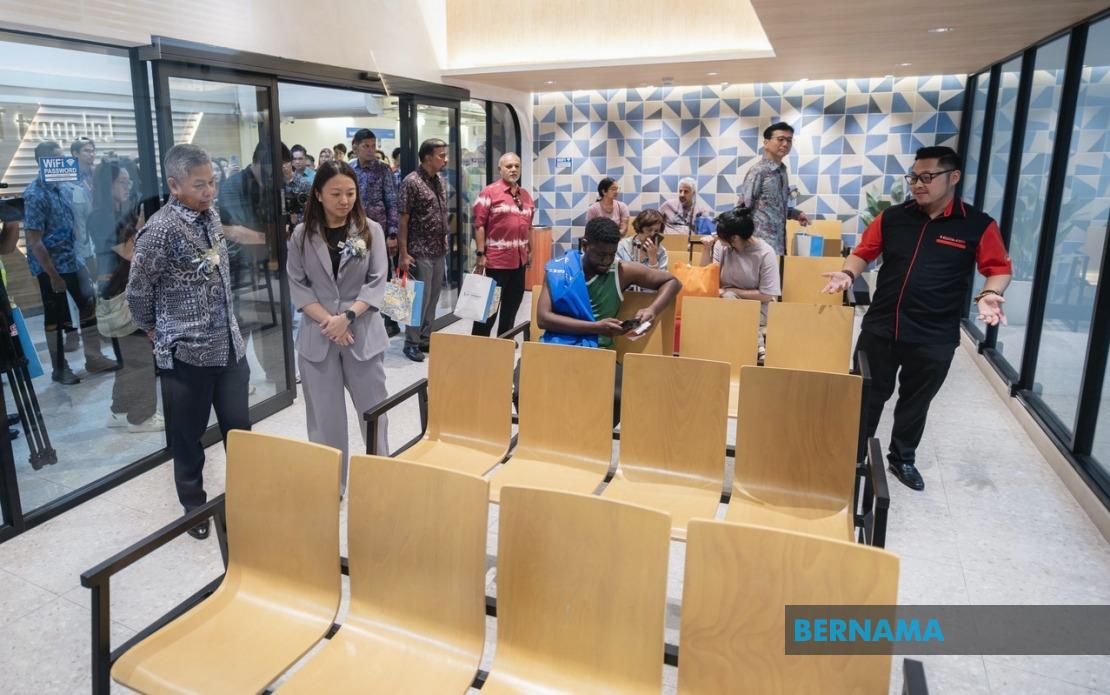
The newly inaugurated LaLaport Transportation Hub in central Kuala Lumpur represents a significant upgrade to the city's fragmented public transport infrastructure, with projections to accommodate up to 10,000 daily passengers through an integrated facility that merges rail, bus, and ride-sharing services. The hub, positioned adjacent to the Hang Tuah LRT and Monorail interchange, was launched today by Hannah Yeoh, the Minister in the Prime Minister's Department (Federal Territories), signalling the government's commitment to modernising last-mile connectivity in the capital.
The facility addresses a critical gap in Kuala Lumpur's transport ecosystem by creating a unified boarding and alighting point that eliminates the friction passengers currently experience when transferring between different modes. Through a covered pedestrian walkway, travellers can access express buses, conventional public transport, e-hailing platforms, conventional taxis, and shared mobility services without exposure to weather—a particularly valuable feature in Malaysia's tropical climate. This architectural integration acknowledges that modern urban mobility is less about individual transport modes and more about seamless transitions between them, a lesson learned from leading Asian cities where intermodal hubs have proven essential to reducing private vehicle dependency.
The scale of Kuala Lumpur's transport demands underscores the urgency of such infrastructure improvements. Daily, approximately 1.2 million people enter and exit the city, generating roughly 5.5 million individual journeys—statistics that reflect the metropolitan area's role as an economic and administrative centre pulling workers and visitors from surrounding regions. Against this backdrop, the addition of a properly regulated, fully-equipped terminal in the city centre represents not merely incremental progress but a structural intervention in how the capital manages passenger flows.
Located on the LG1 level of the East Atrium, the hub boasts 11 dedicated bus parking bays within a fully air-conditioned facility, complete with manned ticket counters, self-service kiosks for passengers seeking independence, and real-time passenger information displays that provide schedules and service updates. The operator, Asia Success Resource Sdn Bhd, expects the terminal to process approximately 150 bus trips daily, including round-the-clock express services linking Kuala Lumpur directly to Singapore—positioning the hub as a crucial gateway in the broader Southeast Asian cross-border travel network. This 24-hour KL-Singapore connection is particularly significant for Malaysia's economic integration with its wealthier neighbour and for leisure travellers who constitute an important revenue stream for regional transport operators.
The terminal's integration of complementary services extends beyond buses. The Boleh-Boleh Ride on-demand shuttle service provides flexible connections to major city-centre destinations, a model that acknowledges last-mile connectivity—the persistent weak link in Southeast Asian public transport systems. Additionally, dedicated shuttle vans serving Kuala Lumpur International Airport Terminals 1 and 2 eliminate the need for passengers to navigate complicated transfers when reaching KLIA, historically a pain point for international travellers arriving in Malaysia. These services collectively aim to position the hub as a neutral, passenger-centric platform rather than a venue competing with alternative transport modes.
The regulatory environment underpinning the hub's operations has evolved to support such initiatives. The Kuala Lumpur City Hall (DBKL) recently transitioned from annual operating licences to three-year permits for transport terminals—a shift designed to reduce administrative burden on operators while providing greater certainty for long-term planning and capital investment. This policy adjustment mirrors international best practice in urban transport regulation and reflects recognition that sustainable transport infrastructure requires stable operational frameworks. The expansion of CCTV coverage across the city, with approximately 10,000 operational cameras planned, simultaneously addresses safety and security concerns that have historically deterred commuters from utilising public transport during off-peak hours.
About 30 bus operators are expected to utilise LaLaport as their primary transit hub for city-centre operations, with particular emphasis on cross-border services between Kuala Lumpur and Singapore. This concentration represents both opportunity and risk—opportunity because consolidated operations can reduce urban congestion and environmental impact, but risk because excessive operator concentration creates dependency on a single facility's continued operation and maintenance. The involvement of Japan's transport expertise adds valuable perspective; Japanese Ambassador to Malaysia Noriyuki Shikata referenced the launch as evidence of bilateral cooperation in sustainable urban development, a partnership formalised through Prime Minister Datuk Seri Anwar Ibrahim's recent visit to Tokyo and reflected in shared commitments to energy security and infrastructure modernisation.
The hub's significance extends beyond operational metrics to symbolic and strategic dimensions. For Malaysian policymakers, it demonstrates capacity to deliver integrated transport infrastructure comparable to standards in developed economies, a capability essential for attracting international investment and maintaining Malaysia's position as Southeast Asia's logistics hub. The involvement of Japanese institutional expertise—through the ambassador's attendance and implicit endorsement—signals that Malaysia remains attractive for Japanese urban development partnerships, particularly in sustainable mobility sectors. The upcoming 75th anniversary of Malaysia-Japan diplomatic relations provides occasion for deepening these ties across multiple economic sectors.
From a Southeast Asian perspective, the hub illustrates how individual cities are incrementally improving intra-regional connectivity. As cross-border passenger volumes increase—driven by ASEAN economic integration, tourism growth, and business travel—transport terminals like LaLaport serve as critical nodes in an emerging regional mobility network. The success of KL-Singapore express services may encourage similar investments in other ASEAN capitals, gradually creating competitive alternatives to private vehicle travel and air travel for medium-distance journeys across the region. This distributed infrastructure development, though less visible than high-speed rail megaprojects, may ultimately prove more impactful in reshaping Southeast Asian transport patterns.
The facility also contributes to Kuala Lumpur's broader urban revitalisation strategy by activating the LG1 level of the East Atrium with pedestrian traffic and formal economic activity. Location decisions in transport networks generate multiplier effects: passenger concentration attracts retail investment, food service operators, and ancillary businesses, transforming transport interchanges from purely functional spaces into micro-commercial ecosystems. This retail activation, when designed thoughtfully, can enhance user experience while generating revenue streams that support terminal maintenance and operator sustainability—creating positive feedback loops absent in purely subsidised public transport models.
The launch occurs within a broader context of Southeast Asian transport modernisation, where cities increasingly recognise that competitive advantage depends on seamless, reliable, passenger-centred mobility rather than individual modal excellence. The LaLaport Transportation Hub, by consolidating previously fragmented services under unified management with standardised facilities, represents a pragmatic response to this imperative. For Malaysian readers, particularly those navigating Kuala Lumpur's daily commute or traversing cross-border routes to Singapore, the facility offers concrete evidence that transport policy is responding to real passenger needs rather than remaining locked in ideological debates between public and private transport advocates. Success or failure of this initiative will likely influence investment decisions for similar projects across Malaysia's other metropolitan areas.

