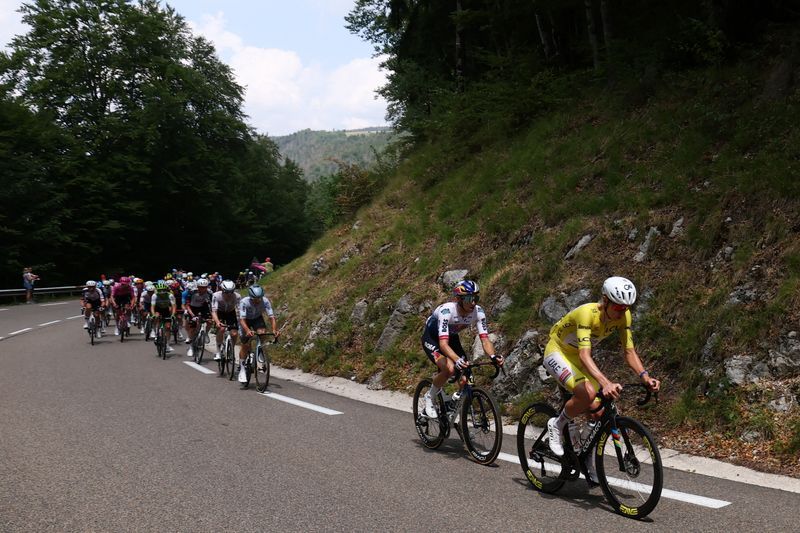
Jonathan Vaughters, the former professional cyclist who now directs the Cannondale-EF team, has stepped into the heated debate surrounding unannounced pre-dawn doping controls at this year's Tour de France, offering a perspective shaped by his intimate knowledge of cycling's darkest chapter. His intervention comes as several elite riders have complained about the timing and impact of surprise drug tests conducted in the early morning hours, but Vaughters argues that such vigilance would have been transformative had anti-doping authorities employed it during the sport's systematic doping years.
The controversy erupted following Sunday's 15th stage, when race leaders Tadej Pogacar and Jonas Vingegaard were roused from sleep for unannounced testing. The disruption proved particularly consequential for Vingegaard, who reported losing approximately 40 minutes of sleep before a mountain stage and subsequently suffered a crash that resulted in a broken collarbone. Pogacar managed only four hours of rest following his 5am test, whilst stage winner Remco Evenepoel characterised the practice as "inhuman," reflecting broader rider concerns about the physical and competitive implications of nocturnal testing protocols.
Vaughters' defence of these controversial procedures carries substantial weight within cycling circles, given his direct involvement in the sport's doping era. Writing on social media, he asserted that 2am testing represents "one of the very effective ways to prevent peptide, EPO, hGH and testosterone micro dosing." His claim goes further: had the UCI implemented such rigorous night-time testing in 2001, when he was actively competing, "we'd all have been suspended and saved the sport 25 years of drama." This statement amounts to a startling acknowledgement of the systematic nature of doping that permeated professional cycling during that period.
The credibility of Vaughters' perspective derives from his personal history with performance-enhancing drugs. As a teammate of Lance Armstrong on the U.S. Postal Service team during cycling's most infamous doping programme, Vaughters subsequently admitted to using EPO and other prohibited substances throughout his professional career. His candour extended to providing testimony in the U.S. Anti-Doping Agency's comprehensive investigation of Armstrong, which concluded in 2012 that the legendary cyclist had orchestrated what USADA characterised as the most sophisticated doping operation in sport. Armstrong's stripping of his seven Tour de France titles marked a watershed moment for cycling's reputation, yet the sport continued to grapple with lingering suspicions about clean racing.
Vaughters' transition from complicit participant to clean sport advocate lends nuance to his current position. After retiring from racing, he founded what became known as the Cannondale-EF team, explicitly positioning the organisation as a champion of ethical cycling practices. This trajectory from insider knowledge of doping culture to public champion of anti-doping measures gives his arguments particular resonance, though they have inevitably drawn scrutiny from riders concerned about their welfare and competitive fairness.
The scientific basis for night-time testing centres on the pharmacokinetics of certain performance-enhancing substances. Micro-dosing protocols employing EPO, human growth hormone, and other peptides work precisely because these compounds can be metabolised and eliminated from the body within hours, leaving minimal traces during standard daytime testing windows. Anti-doping authorities, operating through the International Testing Agency which oversees UCI protocols, have long recognised this vulnerability. By conducting surprise tests at unpredictable hours, officials aim to catch athletes during periods when they may be insufficiently cautious about their micro-dosing schedules.
The International Testing Agency acknowledged this tension in its formal response to rider complaints, conceding that "night-time testing may be disruptive to riders' rest and recovery." However, the agency maintained that effective anti-doping work must, "in limited and justified circumstances," occur outside conventional testing hours. This represents a deliberate prioritisation of testing efficacy over athlete comfort, a choice that reflects hard lessons learned from cycling's doping history, when predictable testing regimes allowed systematic cheaters to time their drug use strategically.
For Malaysian and Southeast Asian sports enthusiasts, the debate illuminates the continuing tension between competitive integrity and athlete welfare that extends beyond cycling. The region's growing investment in professional cycling, including participation in international tours and development of domestic racing infrastructure, means that anti-doping standards and fairness concerns resonate within local sporting discourse. The principles underlying night-time testing—that effective prevention sometimes requires uncomfortable measures—apply across all endurance sports where performance-enhancing substances present ongoing challenges.
Vaughters' intervention also reflects cycling's broader institutional effort to rebuild credibility following the Armstrong scandal. By having prominent former dopers publicly endorse strict testing protocols, the sport signals transformation and commitment to clean competition. Yet this approach carries risks, as rider complaints about unfair conditions could undermine support for rigorous anti-doping measures if public perception shifts toward viewing such controls as excessive or oppressive rather than necessary.
The practical dilemma facing cycling authorities remains unresolved: how to detect micro-dosing without imposing unreasonable burdens on athletes whose careers and health depend on adequate rest. Vingegaard's collarbone fracture, potentially attributable to sleep deprivation from testing, crystallises this challenge. Some observers argue that technological solutions—such as improved biological passport analysis or other detection methods that don't require disrupting sleep—might achieve similar efficacy without the welfare cost.
Vaughters' historical perspective suggests that generations of cyclists could have been spared the ethical compromises and health consequences of systematic doping had such rigorous testing existed earlier. Yet his argument simultaneously demonstrates why current riders resist these controls: the measures are genuinely disruptive and potentially dangerous. As professional cycling continues navigating the legacy of its doping era, the profession confronts the uncomfortable reality that preventing sophisticated cheating requires methods that inconvenience even honest competitors.

