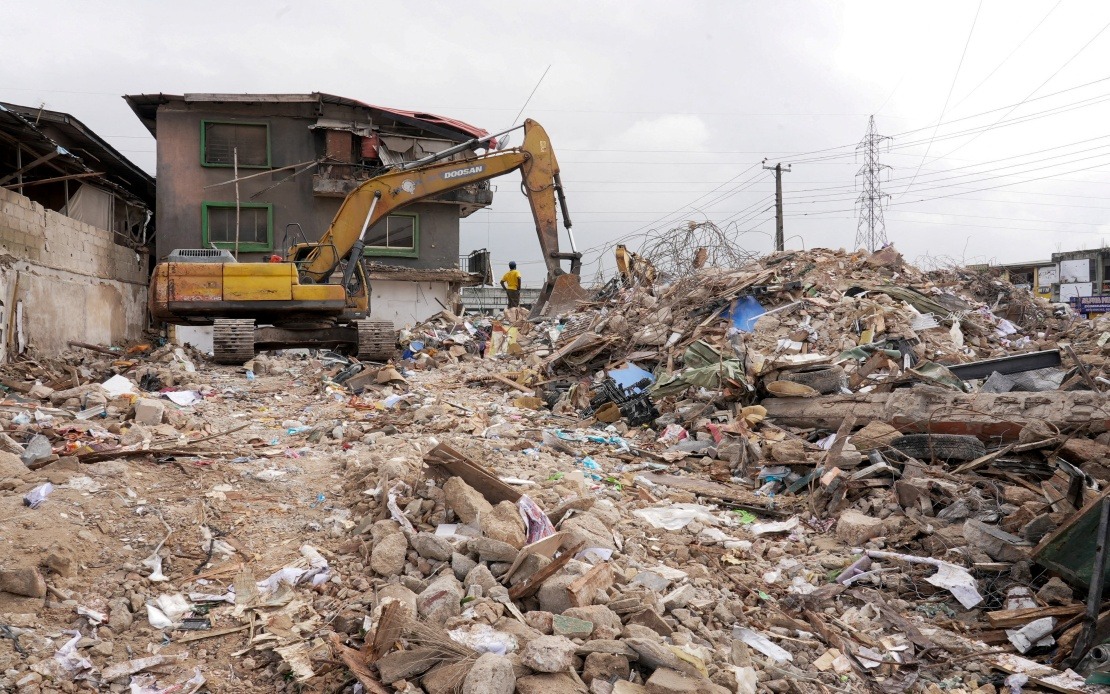
A three-story shopping complex in Alakija, a rapidly developing satellite community along the Lagos-Badagry Expressway in Nigeria's southwestern Lagos State, collapsed on Thursday morning, leaving nine people dead and 27 others rescued from the debris. The disaster underscores persistent construction safety challenges across West Africa's most populous nation, where structural failures continue to claim lives despite growing urbanisation and infrastructure development.
Emergency responders launched an intensive multi-agency rescue operation immediately after the building gave way, mobilising teams that worked continuously throughout Thursday and into Friday morning to locate and extract victims trapped beneath tonnes of rubble. Olufemi Oke-Osanyintolu, permanent secretary of the Lagos State Emergency Management Agency, confirmed that rescue efforts concluded early Friday after all accessible survivors had been removed from the collapsed site. The operation involved coordination between various government agencies and private sector participants, demonstrating the scale of resources required to manage such crises in densely populated urban areas.
The 27 survivors recovered from the wreckage sustained injuries ranging from minor to severe, prompting immediate medical intervention at multiple hospitals throughout Lagos. Rescue workers prioritised stabilising injured victims before transport, recognising that the quality of emergency care in the critical hours following a structural collapse often determines long-term health outcomes. The treatment burden on Lagos's healthcare infrastructure reflects a broader challenge facing Nigeria's medical system when managing mass casualty incidents in urban centres.
Initial investigations revealed that the trapped victims comprised primarily shop owners and customers conducting routine commercial activities when the structure failed without warning. The shopping complex's location in a busy commercial district meant that daytime hours coincided with maximum occupancy, amplifying casualties. Neighbouring residents who occupied nearby structures also became trapped, indicating that the collapse may have affected surrounding buildings or created secondary hazards that extended the danger zone beyond the primary structure.
The China Civil Engineering Construction Corporation, which operates a railway project in the region, mobilised its own rescue resources to assist government teams. This involvement reflects how major infrastructure projects maintain emergency response capabilities that can be deployed during local crises, though it also highlights the reality that Nigeria often relies on private contractors' technical expertise when public agencies face resource constraints. The participation of a foreign construction firm in rescue operations serves as a reminder that Lagos and Nigeria's capacity to respond to disasters sometimes depends on international commercial partnerships.
The underlying cause of the collapse remains undetermined pending formal investigation by Lagos authorities. However, structural engineers and building safety experts have consistently identified a cluster of risk factors endemic to Nigeria's construction sector. Inadequate maintenance of aging structures, with many buildings lacking regular inspections or repairs, represents perhaps the most widespread vulnerability. When combined with deliberate circumvention of building codes—whether through corruption, negligence, or ignorance—structures that were never properly designed or built in the first place deteriorate rapidly and catastrophically.
The use of substandard or counterfeit construction materials represents another critical failure point in Nigeria's building supply chain. Cement, steel reinforcement, and concrete aggregates are frequently diluted or replaced with inferior alternatives by suppliers seeking profit margins. Builders, facing cost pressures and lacking rigorous quality control mechanisms, may unknowingly incorporate these defective materials, or in some cases accept them knowingly. Neither developers nor regulators consistently conduct material testing, allowing compromised components to enter structures that will ultimately support hundreds of occupants.
Building collapses have become tragically routine in Nigeria, with major incidents occurring across Lagos and other major cities at disturbingly regular intervals. The frequency of these disasters suggests that regulatory frameworks exist more in theory than practice. Lagos State and the Federal Government have established building control agencies, development permit requirements, and structural inspection protocols, yet enforcement remains sporadic and sometimes subject to corruption. Without consistent application of regulations and meaningful penalties for violations, the incentive for developers and contractors to cut corners persists.
For Malaysia and other Southeast Asian nations experiencing rapid urban expansion, Nigeria's experience offers cautionary lessons regarding the importance of institutional capacity in construction oversight. Countries like Malaysia that have invested in robust building inspection regimes, professional licensing requirements for engineers and architects, and transparent enforcement mechanisms benefit from measurably better safety records. Yet even advanced regulatory systems face challenges from informal construction, inadequate maintenance of existing stock, and the pressure on developing areas to accommodate growth faster than proper oversight can keep pace.
The Alakija collapse raises questions about the adequacy of disaster preparedness in Lagos, a megacity of over 15 million people where informal settlement, overcrowding, and aging infrastructure create numerous potential failure points. Effective response to structural collapses requires not only rescue equipment and trained personnel, but also pre-established protocols, regular training, and integrated communication systems. The successful evacuation of 27 survivors suggests that Lagos's emergency services possess basic operational capacity, yet the scale of casualties indicates that prevention remains dramatically more cost-effective than response.
Regional urban planners across West Africa and beyond must grapple with the reality that rapid growth, limited budgets, and weak institutional capacity create dangerous combinations. Allocating sufficient resources to building inspection, training qualified engineers and inspectors, implementing transparent permit systems, and establishing enforceable penalties for violations requires political will and financial commitment. Nations that defer these investments in favour of maximising short-term development inevitably face the human and economic costs of preventable disasters like the Alakija collapse.
The investigation into this incident will likely document specific failures—perhaps faulty design, material defects, or inadequate construction supervision—but the broader pattern of recurring collapses suggests systemic rather than isolated problems. Until Nigeria substantially strengthens its regulatory institutions, invests in training and equipment for enforcement agencies, and creates incentives for compliance throughout the construction supply chain, Lagos and other Nigerian cities will continue to experience preventable tragedies that claim lives and undermine public confidence in urban safety.

