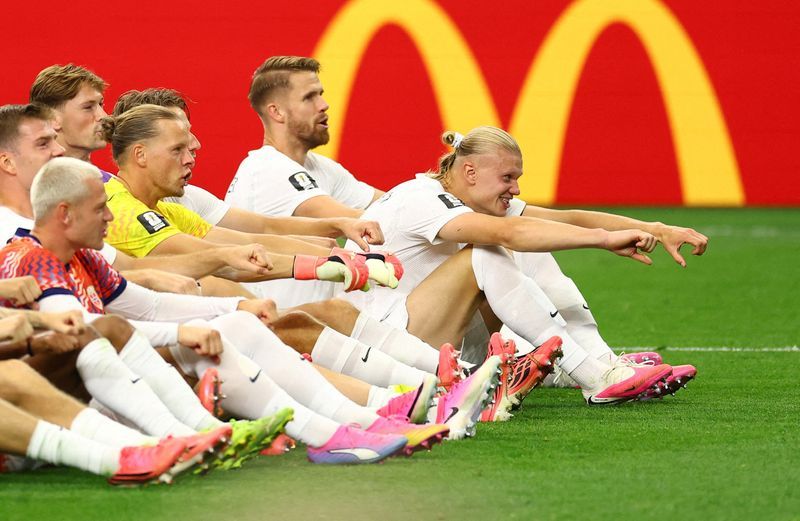
Norway's fairy-tale return to the World Cup finals came to an end on Saturday in Miami, where England's Jude Bellingham's extra-time brace secured a 2-1 quarter-final victory and a berth in the semi-finals. Yet despite the disappointment of elimination, Stale Solbakken's squad has emerged from the tournament with considerable accomplishment, having dismantled expectations and established themselves as a genuine threat among the world's elite football nations after a 28-year absence from the global stage.
The tournament represented a watershed moment for Norwegian football. Coming back to the finals for the first time since 1998, the Nordic side arrived with considerable fanfare, embracing their Viking heritage with pre-tournament photoshoots that tapped into historical imagery of their seafaring ancestors. This cultural confidence extended onto the pitch, where Erling Haaland and his teammates demonstrated a brand of attacking football that captivated audiences and transcended the typical narrative surrounding Scandinavian football.
Norway's qualifying campaign had signalled their intentions clearly, with Haaland's prolific finishing providing the template for success. However, navigating the tournament proper proved a far more challenging endeavour. Progressing through their group was viewed as the baseline expectation, yet the squad quickly began exceeding those modest projections. Their last-32 encounter against Ivory Coast saw Haaland produce a clinical two-goal display to secure a 2-1 triumph, but this victory paled in significance compared to what followed.
The standout moment of Norway's campaign arrived when they dismantled Brazil with a composed 2-1 victory that demonstrated tactical sophistication and technical quality rarely associated with Scandinavian football. The performance captured global attention and sparked genuine speculation about an improbable deep tournament run. Supporters dared imagine a semi-final appearance or even an unlikely final berth, though such aspirations would ultimately prove beyond reach.
Physical fatigue ultimately proved Norway's undoing against England. What had appeared a manageable deficit—holding a one-goal lead entering extra time—rapidly dissolved as Bellingham's double exploits completed the overturned scoreline. The gruelling demands of tournament football, compounded by the intensity of their matches against quality opposition, finally extracted a toll on Haaland and captain Martin Odegaard, whose individual brilliance had sustained the campaign.
Yet Norway's exit masks a far broader narrative concerning Scandinavian football's trajectory. The emergence of clubs like Bodø/Glimt, who have consistently competed credibly in European competitions throughout recent years, suggests a football culture increasingly capable of developing world-class talent. The systematic production of gifted young players represents a decisive break from Norway's historical reputation as a functional but uninspiring football nation built upon direct, pragmatic approaches rather than technical refinement.
Solbakken's characteristically understated assessment—that "the summer of '26 has been fairly OK"—barely masks the genuine transformation achieved. His leadership, alongside the calm authority exuded by Odegaard and the devastating finishing prowess of Haaland, embodies a distinctly Norwegian temperament: capable of self-deprecating humour yet absolutely uncompromising in competitive pursuit. This combination has proven particularly resonant with audiences, with American spectators in particular embracing both Haaland's individual magnetism and the squad's playful "Viking row" celebration that became the tournament's defining cultural moment.
The manager's post-tournament reflection revealed the psychological shift occurring within Norwegian football. "I think that we have players who are left with a feeling that they can more or less match the best teams in the world," Solbakken observed. This sentiment encapsulates the fundamental difference between Norway's 1998 participation and their 2026 return. Then, they arrived as hopeful participants. Now, they depart as a squad genuinely believing they possess the technical and tactical resources to compete with football's established superpowers.
For Malaysian and Southeast Asian observers, Norway's resurgence offers instructive lessons regarding sustained player development, the value of continental competition in elevating domestic standards, and the importance of creating cultural narratives that celebrate rather than diminish football ambition. While England's victory secures their semi-final place, Norway's trajectory suggests the Scandinavians will return to future tournaments as increasingly formidable competitors rather than historical curiosities enjoying a nostalgic reunion with World Cup football.
The legacy of this campaign extends far beyond tournament performance metrics. Norwegian football has definitively announced its arrival among the game's most compelling emerging forces, a status unlikely to be surrendered lightly in coming years.

