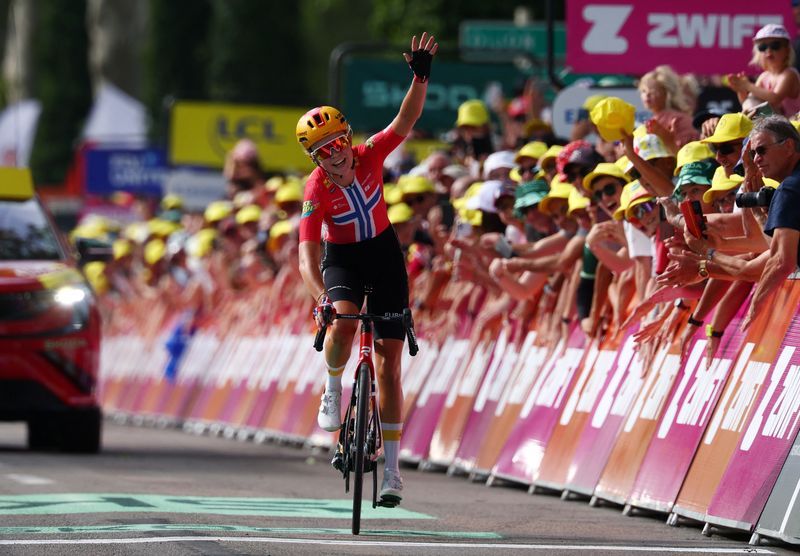
Sigrid Haugset etched her name into cycling history on Monday when the 27-year-old Norwegian rider powered to a solo victory on the Tour de France Femmes, breaching a barrier that had stood for her country in women's professional cycling. Her triumph on the stage saw her seize the overall lead in the race, displacing Dutchwoman Lorena Wiebes at the top of the standings. The Uno-X Mobility rider now carries the yellow jersey with a commanding advantage of two minutes and 22 seconds over second-placed Kimberly Le Court of Mauritius, establishing herself as the race favourite heading into the crucial middle stages.
Haugset's breakthrough reflects broader shifts in women's professional cycling, where Nordic and Northern European nations have increasingly become competitive forces. Her achievement resonates particularly in Norway, a country with deep cycling traditions but one that had yet to produce a women's stage winner at cycling's most prestigious event. The emotional weight of the accomplishment was evident in her post-race comments, where she acknowledged the improbability of her success. For Malaysian and Southeast Asian cycling enthusiasts, Haugset's story illustrates how professional cycling continues to evolve beyond traditional cycling powerhouses, with emerging talents from smaller nations now capable of competing at the highest level.
The stage itself proved decisive because of its mountainous terrain, forcing the race into the Alps for the first time in this year's edition. The 156.5-kilometre route to Poligny included two categorised climbs that tested the field's climbing credentials. Early in the stage, disaster struck when multiple riders hit the pavement during the treacherous ascent of the category one-climb to Col de la Faucille. The incident claimed notable casualties, including reigning world champion Magdeleine Vallieres and Demi Vollering, the previous year's Tour de France Femmes champion. Both riders remounted immediately, demonstrating the resilience that defines professional cycling, though the crash fractured the race's coherence and would influence the tactical landscape for the remainder of the day.
Haugset initiated her decisive move during the subsequent climb to Col de la Savine, when she accelerated away from the main bunch with characteristic aggression. Belgian rival Lotte Kopecky, riding for a strong team, responded promptly and pursued the Norwegian through the remaining kilometres. The two engaged in a prolonged battle of attrition that lasted roughly two-thirds of the stage, with Haugset maintaining her advantage through a combination of superior fitness and mental fortitude. The drama intensified as the kilometres ticked down, with Kopecky narrowing the gap to just ten seconds with ten kilometres remaining, suggesting a potential dramatic reversal of fortune.
Yet precisely when capitulation seemed inevitable, Haugset summoned reserves of energy that proved decisive in the outcome. With three kilometres to the finish, she increased her tempo once more, pushing Kopecky approximately one minute behind and establishing a gap that would prove insurmountable. The Belgian cyclist ultimately crossed the line in second place, one minute and 24 seconds adrift, while Dutch veteran Marianne Vos secured third position. Haugset's ability to recover and accelerate when most needed highlighted the mental and physical attributes that separate cycling's elite competitors from talented domestiques, a quality particularly valued in one-day challenges and stage races where multiple efforts may prove necessary.
Haugset's emotional restraint at the finish line provided an amusing postscript to her triumph. Despite achieving a lifetime ambition, she found herself too exhausted to celebrate properly, remaining locked into her aerodynamic position through sheer fatigue. Her self-deprecating explanation that her boyfriend would be frustrated by her muted celebration revealed the human dimension of professional sport, where physical exhaustion occasionally overwhelms the natural impulse to savour achievement. This candid moment resonated with cycling fans worldwide who recognised the gruelling nature of competing at Tour de France intensity.
The implications for the overall race classification remain substantial. Haugset's two-minute-plus advantage suggests she possesses the climbing credentials and tactical awareness to defend the yellow jersey through subsequent mountain stages. However, the presence of strong challengers including Le Court, Vollering (who recovered from her crash), and other mountain specialists means the race far from concluded. Traditionally, the Tour de France Femmes determines its outcome across multiple mountain stages, rewarding consistency and climbing prowess over an eight-day span. Haugset's ability to maintain her advantage will depend partly on her support team's capacity to control the race and partly on whether stronger climbers can exploit potential weaknesses on steeper gradients.
For the broader women's professional cycling community, Haugset's success underscores the competitive depth that now characterises the sport. Norwegian cycling federations have invested substantially in women's development pathways, and this stage victory validates that strategic approach. The Uno-X Mobility team, her employing squad, has similarly demonstrated commitment to building competitive rosters capable of supporting riders through demanding stage races. These investments contrast with earlier eras when women's cycling received considerably less institutional support, sponsorship, and media attention.
Regional audiences in Southeast Asia increasingly engage with professional cycling through various platforms, and narratives like Haugset's inspire emerging cyclists in developing cycling nations. Malaysia's participation in international cycling competitions has grown substantially, with both track and road cycling attracting growing numbers of practitioners. The visibility of diverse athletes succeeding at world championship level helps normalise cycling as a viable professional pursuit for regional talent. Haugset's story demonstrates that breaking through established barriers requires talent, dedication, and often, the backing of professional team structures that recognise and develop potential.
The Tour de France Femmes itself has undergone significant transformation since returning to prominence in recent years. The race now commands substantial television audiences and sponsorship investment, elevating its status considerably from the era when women's cycling received marginal media coverage. Stages like Monday's outing, featuring dramatic racing across mountain terrain and involving competitors from numerous nations, provide compelling sporting theatre that extends cycling's appeal beyond traditional strongholds. The race showcases individual brilliance while remaining dependent on team tactics and collective effort, qualities that resonate across cultural boundaries.

