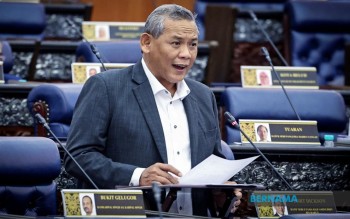
Parliament engaged in a substantive debate on the Tabung Haji investment crisis this week, with Port Dickson Member of Parliament Datuk Seri Aminuddin Harun striking a measured tone that separates legitimate market risk from institutional failure. Speaking during a special sitting focused on the recently released Royal Commission of Inquiry report, Aminuddin contended that any examination of Lembaga Tabung Haji's investment decisions must acknowledge a fundamental reality: that financial markets inherently carry uncertainty, and not every loss signals wrongdoing or breaches of fiduciary duty. His intervention reflects growing recognition within legislative circles that understanding the nature and origin of Tabung Haji's losses—which affected millions of Malaysian pilgrims' savings—requires sophisticated analysis rather than blanket condemnation.
The former Negeri Sembilan menteri besar articulated a critical distinction that will likely shape future policy discussions around the pilgrim fund manager. Market fluctuations, he argued, differ categorically from losses stemming from negligent decision-making, undisclosed conflicts of interest, or systemic governance breakdowns. This nuance matters considerably for Malaysia, where public trust in institutions managing collective savings remains fragile following previous corporate and financial scandals. The RCI's investigation into Tabung Haji's operations between 2014 and 2020 has already uncovered concerning gaps in oversight and accountability, and Aminuddin's comments suggest Parliament is now grappling with how to distinguish genuinely problematic conduct from unavoidable investment volatility—a distinction that affects both public perception and the appropriateness of remedial action.
Aminuddin's remarks came as the RCI report was being examined in detail. The 211-page document, released publicly on July 29, identified significant institutional weaknesses and presented 25 recommendations for improvement. By July 30, Tabung Haji had already implemented three-quarters of these recommendations, suggesting the organisation is attempting swift corrective action. However, the existence of such deficiencies in the first place—particularly around governance structures and decision-making processes—underpins the legitimate concerns that prompted the RCI's establishment in 2021. The fact that Aminuddin felt compelled to emphasise the distinction between market losses and institutional failures indicates lingering public anxiety about Tabung Haji's stewardship.
Central to Aminuddin's intervention was his vigorous critique of the appointment culture surrounding Tabung Haji's leadership. He contended that positions on the organisation's board of directors and senior management should reflect merit-based criteria centring on demonstrable expertise and investment experience. His broader concern—that such positions have historically been distributed as political patronage rather than professional appointments—touches on a persistent challenge in Malaysian governance. The practice of filling important institutional roles with politically connected individuals rather than qualified specialists has contributed to failures across multiple sectors, and the Tabung Haji case represents a particularly consequential example, given the scale of assets involved and the vulnerable population depending on the fund.
Aminuddin's proposed solution involves transforming the culture surrounding such appointments entirely. He envisioned posts within Tabung Haji not as honours to be bestowed on the well-connected but as professional responsibilities demanding rigorous competence. This reframing carries implications beyond a single institution. If successfully implemented at Tabung Haji, it could establish precedent for similar transformations across other government-linked entities managing public assets. The Port Dickson MP explicitly stated that board candidates must possess specific credentials spanning investment acumen, Islamic finance expertise, risk management capabilities, accounting and auditing knowledge, legal understanding, corporate governance familiarity, and knowledge of hajj operations. Such comprehensive screening would substantially elevate appointment standards.
The RCI itself had already recommended that active politicians be prohibited from serving as Tabung Haji's chairman or board members, either in the main entity or its subsidiaries. This recommendation reflects international best practice around governance independence and addresses a structural vulnerability that likely contributed to oversight failures. Aminuddin's proposal to extend this framework further—requiring all candidates to declare conflicts of interest and undergo evaluation against the rigorous criteria he outlined—represents an attempt to fundamentally rebuild institutional integrity. For Malaysian stakeholders concerned about state-owned entities, such measures offer tangible reassurance that governance failures may be addressed systematically.
However, the debate extended beyond Aminuddin's position. Datuk Mohd Isam Mohd Isa, representing Tampin and the Barisan Nasional coalition, raised a different concern that gained parliamentary traction. Mohd Isam called for establishment of a new RCI specifically examining Tabung Haji's management and operations from 2021 to 2025. His intervention highlighted a significant temporal gap: the existing RCI's investigation covered only 2014 to 2020, leaving a five-year window unexamined. This gap assumes particular importance given that major institutional developments affecting Tabung Haji occurred after 2020, beyond the original inquiry's scope. For Malaysian pilgrims and policymakers, this limitation means the full extent of governance issues and investment challenges remains incompletely documented.
Mohd Isam's argument carries substantial weight in light of subsequent developments within the organisation. The period from 2021 onwards witnessed critical restructuring efforts and policy changes that deserve comparable scrutiny to earlier years. The Parliamentary Public Accounts Committee, of which Mohd Isam is a member, represents an alternative investigative avenue he proposed, though establishing a dedicated RCI would provide more focused examination. His suggestion that the PAC take on detailed scrutiny of management and governance issues from 2022 to 2026 reflects recognition that comprehensive accountability requires sustained oversight, not a single historical examination.
The temporal scope debate illuminates a broader challenge facing Malaysian institutional oversight. The original RCI was established in 2021, with members appointed in January 2022, and submitted its report to the Yang di-Pertuan Agong in August 2022. By the time findings became public months later, significant additional organisational history had accumulated. This lag between investigation and public disclosure, combined with the RCI's historical focus, creates accountability gaps that leave subsequent developments inadequately scrutinised. For Malaysian citizens with savings within Tabung Haji, such gaps raise uncomfortable questions about whether visible reforms address all underlying problems or merely those documented in a time-limited inquiry.
The RCI's 25 recommendations and Tabung Haji's swift implementation of 75 per cent of them by late July suggest institutional responsiveness. Yet implementation of recommendations does not necessarily guarantee that governance culture has fundamentally shifted. Aminuddin's emphasis on transforming appointment practices and Mohd Isam's call for extended scrutiny suggest Parliament recognises that procedural reforms, while necessary, may prove insufficient without sustained vigilance and comprehensive investigation of all periods requiring examination. The Tabung Haji situation thus represents a crucial test of Malaysia's capacity to strengthen governance across state-linked institutions.
Moving forward, the parliament's debate reflects a maturing approach to institutional accountability. Rather than accepting either a narrative of wholesale institutional corruption or dismissing all losses as market-inevitable, legislators are attempting sophisticated analysis that distinguishes categories of failure while demanding rigorous standards for future leadership. For Malaysian stakeholders—whether pilgrims whose savings are managed by Tabung Haji, policymakers responsible for oversight, or broader publics concerned about state institutional competence—this parliamentary engagement suggests that systemic reform may proceed despite governance challenges. However, success depends on whether recommendations translate into sustained cultural change and whether investigative gaps are addressed through mechanisms like Mohd Isam's proposed extended inquiry.

