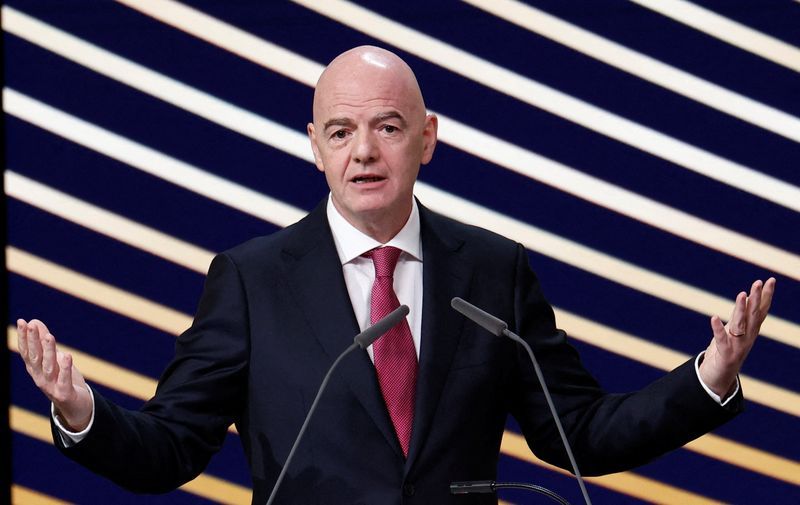
The Oceania Football Confederation has thrown its weight behind FIFA's decision to scrap and review a troubled private investment initiative, marking a departure from the increasingly critical stance adopted by three major continental bodies and, most significantly, fellow regional member New Zealand. The OFC's endorsement represents a rare moment of stability for FIFA leadership, even as the organisation grapples with a widening credibility crisis that threatens the reelection prospects of President Gianni Infantino next year.
Infantino's political fortunes have deteriorated sharply following open revolt from UEFA, the Asian Football Confederation, and CONCACAF—three of FIFA's six continental confederations—which have demanded a comprehensive leadership review and condemned his handling of the FIFA Forward Enterprise scheme. This coordinated challenge represents an unprecedented challenge to Infantino's authority as he prepares for his reelection campaign, signalling deep fractures within international football's governance structure that extend beyond typical regional rivalries.
The Oceania confederation, comprising just 11 full member nations, said at a meeting on Wednesday that it viewed FIFA's management positively and welcomed the decision to withdraw the FFE proposal. In its formal statement, the OFC indicated that the region had experienced tangible benefits from FIFA's strategic direction over the preceding decade and encouraged the global body to use the current review process as an opportunity to implement necessary institutional changes. This backing provides Infantino with crucial support from at least one continental confederation, though the endorsement carries less diplomatic weight given the OFC's modest size and influence within FIFA's hierarchy.
However, New Zealand's repudiation of Infantino represents a more consequential blow. The country is the sole Oceania nation to have qualified for the most recent World Cup, giving it outsized prominence within the confederation and international football. New Zealand Football's withdrawal of support for Infantino's reelection bid signals that even regional allies are fracturing over governance concerns, and the organisation has explicitly demanded an independent investigation into the development and promotion of the FIFA Forward Enterprise scheme.
New Zealand Football articulated its position in stark terms, stating that leadership decisions and actions at FIFA have fundamentally eroded trust among member associations and deepened divisions across the global game. The organisation concluded that restoring confidence in FIFA's governance requires an independent review conducted outside the normal institutional channels—a demand that implicitly questions whether FIFA can credibly investigate itself. This framing transforms the dispute from a disagreement over commercial strategy into a broader indictment of institutional integrity.
The FIFA Forward Enterprise proposal centred on securing private investment for the World Cup and other FIFA competitions, an approach that generated significant controversy. The scheme had dangled substantial financial incentives before member associations, offering a baseline $20 million grant for the next funding cycle with the possibility of doubling that amount if nations endorsed the investment arrangement. These financial inducements, while presented as development opportunities, arguably compromised the independence of member associations' decision-making and created the appearance of coercion.
Following an emergency meeting in Morocco the previous week, FIFA publicly apologised to all 211 member associations for mishandling the proposal and sought to demonstrate organisational unity by affirming that Infantino retained the full confidence of the leadership. This damage-control manoeuvre, however, has proven insufficient to stem the tide of criticism and has failed to convince major confederations or influential member nations that systemic reform is occurring. The apology, while acknowledging procedural failures, did not address the underlying concerns about decision-making processes and accountability that critics have identified.
The bifurcated response from Oceania—with the confederation endorsing FIFA's direction while its most prominent member openly withdraws support—illustrates the complex political dynamics within international football. Member nations must balance immediate financial interests against longer-term governance concerns, and New Zealand's decision to prioritise institutional integrity over regional solidarity suggests that such calculations are shifting in favour of accountability. This development carries significance for Malaysia and other Southeast Asian football nations, as it indicates growing willingness among smaller footballing nations to challenge FIFA leadership when governance standards are perceived to have declined.
The timing of these disputes carries particular importance as Infantino enters a critical phase of his tenure. The convergence of challenges from UEFA, Asian football authorities, CONCACAF, and now individual member nations creates an unusually vulnerable political position for an incumbent FIFA president seeking reelection. While previous FIFA leaders have faced isolated criticism, the current situation reflects systematic questioning of Infantino's judgment and administrative competence across multiple regions simultaneously.
For Malaysian readers and football administrators across Southeast Asia, these developments underscore ongoing tensions between commercial modernisation and institutional accountability within FIFA's governance structure. The outcome of the planned review and Infantino's electoral prospects will shape how FIFA engages with member associations over the coming years, influencing everything from development funding allocations to tournament hosting decisions that could directly affect regional football programmes. The signals emerging from Oceania suggest that FIFA's smaller and medium-sized member nations are increasingly willing to demand transparency and proper process, potentially constraining the autonomy that executive leadership has historically enjoyed in major strategic decisions.

