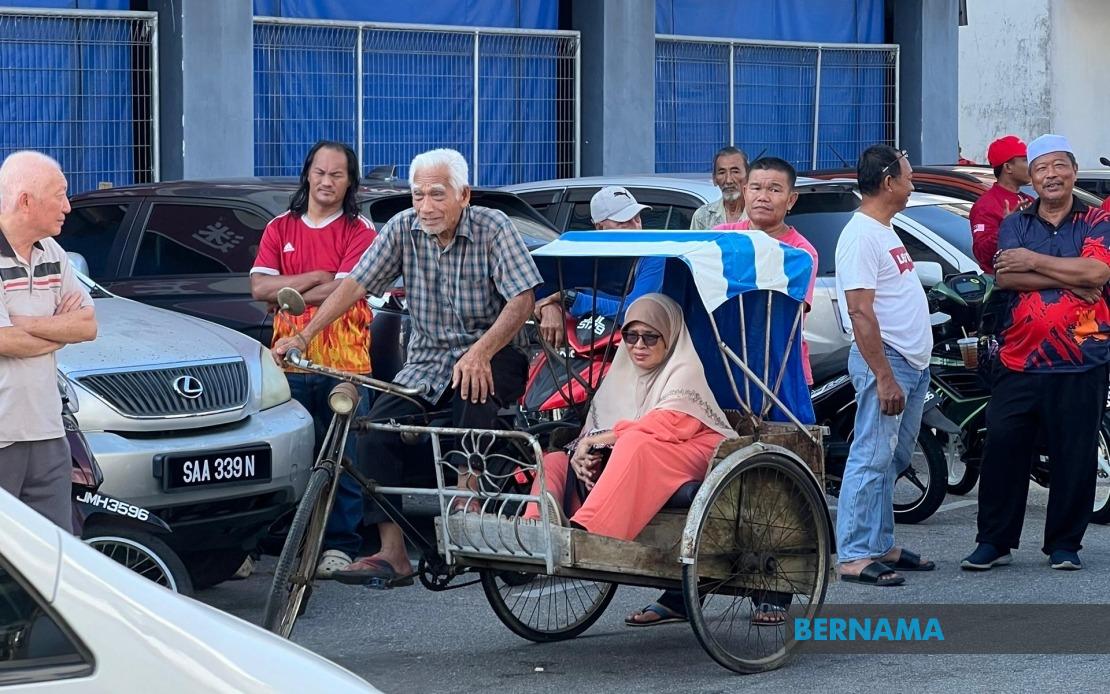
Abdul Razak Pelangga, who serves as imam of Masjid Raudhatul Jannah Parit Bugis in Batu Pahat, set out on an unusual mission last week as temperatures soared across Johor. The 86-year-old man mounted his trishaw and pedalled nearly a kilometre through the oppressive midday heat, determined to transport his wife Jamilah Samsudin to a local coffee shop where Prime Minister Datuk Seri Anwar Ibrahim was scheduled to stop during a breakfast engagement. What began as a simple logistical challenge—finding transport to the Kedai Kopi Hailam Sri Medan in Senggarang—evolved into a touching demonstration of dedication and the enduring appeal of Malaysia's political leadership among ordinary citizens.
The decision to use a trishaw rather than a motorised vehicle reflected both practicality and principle. Abdul Razak explained that while he possessed access to a car or motorcycle, the congestion expected around the Prime Minister's visit made the prospect of securing parking unappealing. Instead, he chose the pedal-powered transport that has characterised Malaysian town life for generations. The choice inadvertently transformed what might have been an unremarkable journey into a symbolic gesture—an elderly religious leader exerting himself physically to honour both his own aspirations and those of his spouse, navigating the modern chaos of state visits by reverting to a slower, more deliberate mode of travel.
Abdul Razak's connection to Anwar Ibrahim stretched back across years of political transformation. He recalled a previous encounter at his mosque, before the Prime Minister had ascended to high office, when Anwar had visited to participate in congregational prayers. That moment of handshake and shared greeting had impressed itself so deeply on Abdul Razak's memory that he spoke of it frequently to Jamilah. The announcement of the Prime Minister's imminent visit to Batu Pahat therefore carried special weight for the household. For Jamilah, the opportunity to see the man her husband had spoken about represented a chance to connect with a moment that clearly mattered to him. For Abdul Razak himself, it represented a full-circle opportunity—the chance to bring his wife into a space of significance in his own life.
The breakfast event that drew Abdul Razak and his wife formed part of the wider PMX Meet-and-Greet Programme, a series of community engagements centred on the Senggarang state constituency. The Prime Minister spent approximately fifty minutes at the coffee shop, engaging in informal conversations with local residents and sampling the refreshments. Pakatan Harapan Communications Director Datuk Fahmi Fadzil, who also holds the portfolio of Communications Minister, attended the occasion. Such events have become standard practice in modern Malaysian electoral cycles, presenting political leaders in accessible, neighbourhood contexts rather than formal state settings. The format aims to humanise leadership and create moments of perceived equality between those who govern and those who elect them.
Despite the sizeable crowd that accumulated around the Prime Minister—inevitable given the ceremonial nature of such visits and the natural curiosity of residents—Abdul Razak and Jamilah found themselves unable to achieve the face-to-face encounter they might have hoped for. Yet the experience satisfied their fundamental objective. Being in proximity to the Prime Minister, observing him across the heads and shoulders of other well-wishers, and witnessing him in person rather than exclusively through the mediated distance of television screens represented achievement enough. What mattered most was the shared accomplishment, the memory created, and the tangible reality of the moment replacing years of abstract viewing. For a couple in their senior years, such immediate experience held a value that transcended conventional political calculation.
Abdul Razak's enthusiasm extended beyond his role as an observer of political leadership. He articulated genuine excitement about his forthcoming contribution to the electoral process itself. The Johor state election, scheduled for July 11, would coincide with his eighty-seventh birthday—a convergence of personal and civic significance that he found deeply meaningful. While he had exercised the franchise on numerous previous occasions, he characterised this particular vote as specially resonant because it fell on a day of personal milestone. For many Malaysians, voting remains principally a civic obligation, discharged with variable enthusiasm. Abdul Razak's perspective suggests an alternative relationship with democratic participation, viewing it not merely as duty but as privilege, especially when circumstance aligned it with personal commemoration.
The Johor state election itself represented a significant electoral moment in the Malaysian political calendar. The seventh of July had been designated for early voting, allowing those with compelling reasons to cast ballots in advance. The main polling would occur four days later across the state. Senggarang constituency, which encompassed the Batu Pahat area, constituted one of numerous electoral divisions competing for attention during this campaign period. The significance of Anwar Ibrahim's personal engagement in such constituency-level appearances underscored the competitive nature of state elections in Malaysia, where even the highest-ranking federal officials participate in grassroots campaigning.
The story of Abdul Razak and his trishaw journey illuminates broader patterns in Malaysian political culture. Despite occasional cynicism about political leadership and governance, many citizens retain genuine emotional investment in their leaders' work and public appearances. The willingness to expend physical effort—pedalling through intense heat—to witness a political figure suggests that the relationship between leaders and led in Malaysia remains characterised by elements of reverence and personal connection. This dynamic differs markedly from the more detached, institutional relationships with leadership that characterise some democracies, and reflects cultural traditions that vest political figures with significance beyond their formal roles.
The incident also reflects the status of older citizens within Malaysian society. Abdul Razak, identified both by his age and his formal role as a religious leader, remains an active participant in community life and political engagement. His story was deemed newsworthy—captured by national news agency Bernama and circulated across the country—precisely because it exemplified the kind of citizenship and intergenerational partnership that political figures and media institutions celebrate. Rather than retreating from public life, Abdul Razak and Jamilah demonstrated continued engagement with the mechanisms of national governance and the personalities who direct them. For a country where demographic ageing presents both challenges and opportunities, such examples carry subtle but real significance.
The trishaw itself carries historical weight within the Malaysian context. These three-wheeled vehicles, once ubiquitous for both cargo and passenger transport, have gradually ceded ground to motorcycles and automobiles. By choosing this mode of transport, Abdul Razak was, perhaps unknowingly, making a statement about the continuities that persist within rapid modernisation. The coffee shop where the Prime Minister stopped similarly represented continuity—these establishments remain spaces of community gathering and informal commerce despite the proliferation of shopping malls and franchised establishments. Abdul Razak's journey thus moved through a Malaysia of multiple temporal layers, using older infrastructure to access a contemporary political moment.
The framing of this encounter around a wedding anniversary celebration—Jamilah's wish to see the Prime Minister—added emotional dimensionality to what might otherwise have been a simple political engagement. It transformed the event from a one-directional observation of leadership into a mutual moment within domestic partnership. Abdul Razak's determination to fulfil his wife's aspiration, and his physical capability to accomplish this despite advanced age and climatic hardship, offered an implicit commentary on marital commitment and continuing vitality in later life. Malaysian society, like most societies, contains complex attitudes toward ageing. Stories like this one, which present elderly citizens as physically active, emotionally engaged, and capable of meaningful contribution, subtly shape broader cultural conversations about the place of older people in national life.
The broader Johor electoral context provided the immediate backdrop for this encounter, but the significance of Abdul Razak's journey extended beyond partisan political calculation. It spoke to something more fundamental about citizenship, aspiration, and the role of proximity—physical nearness to those who wield power—within democratic experience. For many Malaysians, democratic participation encompasses not merely the casting of votes but the seeking of moments of direct or near-direct contact with leadership. These encounters, whether brief and mediated by crowds or achieved only from a distance, carry psychological weight that formal institutional structures do not fully explain. In this light, Abdul Razak's determination to pedal his trishaw becomes not merely a quaint anecdote but an expression of how ordinary Malaysians understand their relationship to political authority and national governance.

