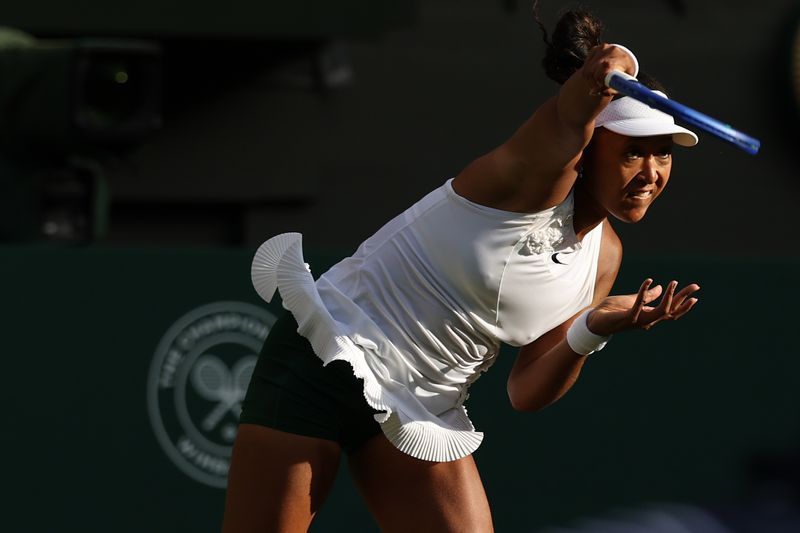
Naomi Osaka's Wimbledon campaign has been a study in contrasts—she arrived at the All England Club in a striking Kill Bill-inspired kimono walk-on outfit, but departed the court having dismantled top seed Aryna Sabalenka with ruthless precision. The 14th-seeded Japanese star claimed a dominant 6-2 7-6(2) victory to advance to her first Wimbledon quarter-final, demonstrating the sharp, aggressive tennis that carried her to four Grand Slam championships in earlier years. The result marked a watershed moment in a tournament already marked by upsets, adding significantly to the disruption that has characterised the women's draw across the early rounds.
Osaka's demolition of Sabalenka compounds the remarkable exodus of established champions from these championships. The defending champion Iga Swiatek and 2022 winner Elena Rybakina both departed in the third round, meaning the three top-seeded competitors have now been eliminated entirely. When Barbora Krejcikova, the Czech player seeded fourth, fell to fellow countryman Karolina Muchova in the fourth round, the writing became clear: a first-time Wimbledon champion will be crowned for the ninth consecutive year, a streak that underscores the tournament's unpredictability and the evolving competitive landscape of women's tennis at the majors.
The clash between Osaka and Sabalenka held particular narrative weight. These two competitors, both 28 years old and each possessing four Grand Slam titles to their names, had contested their most meaningful encounter eight years earlier when Osaka defeated Sabalenka en route to winning the 2018 U.S. Open. When their paths crossed again this season after a lengthy absence from each other's schedules, the momentum had swung decisively toward the Russian, who secured three victories against the Japanese player in rapid succession. However, Centre Court witnessed a complete reversal of fortune on this occasion, as Osaka, serene and purposeful throughout the match, unleashed a masterclass in controlled power and precision that left Sabalenka visibly frustrated.
What could have materialised as a display of fireworks between two hard-court specialists instead became a exhibition of Osaka's superiority. Against an off-colour Sabalenka, the Japanese player never relented, claiming her most significant victory since returning to competitive tennis following maternity leave in 2024. The performance suggested that Osaka's quality remains fundamentally intact, even as she navigates the logistical and psychological complexities of balancing professional sport with motherhood. Her evident delight reflected the magnitude of the achievement; the string of recent losses to Sabalenka had clearly weighed upon her, and reversing that record at a Grand Slam venue carries outsized psychological value.
Osaka's path forward will test her against Karolina Muchova, the 10th seed who recently dispatched Barbora Krejcikova, the 2024 Wimbledon champion, in a tightly contested 7-5 5-7 6-3 encounter. That match itself demonstrated the competitive calibre on display across the women's draw—both competitors unleashed skilled attacking tennis while defending tenaciously when pressed, producing the kind of quality that befits a quarter-final setting. Muchova's victory over Krejcikova, coupled with her progression past a formidable opponent, suggests that Osaka's next assignment will demand sustained excellence rather than capitalising on momentary lapses from her opponent.
While Osaka's trajectory has captured significant attention, the men's side continued to be shaped by Novak Djokovic's methodical advance toward a record-equalling eighth Wimbledon title. The 39-year-old Serbian, however, provided unusually candid commentary about his fourth-round encounter against Russian qualifier Roman Safiullin, admitting that neither satisfaction nor enjoyment accompanied his 7-6(6) 6-3 3-6 6-3 victory. This frank assessment from a competitor normally reserved in his public remarks indicated that the match itself failed to meet the standards he typically demands of his own performance, even as the outcome proved positive.
Despite his apparent discomfort throughout the contest, Djokovic achieved a milestone that further cements his status among tennis's greatest players: his victory marked his 106th match win at Wimbledon, surpassing the long-standing record held by Roger Federer, the legendary Swiss champion who defined men's grass-court tennis for over a decade. Reaching his 17th Wimbledon quarter-final, Djokovic now stands one victory removed from a potential semi-final confrontation with defending champion Jannik Sinner, the Italian prodigy whose emergence has symbolised the generational shift occurring in men's tennis. To engineer such a meeting, Djokovic must first overcome Canadian third seed Felix Auger-Aliassime, presenting a matchup between experience and youth.
Auger-Aliassime's passage to the quarter-finals came at considerable physical cost. The Canadian needed four hours and 26 minutes to outlast Spain's final remaining representative, Alejandro Davidovich Fokina, in an attritional 6-7(4) 7-6(6) 6-3 6-7(2) 6-1 contest that concluded with a heated verbal exchange at the net. Such marathons exact a toll that extends beyond the immediate fatigue; the emotional intensity and physical depletion that accompany extended baseline battles can influence a competitor's capacity to recover and perform at peak levels in subsequent matches. Whether Auger-Aliassime can maintain sufficient energy and focus to challenge Djokovic remains an open question.
The men's draw experienced its own measure of dramatic departure when Polish competitor Hubert Hurkacz was forced to retire during the fifth set of his clash against German veteran Jan-Lennard Struff. At 36 years old, Struff achieved a significant personal milestone in reaching his first Grand Slam quarter-final, a testament to the physical longevity and tactical evolution that extended professional tennis careers have come to require. Hurkacz's retirement, though disappointing given his previous performances at major championships, reflects the gruelling nature of five-set tennis over consecutive days, where accumulated fatigue and minor physical issues can compound into obstacles too significant to overcome.
The American contingent has emerged as an unexpected beneficiary of the tournament's unsettled nature. Five American women have secured places in the last 16, representing the strongest collective showing by the nation since 2002, a gap of more than two decades. Jessica Pegula, the fourth seed, demonstrated why experience and match management remain valuable commodities in professional tennis when she decisively handled 18-year-old Iva Jovic with a 4-6 6-3 6-1 victory on Court One. Pegula's win has matched her best previous Wimbledon result, and depending on the outcome of Coco Gauff's fourth-round match against Belinda Bencic, the possibility exists for an all-American quarter-final pairing. Such an occurrence would further underscore the shifting global dynamics within women's professional tennis, where the traditional powerhouses face sustained challenges from emerging and re-emerging competitors.
For Malaysian and Southeast Asian observers, the tournament's trajectory carries particular resonance given the region's growing investment in tennis development and the aspirations of emerging players to break through at the sport's highest levels. The success of relatively younger or previously overlooked competitors in breaking the stranglehold of established champions provides inspiration for the next generation of regional players. Simultaneously, the physical and mental challenges evident in these matches—from Djokovic's uncomfortable progression to Hurkacz's retirement—illustrate the unforgiving standards required to compete successfully at Grand Slam level, tempering optimistic expectations with realistic assessment of the demands involved.
As the tournament enters its quarter-final stage, the women's draw presents a genuinely open contest with Osaka's demonstrated form and Muchova's recent triumph over a champion offering pathways for players outside the traditional elite. The men's side, by contrast, remains anchored by Djokovic's presence and the emerging challenge from Sinner, though Auger-Aliassime's opportunity to upset conventional expectations should not be discounted. The remaining fortnight promises continued drama, as competitors navigate the physical and mental gauntlet that distinguishes champions from merely talented players.

