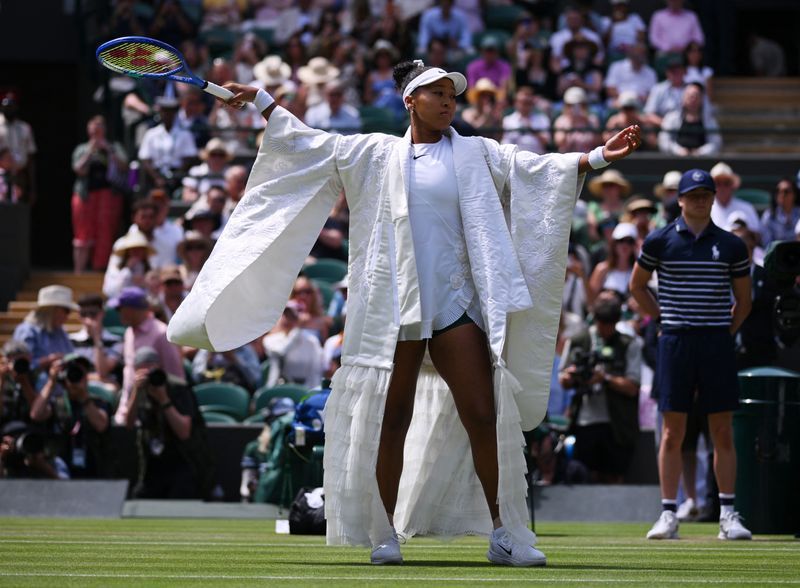
Naomi Osaka has arrived at Wimbledon with a message that extends far beyond the baseline. The Japanese champion's journey through the tournament's opening week has been marked by an intriguing duality: she arrives at each match draped in meticulously curated ensembles that signal her status as one of tennis's most influential style ambassadors, yet increasingly it is the precision and power of her game that commands attention. On Friday, she underscored this evolution by eliminating unseeded Australian Daria Kasatkina 6-1 6-3 on Court One, advancing to the fourth round for the first time and cementing her credentials as a genuine contender at the All England Club.
Osaka's reputation for sartorial innovation precedes her onto the grass courts of southwest London. The 14th seed has turned her pre-match ritual into high theatre, this time donning a flower-patterned kimono in her characteristic "Kill Bill" style—a design concept she has deployed throughout the fortnight to draw the eye and shape conversation off the court. Yet what has become increasingly evident is that Osaka refuses to allow costume to overshadow craft. As a four-time Grand Slam winner, she possesses the technical arsenal and mental fortitude required to compete at the highest level, and her performance against Kasatkina demonstrated a deliberate integration of flair and substance that speaks to her maturation as a competitor.
The opening set revealed the dimensions of Osaka's advantage. Breaking Kasatkina early with a crisp backhand winner, she consolidated her position through a succession of deep forehands struck with the kind of precision that characterizes champions accustomed to operating on the sport's grandest stages. The sun-soaked conditions on Court One appeared to energize rather than distract her, and she raced through the set 6-1 in dominant fashion. The Russian-born Kasatkina, despite her unseeded status, carried tournament pedigree, yet found herself unable to mount meaningful resistance against an opponent operating at peak efficiency.
The second set proved marginally more competitive, though Osaka's fundamental superiority ensured the outcome never genuinely hung in doubt. She squandered an early advantage, allowing Kasatkina momentary encouragement, but responded with characteristic resolve. Having navigated a pattern of near-misses, Osaka elevated her intensity at crucial junctures, raising two match points before ultimately sealing victory with the kind of flourish befitting a competitor of her calibre. This capacity to recover from minor setbacks and finish convincingly speaks to the mental resilience that has anchored her multiple Grand Slam campaigns.
Osaka's Wimbledon narrative carries particular significance for regional audiences across Southeast Asia. Her emergence as a major force in professional tennis, combined with her willingness to embrace non-traditional expressions of identity through fashion and activism, has redefined what elite female athletes in Asia can project. Her presence at Wimbledon represents not merely a Japanese athlete competing at the highest level, but a figure reshaping conversations around representation, style, and feminine power in sport. For Malaysian and regional sporting audiences, her trajectory offers a compelling counter-narrative to conventional expectations around athlete comportment and aesthetic expression.
The path to the fourth round becomes progressively more demanding, and Osaka's next opponent emerges from a contest between world number one Aryna Sabalenka and former French Open champion Jelena Ostapenko. This positioning places Osaka directly in the upper echelon of competition, a placement that reflects both the strength of her current form and her career trajectory as a perennial Grand Slam contender. A quarter-final berth remains attainable, contingent upon her maintaining the balance of aggressive striking and tactical discipline she demonstrated against Kasatkina.
Osaka's comments following victory carried characteristic humility tempered with competitive awareness. She noted that her previous inability to record success on Court One had been rectified, and expressed gratitude for the crowd's support—a nod to the increasingly vocal enthusiasm that surrounds her presence at major tournaments. Her comment about feeling confident after extended grass court competition in the preceding weeks speaks to the importance of surface-specific preparation in modern professional tennis. The Bad Homburg tournament, though truncated by injury, had nonetheless provided crucial match practice on grass, a surface where technique and timing demand particular precision.
The implications of Osaka's progression resonate through the broader Wimbledon narrative. Her emergence as a genuine threat in the second week challenges pre-tournament assumptions about which players would shape the tournament's outcome. The grass court's historical reputation as an unpredictable equalizer has been complicated by modern racket technology and training methodologies, yet Osaka's success suggests that the surface remains receptive to players who combine technical sophistication with the mental acuity to navigate its particular demands. Her stylistic flourishes, far from distracting from her tennis, appear to form an integrated part of her competitive psychology—a means through which she asserts dominance and shapes narrative around herself.
As Osaka progresses deeper into the tournament, Malaysian and Southeast Asian audiences will likely follow her trajectory with particular interest. Her status as a global figure who has transcended the traditional boundaries of sports celebrity creates a constituency that extends well beyond dedicated tennis followers. Whether she ultimately captures her first Wimbledon title or falls short, her presence in the latter stages of a major championship tournament represents a continuation of the impact she has exerted on professional tennis since her breakthrough years. The synthesis of confidence, power, and carefully cultivated personal expression that she brings to the court suggests that her remaining matches at the All England Club will merit close attention from those seeking to understand how contemporary elite athletes navigate the intersection of sport, fashion, and identity in the digital age.

