Since its launch in April 2026, Singapore's SG Partnerships Fund has become a significant catalyst for community-led innovation, drawing applications from more than 200 grassroots organisations and individuals seeking to address social needs. The S$50 million scheme, announced by Prime Minister Lawrence Wong during February's Budget speech, represents a strategic pivot toward empowering Singaporeans to develop their own solutions rather than relying solely on top-down government programmes. The fund's tiered structure reflects a recognition that social change operates at multiple scales, from intimate neighbourhood interventions to sector-wide transformations.
The funding framework comprises four distinct categories, each targeting different stages of organisational maturity and ambition. At the foundation sits the seed tier, offering grants of up to S$5,000 to individuals, grassroots groups, and newly registered organisations piloting community ideas. Above this sits the sprout tier, which allocates up to S$50,000 to established organisations pursuing sector-wide impact. The newly launched scale tier, unveiled in July 2026, provides grants reaching S$1 million for mature organisations aiming to transform entire sectors. This graduated approach acknowledges that meaningful community work rarely begins with major funding; instead, it often germinates from small, experimental initiatives that prove their value before expanding. The diversity of funding levels has ensured broad accessibility, with entry-level projects able to participate without years of track record.
Data from the Singapore Government Partnerships Office reveals that the seed tier has proven overwhelmingly popular with applicants, despite offering the smallest financial support. SGPO director Hasliza Ahmad attributes this pattern to the fund's intentional design philosophy, which encourages citizens to initiate action without requiring large-scale ambitions from the outset. This phenomenon has significant implications for how communities function: it validates the notion that transformative social work need not always demand substantial capital, and that many meaningful interventions emerge from committed individuals willing to start modestly. For Malaysian readers observing similar community challenges around mental health, youth engagement, and social inclusion, Singapore's experience suggests that accessible micro-funding can unlock substantial civic participation.
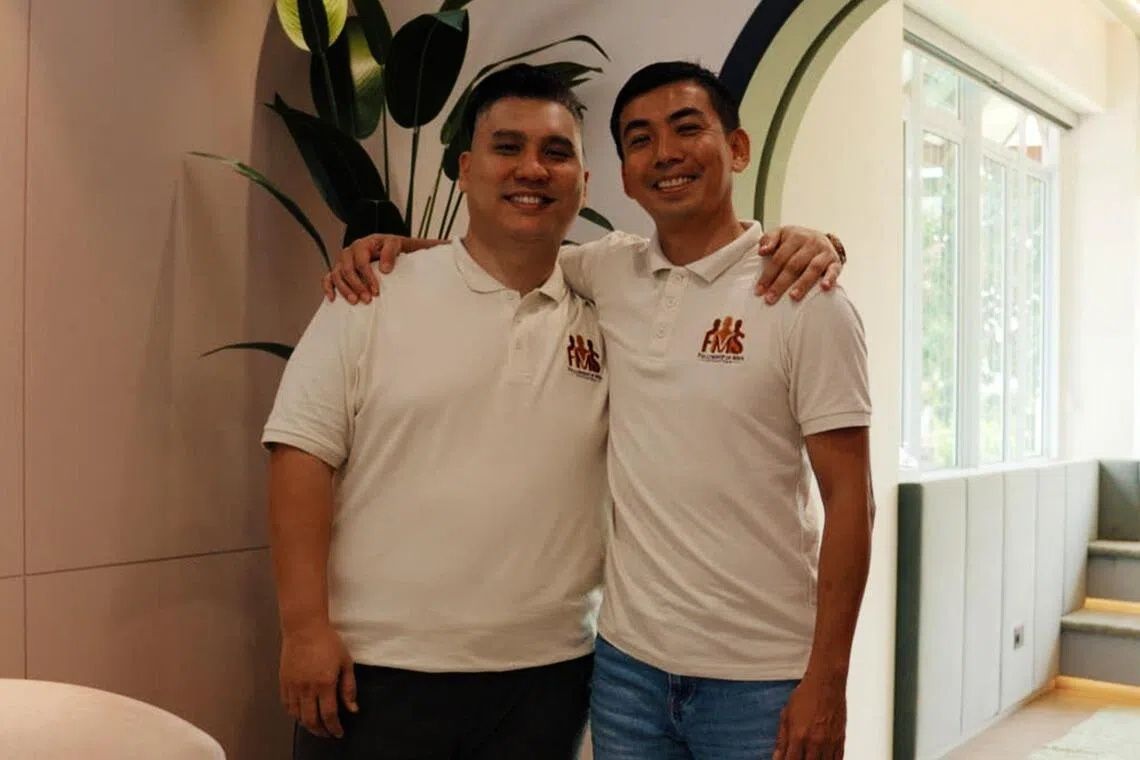
Fellowship for Movement Singapore exemplifies how modest seed funding catalyses meaningful social intervention. Founded in January 2026 by Ben Ang, a former family service centre director, and Ismail Didih Ibrahim, a volunteer educator, the non-profit addresses a critical yet often-neglected demographic: men struggling with violence and aggression. Rather than pursuing crisis management after problems escalate, the organisation's founders recognised that prevention and early intervention demand a different approach. Ang and Didih deliberately transitioned away from secure employment to dedicate themselves fully to this initiative, demonstrating the personal conviction that animates many grassroots projects. Their conviction rested on a fundamental insight that professional mental health support, while valuable, sometimes fails to reach individuals who fear stigma or lack comfort with therapeutic settings.
The organisation's programming strategy reflects sophisticated understanding of how men engage with emotional development. Fellowship for Movement combines community engagement, mentoring, and guided group work that weaves together practical activities with structured conversations. Rather than framing emotional growth as a clinical process, the initiative creates relatable entry points where men can explore masculinity, relationships, self-care, and help-seeking through contextual, lived experiences. This approach directly challenges traditional notions of male stoicism that persist across Southeast Asian societies, where emotional expression remains culturally coded as weakness. By redefining what healthy manhood encompasses—moving beyond provider and protector archetypes to embrace vulnerability and emotional literacy—the programme offers cultural recalibration at the community level.
With their S$5,000 seed grant, Ang and Didih conducted a three-hour engagement session at a professional kitchen in Geylang, bringing together 24 men alongside their wives and children. The session cleverly leveraged cooking as a non-threatening vehicle for discussing sensitive topics including self-care, masculinity, relationships, and help-seeking behaviours. Without the grant, this intervention would have relied on Ang's home kitchen and been entirely self-funded, severely limiting its reach and professionalism. The structured environment and professional facilities enabled a quality experience that participants could not have received in domestic settings. This practical outcome illustrates the genuine multiplier effect of modest funding: it transforms ambitious ideas into tangible community experiences while preserving the grassroots authenticity that makes them effective.
Little Wishes represents another compelling application of seed funding to address social inequality at the intersection of childhood welfare and civic participation. Loke Wai Yee, a 21-year-old LASALLE College of the Arts student, observed during Singapore's annual angel tree season that existing charity infrastructure excluded many potential donors and beneficiaries. The programme's physical concentration in select shopping malls, combined with expectations that donors purchase expensive gifts, created barriers to participation from younger and lower-income givers. Rather than accepting these constraints as inevitable, Loke mobilised 12 peers to build Little Wishes, an online platform democratising access to gift-giving to disadvantaged children. The platform enables donors to select gifts within their budget parameters while algorithms match contributions to child beneficiaries, removing friction from the transaction.
The S$5,000 seed grant proved transformative for Little Wishes' capacity development. The team had initially planned to construct their website independently, a technically demanding task that would have consumed extensive volunteer time while potentially compromising user experience. Professional web development support, funded through the grant, elevated the platform's quality and functionality substantially. When the platform launches in August, users will encounter a professionally designed interface rather than an amateur implementation, directly improving donation completion rates and user satisfaction. For a youth-led initiative, this injection of professional expertise represents more than financial convenience; it legitimises the project within digital ecosystems where poorly executed platforms lose credibility rapidly. The expansion trajectory targets 80 beneficiaries in the initial phase, demonstrating how modest seed funding can scale impact measurably.
Beyond direct financial transfers, the Singapore Government Partnerships Office provides recipients with ecosystem support that amplifies grant value substantially. For Little Wishes, this encompassed connection to social service agencies, information about complementary funding sources, and ongoing guidance and mentorship. Loke characterised this multifaceted support as the SGPO "journeying" alongside recipients to translate passion into sustainable impact. This ecosystemic approach recognises that funding represents only one dimension of community initiative success; equally critical are networks, knowledge, legitimacy, and expert counsel. For nascent organisations, access to these intangible assets often determines whether projects flourish or stall. The intentional infrastructure supporting grantees suggests sophisticated understanding of grassroots capacity constraints, something Southeast Asian governments frequently overlook when disbursing community funds.
The SG Partnerships Fund's architecture contains important lessons for Malaysia and other regional economies contemplating community funding models. The tiered structure acknowledges that not all community work should be scaled simultaneously; some initiatives require protected space to experiment and learn before expanding. The emphasis on accessibility, particularly through low-barrier seed funding, democratises community leadership by removing preconditions that often exclude younger people, lower-income residents, and those without extensive organisational experience. The provision of non-financial support signals recognition that communities need infrastructure, not just capital, to flourish. For Malaysian policymakers considering how to strengthen civil society engagement around issues including mental health, social inclusion, and youth development, Singapore's approach offers a practical blueprint for channelling state resources toward distributed community problem-solving.
The response to the SG Partnerships Fund—with over 200 applications across multiple tiers—validates pent-up demand for accessible mechanisms enabling community participation in social problem-solving. This enthusiasm suggests that citizens possess substantial unrealised capacity to address local challenges when structural barriers diminish. Ang and Didih's journey from family service centre employees to non-profit founders, combined with Loke's transition from concerned student to platform architect, illustrates how funding accessibility converts individual concern into organised action. These trajectories, replicated across 200 applications, represent aggregated community energy previously dispersed or suppressed. For Southeast Asian societies navigating persistent social challenges with constrained government resources, this decentralised approach to community leadership offers potential pathways toward more resilient, locally-responsive solutions while simultaneously strengthening civic participation and social trust.

